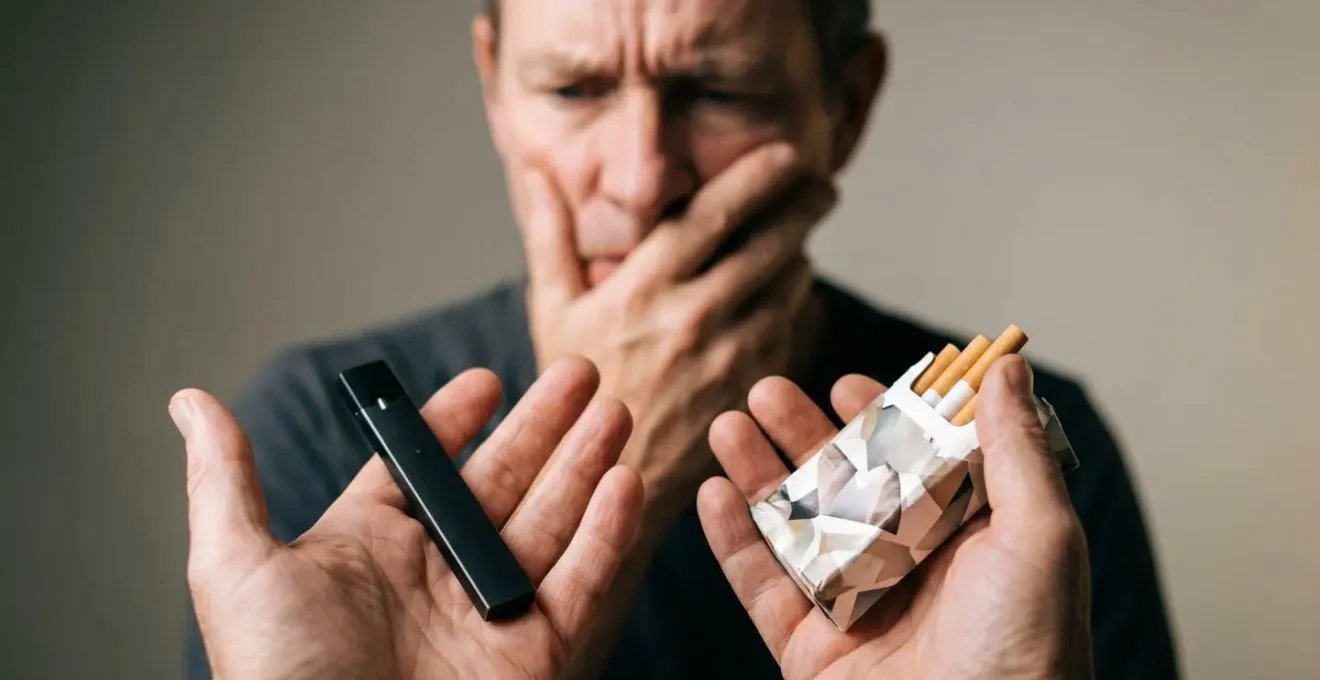
Success in vaping isn’t about features or flavours; it’s about precisely matching a device’s nicotine delivery to your unique smoking habit.
- Most beginner failure stems from a “satisfaction gap”—where a weak or complex vape fails to curb cravings effectively, pushing you back to cigarettes.
- Modern pod systems using nicotine salts are specifically engineered to close this gap by delivering nicotine more like a cigarette, but without the harmful smoke.
Recommendation: Before buying, identify your true smoker profile. A heavy, ‘first-thing-in-the-morning’ smoker needs a different starting strength and device than a ‘social-only’ smoker to guarantee success.
You’re standing in front of a wall of sleek, colourful devices, or scrolling through endless online pages. The goal is simple: quit smoking. But the path is confusing. You’ve been told to “just pick a simple starter kit,” but what does that even mean? You’re worried about getting it wrong, wasting money, and—worst of all—ending up with a cigarette in your hand a week later, feeling like a failure.
This feeling of being overwhelmed is the first hurdle, and it’s where most quit attempts stumble. The common advice to “start cheap” or “pick any pod system” ignores the most critical factor for success: the psychological and physiological battle against nicotine cravings. Your brain isn’t looking for a new hobby; it’s looking for a specific, rapid dose of nicotine it has become dependent on. Most beginner kits fail because they don’t deliver it correctly.
But what if the key wasn’t about finding the ‘best’ kit, but about understanding your personal craving pattern and choosing a tool designed to match it? This guide moves beyond generic advice. We will dismantle the common myths and traps that lead to failure. We will focus on one thing: helping you choose a first vape that actually satisfies your cravings, making the switch from smoking not just possible, but surprisingly straightforward.
This article breaks down the essential decisions you need to make, from the type of system to the exact nicotine strength, ensuring your first step into vaping is a confident and successful one. Explore the sections below to build your personalised quit plan.
Summary: Why Most First Vapes Fail: How to Choose the Right Kit to Finally Quit Smoking
- Why Simple Kits With Fewer Settings Have Higher Quit-Smoking Success Rates?
- Closed or Open System: Which Starter Kit Type Keeps Beginners From Giving Up?
- How to Match Your Starter Kit With the Right Nicotine Strength for Your Habit?
- The £10 Starter Kit Trap That Sends 70% of Buyers Back to Cigarettes
- What to Expect in Your First 7 Days With a Vape: A Day-by-Day Reality Check?
- Why Did Your First E-Cigarette Fail but Modern Pods Actually Satisfy Cravings?
- How to Choose Between 10mg and 20mg Nic Salts as a 10-a-Day Smoker?
- Why Modern Pod Systems Outperform Cigarettes for 78% of UK Switchers?
Why Simple Kits With Fewer Settings Have Higher Quit-Smoking Success Rates?
When you’re trying to quit smoking, your brain is already working overtime to manage withdrawal and break a long-standing habit. The last thing you need is more complexity. This is why advanced vape kits with multiple buttons, adjustable wattage, and airflow controls often lead to failure for beginners. They introduce a high cognitive load—too many new things to learn and manage—at a time when your willpower is already strained. If the device is confusing to fill, prone to leaking because of user error, or delivers a harsh hit because the settings are wrong, it creates frustration. That frustration is a direct path back to the simple, reliable (and deadly) cigarette.
Simplicity, therefore, isn’t about a lack of technology; it’s about technology that works for you without demanding your constant attention. A simple pod kit that you just fill and puff on removes the variables. It provides a consistent, reliable experience every time, which is crucial for building a new, smoke-free routine. The goal is to replace one habit with another, and habits are built on repetition and predictability, not on constant tinkering and problem-solving.
This isn’t just theory. As a research team noted in a study on vape shop consumers, higher success rates are directly linked to effective devices. They observed, “Not surprisingly, much higher success rates have been reported in clinical trials with refillable penlike e-cigs, with an overall quit rate of 36% at 6 months.” These devices are effective precisely because they balance simplicity with performance, a stark contrast to the often-overwhelming complexity of advanced mods.
Closed or Open System: Which Starter Kit Type Keeps Beginners From Giving Up?
Once you’ve embraced simplicity, the next choice is between a “closed” or “open” pod system. A closed system uses pre-filled pods that you click into place and dispose of when empty. An open system has a pod that you manually refill with e-liquid from a bottle. For a beginner, this choice is about balancing convenience against long-term cost and variety. While open systems are more economical and offer a wider range of flavours, they also introduce steps where things can go wrong: messy refilling, choosing the wrong liquid, and needing to replace coils.
For the first few weeks, a closed system is often the superior choice for preventing relapse. It offers the ultimate in convenience and removes nearly all potential for user error. There’s no refilling, no coil-changing, and no settings to adjust. You simply pop in a pod and vape. This level of hassle-free operation is critical when you’re most vulnerable to craving a cigarette. The goal is to make vaping significantly easier and more pleasant than smoking. A prospective study on smokers switching to personal vaporizers backs this up, finding that 36% achieved smoking abstinence at 24 weeks using simple, effective second-generation devices. These results were significantly higher than those seen with older, less user-friendly models.
The visual difference between these two approaches is stark. One path is about minimalism and focus, while the other is about customisation and complexity.
As the image illustrates, the closed system on the left removes all the clutter. For someone just starting, this visual simplicity translates directly into mental simplicity. You can always move to an open system later, once vaping has become your new normal. But to start, prioritising convenience is a powerful strategy for staying smoke-free.
How to Match Your Starter Kit With the Right Nicotine Strength for Your Habit?
This is the single most important decision you will make. Choosing the wrong nicotine strength is the primary reason for the “satisfaction gap”—that feeling where a vape just doesn’t “hit the spot” like a cigarette. Many beginners mistakenly believe they should start with a low strength (like 3mg or 6mg) to wean themselves off nicotine immediately. This is a recipe for failure, especially for moderate to heavy smokers. Your body is accustomed to a certain level of nicotine, and if your vape doesn’t provide it, you will experience intense cravings and withdrawal symptoms, making a return to smoking almost inevitable.
The key is to match, or even slightly exceed, the satisfaction you get from a cigarette, particularly in the first few weeks. Modern e-liquids called nicotine salts are a game-changer here. They are formulated to be absorbed into the bloodstream more quickly and smoothly than older “freebase” nicotine, mimicking the rapid spike from a cigarette. Research confirms that nic salts have a 30-40% faster absorption rate than freebase nicotine, which directly translates to faster craving relief. For most smokers, starting with 10mg or 20mg nicotine salts is the right call.
But how do you know which is right for you? It’s less about the number of cigarettes you smoke and more about your craving pattern. A person who smokes 10 cigarettes spread evenly throughout the day has a different dependency from someone who also smokes 10 but has their first one within five minutes of waking up. The latter has a much higher dependency and needs a stronger, faster-acting nicotine level to succeed.
Your Action Plan: Find Your Smoker Archetype
- The Heavy Smoker (20+ cigarettes/day): You need immediate and strong satisfaction. Start with 18-20mg nicotine salts to replicate the powerful nicotine spike you’re used to.
- The Moderate Smoker (10-15/day): Your first cigarette of the day is the key indicator. If you have it within 30 minutes of waking, start with 20mg. If you can wait an hour or more, begin with 10-12mg nicotine salts and see if it satisfies your morning craving.
- The Light/Social Smoker (under 10/day): You have lower nicotine dependency. Starting too high can cause dizziness. Use 3-6mg freebase nicotine or 10mg nic salts, used sparingly, to avoid increasing your overall nicotine dependence.
- The Chain Puffer (frequent but small puffs all day): You maintain a constant nicotine level. A lower concentration like 10mg salts is better to prevent excessive intake, as you’ll be vaping frequently.
- The Break Smoker (intense but infrequent use): Your smoking is concentrated into short, intense breaks. You need maximum satisfaction in a short window. A higher concentration of 20mg salts is ideal for these sessions.
The £10 Starter Kit Trap That Sends 70% of Buyers Back to Cigarettes
In the quest to save money, many first-time vapers fall into a predictable trap: the ultra-cheap starter kit. These devices, often found in corner shops or petrol stations for around £10, promise an easy entry point but are frequently the direct cause of failure. Their low price is a reflection of low-quality components: weak batteries that die halfway through the day, poorly made coils that burn out quickly, and an inability to deliver nicotine effectively. The experience is often frustrating and deeply unsatisfying.
The result is a harsh, burnt taste, weak vapour production, or a device that simply stops working. When this happens during a moment of high stress or intense craving, the user doesn’t blame the cheap device; they conclude that “vaping doesn’t work for me” and immediately revert to smoking. This initial negative experience can poison their perception of vaping for years. In fact, some research has shown that smokers who vape daily using inadequate devices can have lower quit rates than those who don’t vape at all, precisely because the poor experience reinforces the perceived reliability of cigarettes.
This failure is quantifiable. Early randomised controlled trials investigating success rates with basic devices showed quit rates as low as 4-8.7%. Investing just a little more (£20-£30) in a quality, reliable starter kit from a reputable brand dramatically increases your chances of success. A good kit provides a consistent battery life, quality coils that deliver clean flavour, and effective nicotine delivery.
The image above shows the physical reality of a cheap coil. This is what creates that awful taste and drives people back to smoking. Avoiding this trap isn’t about extravagance; it’s about investing in a tool that is fit for the critical job of helping you quit.
What to Expect in Your First 7 Days With a Vape: A Day-by-Day Reality Check?
Your first week of switching is a period of adjustment, both physically and psychologically. Expecting it to be a flawless transition is unrealistic. You’re not just switching a product; you’re unlearning years of ingrained behaviour. Being prepared for the common hurdles can make the difference between giving up and pushing through to success.
You may experience some side effects as your body adjusts. A cough or a sore throat is common in the first few days as your lungs begin to clear out tar and cilia start to regrow. It’s also a reaction to inhaling vapour for the first time. Staying hydrated by drinking plenty of water can help alleviate this. The key is to distinguish between temporary adjustment symptoms and signs that your setup is wrong. Mild, improving symptoms are normal; severe or worsening symptoms may indicate your nicotine is too high or you’re sensitive to the e-liquid base.
Here is a realistic timeline of what you might feel and how to cope during that critical first week:
- Day 1: Performance Anxiety. You might feel awkward or self-conscious using the device. You’ll be worried if you’re “doing it right.” Coping: Don’t wait for a craving to strike. Use your vape preemptively. Practice taking slower, longer draws than you would on a cigarette. Drink water to help with the oral fixation.
- Days 2-3: Peak Frustration. This is when the “it’s not the same” feeling is strongest. The ritual, the sensation, the immediate chemical hit—it’s different. Coping: If you’re still not satisfied, this is the time to reassess. Do you need a higher nicotine strength? Try a different flavour? Don’t be afraid to go back to the vape shop and ask for advice.
- Days 4-5: The First Social Test. Being around other smokers is a major trigger. You may feel a powerful urge to have “just one.” Coping: Take your vape with you everywhere. Have a prepared line: “I’m switching, not quitting,” which can feel less absolute and reduce pressure. Step away with your vape when others go for a smoke break.
- Days 6-7: Physical Adjustment. A persistent cough or throat tickle might be causing concern. Diagnostic: If it’s mild and you’re feeling better overall (breathing easier, sense of smell returning), it’s likely a normal part of your body healing. If it’s harsh and painful, try a lower nicotine strength or an e-liquid with a different PG/VG ratio (more VG is smoother).
Why Did Your First E-Cigarette Fail but Modern Pods Actually Satisfy Cravings?
If you tried to switch with an e-cigarette years ago and failed, you’re not alone. Early devices, often called “cigalikes,” were notoriously ineffective. They had weak batteries, produced very little vapour, and, most importantly, used a form of nicotine called “freebase” that was inefficiently delivered and harsh on the throat at high concentrations. Users had to puff constantly to get even a fraction of the nicotine from a cigarette, leading to frustration and the conclusion that vaping didn’t work.
The breakthrough came with the widespread adoption of nicotine salts in modern pod systems. This is the same form of nicotine naturally found in the tobacco leaf. Chemists found that by adding benzoic acid to freebase nicotine, it created a salt form that could be vaped at high strengths (like 20mg) with very little throat irritation. Crucially, this formulation also allows for much faster absorption into the bloodstream, more closely mimicking the satisfaction profile of a traditional cigarette.
This isn’t just marketing; it’s proven science. A study in the *Nicotine & Tobacco Research* journal found that modern pod devices using nicotine salts solve the core problem of older e-cigarettes. The research confirms that these systems deliver nicotine more efficiently and with less irritation, which is the fundamental reason they are so much more successful at satisfying cravings. As a 2024 study highlighted, the science is clear: “A 2024 randomised crossover study published in Nicotine & Tobacco Research found that nicotine salt formulations delivered higher peak serum nicotine concentrations than freebase nicotine at equivalent concentrations.” This higher peak is what kills the craving.
So, if you failed before, it likely wasn’t your fault. The technology was not yet up to the task. Today’s pod systems are a different beast entirely, designed from the ground up to close the satisfaction gap that left early adopters disappointed.
How to Choose Between 10mg and 20mg Nic Salts as a 10-a-Day Smoker?
The “10-a-day” label can be misleading. As we’ve discussed, it’s the *pattern* of your smoking, not just the quantity, that dictates your nicotine needs. Two people who both smoke 10 cigarettes a day can have vastly different levels of dependency. The most telling indicator is how soon you need a cigarette after waking up. This reveals your baseline nicotine requirement and is the best guide for choosing between a 10mg and 20mg nicotine salt e-liquid.
If you have your first cigarette within 30 minutes of waking, your dependency is high. Your body is in a state of withdrawal after a night’s sleep, and you need a strong, rapid dose of nicotine to feel “normal.” In this scenario, starting with 20mg nicotine salts is almost always the correct choice. A 10mg strength will likely feel weak and unsatisfying, forcing you to vape constantly and increasing your risk of relapse. You need to match the intensity of that first-morning cigarette.
Conversely, if you can comfortably wait an hour or more after waking before your first cigarette, your dependency is lower. Your body is not screaming for nicotine in the same way. For you, starting with 20mg could lead to over-stimulation, causing dizziness or a headache. A 10mg nicotine salt strength is the more appropriate starting point. It will be sufficient to manage your cravings without delivering an excessive dose. The following table breaks down these profiles to help you make the right choice.
| Smoking Profile | Recommended Nic Salt Strength | Key Indicator | Rationale |
|---|---|---|---|
| 10/day full-flavour cigarettes or roll-ups | 20mg | First cigarette within 30 min of waking | High nicotine dependency requires rapid, strong delivery to prevent relapse |
| 10/day light/ultra-light cigarettes | 10mg | First cigarette after 1+ hour of waking | Lower nicotine tolerance, risk of over-stimulation with 20mg |
| 10/day with frequent puffing throughout day | 10mg primary, 20mg for morning | Cannot go 2+ hours without smoking | Dual-strength prevents excessive daily nicotine with frequent use |
| 10/day concentrated in specific breaks | 20mg | Smoke entire cigarette in one sitting | Intensive usage pattern needs satisfying concentrated delivery |
Key takeaways
- Simplicity is a strategy: Choosing a starter kit with fewer settings reduces cognitive load and frustration, dramatically increasing your chances of sticking with it.
- Nicotine satisfaction is non-negotiable: Modern nicotine salts are designed to mimic a cigarette’s rapid delivery, closing the “satisfaction gap” that causes most failures.
- Your habit defines your need: Match your nicotine strength to your craving pattern (e.g., time to first cigarette), not just the number of cigarettes you smoke per day.
Why Modern Pod Systems Outperform Cigarettes for 78% of UK Switchers?
The narrative that vaping is an ineffective sideshow to “proper” quitting methods is outdated and factually wrong. When the right device is paired with the correct nicotine strength, vaping is one of the most effective tools available for smoking cessation. This isn’t anecdotal; it’s backed by large-scale data from public health bodies in the UK. The evidence shows that for the majority of people who make an informed switch, it works.
The success lies in vaping’s ability to address both the chemical addiction and the behavioural rituals of smoking simultaneously. It delivers the nicotine your body craves while also replacing the hand-to-mouth action, the “throat hit” sensation, and the social ritual of taking a break. No other nicotine replacement therapy, like patches or gum, can do this. Official NHS England data shows that nicotine vapes used in quit attempts achieved a 56.2% success rate, outperforming other methods.
This effectiveness is reshaping the landscape of public health in the UK. For the first time, vaping is not just an alternative; it’s a leading force in the decline of smoking. A landmark 2024 analysis showed that adult e-cigarette use has surpassed tobacco smoking in Great Britain, a direct result of sustained declines in smoking rates. This statistical crossover proves that on a population level, modern vaping technology is successfully displacing cigarettes and contributing to a healthier society.
The question is no longer “if” vaping works, but “how to make it work for you.” By avoiding the beginner traps and making a deliberate, informed choice based on your specific needs, you are not just trying a new gadget; you are adopting a proven strategy used by millions to successfully quit smoking for good.
Your journey to quitting smoking starts with this single, informed choice. Use the insights from this guide to select the right tool for the job, and take the first confident step towards a life free from cigarettes.