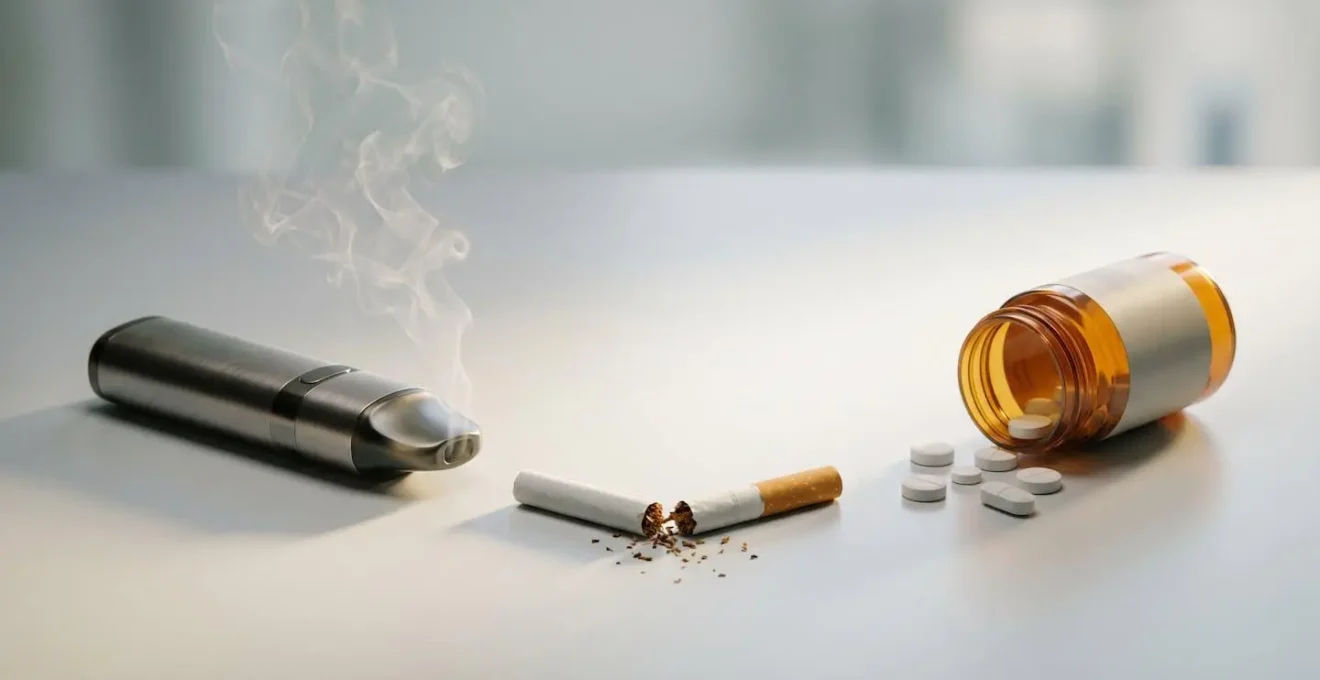
Vaping’s higher success rates in UK trials are not just about nicotine; they are about effectively replacing the behavioural ritual of smoking, a factor that patches and gums miss.
- Vaping addresses the hand-to-mouth action and sensory feedback, making it a powerful tool for those with a strong “behavioural dependency profile.”
- Prescription medications like Champix (Varenicline) work via a different “cessation mechanism,” blocking nicotine receptors in the brain, which may be more effective for those who fail to quit with behavioural replacement.
Recommendation: The most effective cessation aid is the one that best matches your personal smoking triggers. Analyse whether your dependency is more behavioural or chemical to make an informed choice.
For any UK smoker determined to quit, the landscape of cessation aids can feel like a confusing maze. You’ve likely heard the standard advice: use nicotine replacement therapy (NRT) like patches or gum, or perhaps ask your GP for a prescription medication like Champix (Varenicline). Yet, a newer, more debated tool has emerged with surprisingly high success rates in clinical trials: vaping. The conversation often gets stuck on a single, highly-publicised figure about its relative safety, but this misses the most important question: not just *if* you should quit, but *how* you can do so successfully.
The common approach is to see these options as a simple ladder of effectiveness, but this is a flawed perspective. Many who have tried and failed with patches wonder why a vape might succeed where proven medical products did not. The answer lies beyond a simple comparison of success statistics. It requires a deeper understanding of the different types of smoking dependency and the specific “cessation mechanism” each tool employs. Is your addiction primarily a chemical craving for nicotine, or is it deeply intertwined with the physical habit, the hand-to-mouth ritual, and the sensory feeling of inhalation?
This article moves beyond the platitudes to offer a comprehensive comparison for the discerning quitter. We will dissect *why* vaping shows higher success rates in UK trials, not to declare it a universal solution, but to reveal the crucial role of behavioural satisfaction. We will explore how prescription medications offer a completely different, neurochemical pathway to quitting. By understanding these distinct mechanisms, you can move from asking “What’s the best way to quit?” to identifying “What’s the best way for *me* to quit?”
To navigate these complex choices, we will break down the evidence, compare success rates, and explore the practical steps for integrating these tools with NHS support. This structured analysis will provide a clear framework for your decision-making process.
Summary: Vaping vs. Prescription Medication for Quitting Smoking
- Why Does Vaping Have Higher Success Rates Than Nicotine Patches in UK Trials?
- Why Vaping Works When Patches Failed: The Behavioural Satisfaction Factor?
- How to Use Your Vape Alongside Free NHS Stop Smoking Services?
- Why Vaping Doesn’t Work for Everyone: The 20% Who Need Different Approaches?
- Vape, Patch, or Gum: Which Cessation Aid Has the Highest UK Success Rate?
- Vaping vs Patches vs Cold Turkey: Which Method Has the Best UK Success Rate?
- Why Public Health England States Vaping Is 95% Less Harmful Than Smoking?
- What Comes After Quitting Smoking Via Vaping: Forever Vaper or Eventually Free?
Why Does Vaping Have Higher Success Rates Than Nicotine Patches in UK Trials?
The surprising effectiveness of vaping as a cessation tool is not just anecdotal; it’s backed by robust, UK-centric evidence. When comparing e-cigarettes to traditional nicotine replacement therapies (NRT) like patches or gum, the data consistently shows a significant advantage for vaping. The core reason lies in how effectively vaping delivers nicotine while also satisfying the behavioural components of smoking that NRTs simply cannot address.
Recent data from NHS England, for instance, showed a 60.7% success rate for those using nicotine vapes through stop smoking services, compared to just 56.2% for single NRT products. While this gap may seem modest, it represents thousands of additional successful quits. The difference becomes even clearer in large-scale systematic reviews. A landmark 2025 Cochrane systematic review, a gold standard in medical evidence, concluded that for every 100 people using e-cigarettes to quit, there are 4 additional successful quitters compared to those using traditional NRT.
This statistical edge stems from vaping’s dual-action cessation mechanism. It provides the nicotine to stave off chemical withdrawal, much like a patch. However, it also mimics the physical act of smoking—the hand-to-mouth gesture, the inhalation, the exhalation of a visible cloud—which addresses the deeply ingrained ritualistic part of the addiction. This combination makes it a more complete substitute, leading to higher adherence and, ultimately, higher success rates in real-world settings and clinical trials alike.
Why Vaping Works When Patches Failed: The Behavioural Satisfaction Factor?
For many smokers who have unsuccessfully tried patches, gum, or inhalators, the experience is one of frustrating disconnect. While the NRT product may reduce the underlying chemical craving, it does nothing to satisfy the powerful, ingrained habits and rituals of smoking. This is where the concept of behavioural satisfaction comes in, and it is the single biggest reason vaping often succeeds where NRT fails. Smoking is more than a chemical addiction; it is a complex behavioural ritual.
This ritual involves multiple sensory inputs: the feeling of the cigarette in your hand, the hand-to-mouth motion, the sensation of warmth and smoke in your throat (the “throat hit”), and the visual feedback of exhaling a cloud. A nicotine patch, stuck on your arm, addresses none of these. Vaping, by contrast, replicates almost all of them. This allows the user to substitute the harmful act of smoking with a significantly less harmful one that still fulfils the psychological need for the ritual. The tactile experience is a key part of this mechanism.
As this image illustrates, the physical act is central to the experience. By providing a direct replacement for this sensory feedback loop, vaping helps manage the psychological cravings triggered by situations associated with smoking, such as after a meal, with a coffee, or during a work break. As the Cochrane Library Research Team noted in their review on e-cigarettes for smoking cessation, this is a key reason why “vaping increases quit rates compared to nicotine replacement therapy”. It’s a more complete substitute, which makes the transition away from combustible tobacco feel less like a deprivation and more like a simple switch.
How to Use Your Vape Alongside Free NHS Stop Smoking Services?
While vaping is a powerful tool on its own, UK data overwhelmingly shows that your chances of quitting successfully skyrocket when you combine it with professional support. Free NHS Stop Smoking Services are designed to provide this crucial behavioural counselling. Combining the right tool (vaping) with the right support (NHS services) creates the most effective quitting strategy available. In fact, NHS data confirms you are up to three times more likely to quit successfully with this combined approach than by going it alone.
Engaging with these services is straightforward and they are now fully equipped to support people who choose to use vaping as their primary cessation aid. The process is not about being told what to do; it’s a partnership to create a personalised quit plan. The trained advisors provide accountability, help you manage triggers and cravings, and monitor your progress in a supportive, non-judgmental environment. This structure is invaluable, particularly during the first few challenging weeks of your quit attempt.
The support provides the psychological framework, while the vape manages the physical and behavioural cravings. This synergy is what makes the combination so potent. To get started, you don’t need a formal GP referral; you can take the initiative yourself to access this free and highly effective resource. Following a clear set of steps will ensure you are enrolled and supported throughout your journey.
Your Action Plan: Accessing NHS Support with Vaping
- Self-refer to your local NHS stop smoking service via the NHS Better Health website or ask your GP or pharmacist for a referral.
- At your first meeting, discuss your smoking history, why you want to quit, and your decision to use vaping as your cessation tool.
- Receive a carbon monoxide breath test to establish your baseline and track your progress throughout the 12-week programme.
- Commit to weekly face-to-face or phone contact for the first 4 weeks, then less frequent meetings for the remaining 8 weeks.
- Use the emergency support number provided for out-of-hours help when cravings are strong or you feel at risk of relapse.
Why Vaping Doesn’t Work for Everyone: The 20% Who Need Different Approaches?
While vaping is highly effective for many, it is not a universal panacea. A significant portion of smokers—often estimated at around 20% of those who try—find that vaping does not lead to a successful quit. For this group, the reason for failure often lies in their specific dependency profile. Their addiction may be less about the behavioural ritual and more intensely rooted in the brain’s neurochemical response to nicotine. For these individuals, a purely behavioural substitute isn’t enough; they require a direct pharmacological intervention.
This is where prescription medications like Champix (active ingredient: Varenicline) demonstrate their unique value. Varenicline works via a completely different cessation mechanism. It’s not a nicotine replacement. Instead, it’s a partial agonist that binds to the same nicotine receptors in the brain. This has a dual effect: it reduces the severity of cravings and withdrawal symptoms, and it blocks nicotine from cigarettes from binding to these receptors, which diminishes the rewarding, pleasurable sensation of smoking. For someone whose addiction is primarily driven by this neurochemical reward loop, this approach can be far more effective.
Clinical data supports this. In trials, Varenicline consistently shows high rates of success. For example, one key trial revealed a 32.1% continuous abstinence rate for varenicline versus just 6.9% for placebo during the crucial final weeks of the study. This demonstrates its power as a neurochemical intervention.
Case Study: Real-World Varenicline Effectiveness
A prospective cohort study of 270 adults in the general population found that users of varenicline with minimal professional support had adjusted odds of abstinence 3.83 times higher compared to users of prescription nicotine replacement therapy. This suggests that for individuals seeking a definitive pharmaceutical intervention rather than a behavioural replacement, Varenicline offers a significantly more powerful solution, confirming its role for a specific segment of the smoking population.
Therefore, if you have tried vaping and found it ineffective, it may not be a personal failure but rather an indication that your dependency profile is better suited to a direct neurochemical intervention like Varenicline.
Vape, Patch, or Gum: Which Cessation Aid Has the Highest UK Success Rate?
When evaluating the most effective way to quit smoking, it is essential to look at the comparative evidence. The Cochrane evidence summary, a highly respected source in the medical community, provides a clear hierarchy of effectiveness based on extensive reviews of clinical trials. This data allows for an objective comparison between different cessation aids, including e-cigarettes, prescription medications, and various forms of nicotine replacement therapy (NRT).
The evidence shows that the most effective methods are those that either provide a potent neurochemical intervention or offer a highly satisfying nicotine delivery system. According to the data, prescription medications like Varenicline (Champix) and Cytisine, along with e-cigarettes, consistently outperform single-form NRTs like patches or gum alone. Interestingly, using two forms of NRT together (e.g., a patch for a steady dose and gum for acute cravings) brings its effectiveness up to a level similar to that of e-cigarettes.
The following table, based on the comprehensive analysis from the Cochrane review, summarises the expected quit rates per 100 people for various methods, providing a clear, at-a-glance comparison.
| Cessation Aid | Quit Rate per 100 People | Success vs Placebo (6 people per 100) |
|---|---|---|
| Varenicline | 12 to 16 | 2x to 2.7x higher |
| E-cigarettes | 10 to 19 | 1.7x to 3.2x higher |
| Cytisine | 10 to 18 | 1.7x to 3x higher |
| Dual NRT (patch + gum/lozenge) | Similar to e-cigarettes | ~1.7x to 3x higher |
| No treatment or placebo | 6 | Baseline |
This data is reinforced by NHS reports, which state that when using varenicline with behavioural counselling, around 1 in 4 people successfully stop smoking for at least six months. This highlights that for a purely pharmaceutical route, Varenicline stands as a top-tier option. The key takeaway is that both modern e-cigarettes and prescription drugs represent a significant leap in effectiveness over older, single-form NRT methods.
Vaping vs Patches vs Cold Turkey: Which Method Has the Best UK Success Rate?
When comparing quit methods, it’s crucial to look at the three main pathways: behavioural substitution (vaping), traditional nicotine replacement (patches), and unaided cessation (“cold turkey”). While quitting cold turkey is often lauded for its simplicity, the evidence is stark: it is by far the least effective method. The vast majority of people who try to quit without any aid relapse, often within days, because they are fighting both a chemical addiction and a deeply ingrained behavioural habit simultaneously and without support.
At the other end of the spectrum, vaping has demonstrated superior success rates, particularly in UK-based initiatives. For instance, an analysis of the UK’s pioneering “Swap to Stop” programme found that vapers were 50% more likely to succeed in quitting smoking than those who used traditional NRT like patches or gum. This significant difference reinforces the idea that satisfying the behavioural ritual is a critical component of a successful quit attempt for a large portion of the smoking population.
Between these two extremes lie nicotine patches. They are medically proven to be more effective than cold turkey by providing a steady supply of nicotine to ease withdrawal symptoms. However, as noted, they fail to address the behavioural aspect of smoking. This makes them a viable but often less complete solution compared to vaping. The hierarchy is clear: any form of supported quit attempt is better than none, but methods that address both the chemical and behavioural dependencies, like vaping combined with NHS support, offer the highest likelihood of success. Ultimately, the “best” method is the one you can stick with, but starting with the most evidence-backed option gives you a significant head start.
Why Public Health England States Vaping Is 95% Less Harmful Than Smoking?
The “95% less harmful” figure is one of the most cited—and most contentious—statistics in the public health debate around vaping. It originates from a 2015 evidence review commissioned by Public Health England (PHE), now the Office for Health Improvement and Disparities. In their landmark report, the authors concluded: “It has been previously estimated that EC are around 95% safer than smoking. This appears to remain a reasonable estimate.” This statement formed the bedrock of the UK’s harm reduction approach to tobacco control.
The basis for this claim is the fundamental difference in process between smoking and vaping. Smoking involves combustion, which burns tobacco at extremely high temperatures, creating a toxic cocktail of over 7,000 chemicals, including tar and carbon monoxide, dozens of which are known carcinogens. Vaping, on the other hand, involves heating a liquid to create an aerosol (commonly called vapour). This process does not involve combustion, and the resulting aerosol contains a fraction of the harmful constituents found in cigarette smoke, and at much lower levels. The core of the harm reduction argument is that while vaping is not risk-free, the risks are substantially lower than continuing to smoke.
However, the 95% figure has not been without its critics. An editorial in the prestigious medical journal The Lancet characterized the evidence base as “an extraordinarily flimsy foundation”, highlighting that the original estimate came from a small expert panel opinion paper that itself acknowledged a lack of long-term data. This sparked a significant scientific debate about the precision of the number.
The Scientific Debate Over the 95% Claim
The Lancet’s 2015 editorial scrutinised the origin of the 95% figure, tracing it to a 2014 paper. The editorial pointed out that the paper’s authors admitted a ‘lack of hard evidence for the harms of most products’ and used ‘no formal criterion for the recruitment of the experts.’ While defenders of the figure argue that it correctly captures the vast difference in relative risk, critics maintain that it gives a false sense of scientific precision. Despite this controversy, the general consensus among UK health bodies remains that vaping is far less harmful than smoking, even if the exact percentage is debatable.
Despite the debate over the exact number, the population-level data from the UK provides compelling circumstantial evidence for the success of this harm reduction approach. As vaping rose in popularity, smoking rates plummeted. In fact, adult smoking in Britain fell from 20.2% in 2011 to 10.6% in 2024, nearly halving, a decline that tracks almost perfectly with the rise of vaping as a mainstream consumer product and cessation tool.
Key Takeaways
- Success in quitting depends on matching the tool’s mechanism (behavioural vs. neurochemical) to your personal dependency profile.
- Vaping’s high success rate is largely due to “behavioural satisfaction,” replacing the ritual of smoking in a way NRT cannot.
- Prescription drugs like Champix (Varenicline) offer a powerful “neurochemical intervention” and are a top-tier option for those whose addiction is not primarily behavioural.
What Comes After Quitting Smoking Via Vaping: Forever Vaper or Eventually Free?
For many who successfully use vaping to quit smoking, a new question emerges: what’s the end game? Have I simply traded one habit for another? The goal for most is to eventually be free from nicotine addiction altogether. The good news is that the vaping ecosystem is uniquely designed to facilitate this gradual journey toward complete cessation, a process often referred to as “tapering down.”
Unlike cigarettes, which have a fixed nicotine content, e-liquids are available in a wide range of nicotine strengths. This allows users to systematically reduce their nicotine intake over time without abandoning the behavioural support the vape provides. A common tapering strategy involves staying on a higher nicotine level (e.g., 18-20mg/ml) for the initial, difficult months after quitting smoking, then incrementally stepping down to 12mg, then 6mg, then 3mg, and finally to 0mg (nicotine-free) e-liquid. This methodical reduction allows the body to gradually adjust, minimising withdrawal symptoms and making the final leap to being nicotine-free much more manageable.
This visual journey from higher to lower strength is a path many successful ex-smokers follow. While some critics worry about long-term vaping, evidence suggests that most people who use vapes to quit smoking do naturally reduce their dependency over time. For instance, a 2024 population survey in Great Britain found that only 13.9% of long-term ex-smokers who vape use high-strength e-liquids, compared to 28.8% of current smokers who also vape (dual users). This indicates a clear trend of nicotine reduction among those who have successfully quit cigarettes. The ultimate goal remains to be free of both smoking and vaping, and the built-in flexibility of vaping makes this a more achievable long-term outcome.