Your persistent cigarette cravings are not a sign of failure but a predictable neurochemical echo that your vape, despite delivering nicotine, cannot fully silence.
- Cigarettes deliver nicotine plus other chemicals (MAOIs) that create a unique ‘satisfaction’ profile, a gap your vape doesn’t fill.
- Cravings are intense but brief “neurochemical waves,” typically lasting only 3-5 minutes, which you can learn to ride out.
- Dual-using (smoking and vaping) prevents your brain from ever recalibrating, keeping you tethered to the cigarette’s satisfaction standard.
Recommendation: Instead of increasing nicotine, focus on ‘ritual decoupling’—actively replacing the old smoking rituals with new, structured vaping routines to retrain your brain’s associations.
You’ve done everything right. You’ve ditched the cigarettes, invested in a vaping device, and made it through the gruelling first few weeks. Yet, here you are, three weeks in, and the ghost of a cigarette still haunts you. A sharp, undeniable craving cuts through the day, making you question if this is even working. You’re getting nicotine, so why does it feel like something fundamental is missing? Why does the thought of a “real” cigarette still feel like a forbidden comfort?
The common advice is often simplistic: “up your nicotine strength” or “just vape more.” But you’ve tried that, and the specific, almost nostalgic, pull for a cigarette remains. This isn’t just about nicotine delivery; it’s about a complex relationship your brain formed with smoking, a partnership involving more than just one chemical. The frustration you’re feeling is valid, and it’s rooted in a neurochemical phenomenon that most people don’t understand.
This feeling is what we can call the “satisfaction gap.” It’s the difference between the multifaceted chemical cocktail of a combustible cigarette and the cleaner, more singular delivery of a vape. Understanding this gap is not an admission of defeat; it’s the most powerful tool you have. This article will deconstruct that craving, moving beyond generic advice to explain the precise psychological and biological mechanisms at play. We will explore why your vape doesn’t hit the same spot, how to survive the most intense craving triggers, and why the 90-day mark is a neurological turning point. It’s time to understand your enemy so you can finally defeat it.
To navigate this complex transition, this article breaks down the key stages and psychological hurdles you’re facing. The following sections will guide you through the science of your cravings and provide actionable strategies to solidify your smoke-free journey.
Summary: Understanding and Overcoming Post-Smoking Cravings While Vaping
- Why Your Vape Delivers Nicotine but Doesn’t Satisfy Like a Cigarette?
- How to Survive the First 72 Hours Without Cigarettes Using Your Vape?
- Which 5 Situations Make Ex-Smokers Reach for Cigarettes Despite Having a Vape?
- The Dual-Use Mistake That Keeps You Addicted to Both Cigarettes and Vaping
- When You Reach 90 Days Smoke-Free: Why This Milestone Changes Everything?
- Why Cravings Feel Unbearable for 3 Minutes Then Suddenly Disappear?
- Why Nicotine Hijacks the Same Brain Pathway as Food and Social Connection?
- Why Does One Cigarette Craving Destroy Weeks of Progress Even While Vaping?
Why Your Vape Delivers Nicotine but Doesn’t Satisfy Like a Cigarette?
The central frustration for many new vapers is the persistent feeling that something is “missing.” You’re inhaling nicotine, but the deep, calming satisfaction of a cigarette remains elusive. This isn’t in your head; it’s a real neurochemical phenomenon known as the “satisfaction gap.” The truth is, you weren’t just addicted to nicotine; you were addicted to the highly-engineered drug delivery system of a cigarette, and a vape is a fundamentally different machine.
Firstly, the pharmacokinetics—how a drug is absorbed and distributed—are different. While it varies, some pharmacokinetic studies demonstrate that e-cigarettes may deliver nicotine less efficiently than a cigarette in a puff-for-puff comparison. This has led many experienced vapers to unconsciously adapt their behaviour. A comparative study noted that experienced vapers took significantly longer puffs (3.5 seconds) compared to smokers (2.3 seconds) to achieve a satisfying nicotine level, showing a subconscious effort to bridge this delivery gap.
However, the most crucial difference isn’t the speed of nicotine delivery, but the other chemicals you’re no longer getting. Tobacco smoke contains thousands of compounds, including natural Monoamine Oxidase Inhibitors (MAOIs). MAOIs work by slowing the breakdown of mood-regulating neurotransmitters like dopamine and serotonin. In essence, cigarettes deliver nicotine (the “hit”) and an antidepressant-like compound (the “hug”) simultaneously. Research confirms this, showing that smokers have much lower activity of peripheral and brain MAO-A (30%) and -B (40%) isozymes. Your vape provides the nicotine, but it’s missing that secondary mood-lifting component. This is the “satisfaction gap” you feel: your brain is getting the nicotine it expects but misses the accompanying chemical entourage it grew dependent on.
How to Survive the First 72 Hours Without Cigarettes Using Your Vape?
The first three days after your last cigarette are a critical battleground. This is when physical withdrawal symptoms peak and the psychological weight of your old habit is at its heaviest. Success in this period isn’t about willpower alone; it’s about having a structured, deliberate strategy to replace the cigarette ritual, not just the nicotine. Your vape is your primary tool, but how you use it matters immensely. The goal is to perform a “ritual transfer”—methodically mapping your old smoking routines onto new vaping ones.
Instead of randomly puffing when a craving strikes, you must be disciplined. If you smoked for five minutes every two hours, you must now vape for five minutes every two hours. Go to the same spot. Hold the device as you held your cigarette. This process, known as ritual decoupling, helps your brain associate the old cues (a coffee break, finishing a meal) with the new action (vaping). This conscious replacement is far more effective than simply trying to “avoid triggers,” which is often impractical.
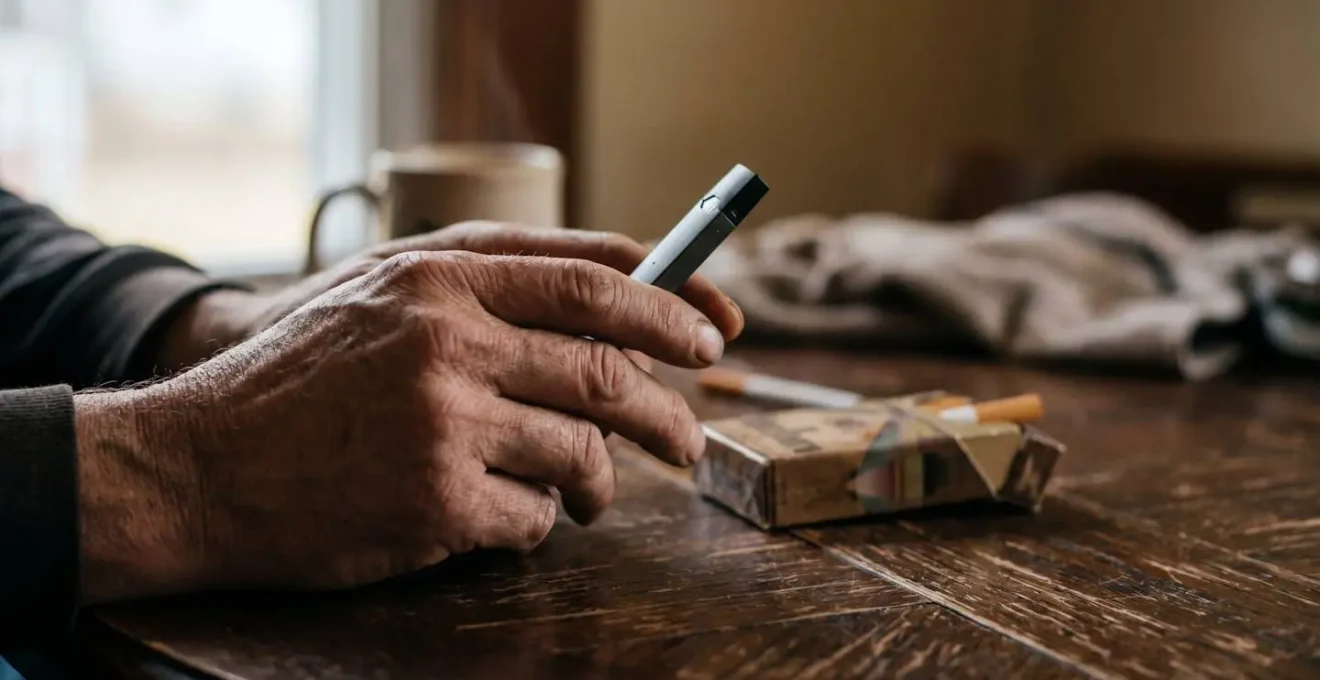
The image below captures this idea perfectly: the vape isn’t just a device, but a placeholder for a new ritual in a familiar setting. It represents the quiet, deliberate act of reclaiming a moment that once belonged to smoking.
This structured approach helps manage the chaos of withdrawal by giving you a predictable pattern to follow. To make this practical, here is a protocol to follow for those first 72 hours, designed to address not just the nicotine craving but the oral fixation, dehydration, and blood sugar drops that come with withdrawal.
Your 72-Hour Cigarette-Free Vaping Protocol:
- Hour 0-24: Replace each cigarette break with an identically timed vaping session (5-7 minutes). Go to the same location you used to smoke and maintain the exact timing of your old ritual.
- Hour 24-48: Drink a full glass of water before every scheduled vaping session. This directly combats withdrawal-induced dehydration and helps stabilise blood sugar.
- Hour 48-72: Keep protein-rich snacks like nuts or cheese within reach during your vaping breaks. This addresses the need for oral fixation and further stabilises your energy levels.
- Throughout the 72 Hours: Stick to a single tobacco-flavoured vape liquid. Avoid experimenting with sweet or fruity flavours during this critical period to create a strong, unambiguous neurological association for your new primary nicotine source.
- After Each Session: Immediately put your vape device away and out of sight. This helps rebuild the “completion signal” your brain previously associated with finishing a cigarette, preventing mindless, all-day puffing.
Which 5 Situations Make Ex-Smokers Reach for Cigarettes Despite Having a Vape?
Even with a vape in hand, certain situations can trigger a craving so powerful it feels primal. These aren’t random; they are deeply ingrained cues your brain has associated with smoking for years. Understanding these five high-risk triggers is crucial to preparing a defense. These are the moments when your brain screams for the specific, rapid ‘solution’ of a cigarette, not the slower comfort of a vape. The Centers for Disease Control and Prevention confirm that triggers like stressful situations or coffee consumption are among the most common craving catalysts for those quitting.
The five most common relapse traps for new vapers are:
- The Morning Coffee/Tea: For many, the first cigarette of the day was an inseparable part of their morning ritual. The combination of caffeine and nicotine creates a powerful synergistic effect that your brain comes to expect. Vaping doesn’t always cut through the morning fog in the same way.
- Stressful Moments: When faced with a sudden shock, an argument, or work pressure, the ingrained response is to reach for a cigarette. It feels like an emotional regulator, a tool to manage anxiety.
- After a Meal: The end of a meal is a powerful “completion signal” that, for smokers, was historically marked by a cigarette. The feeling of fullness and satisfaction becomes neurologically linked to the act of lighting up.
- Drinking Alcohol: Alcohol lowers inhibitions and weakens resolve. The social context of a pub or party, combined with the physiological effects of alcohol, creates a perfect storm for relapse.
- Boredom or Procrastination: Moments of unstructured time, like driving or waiting for something, were often filled by the ritual of smoking. It provided a small, structured activity to break the monotony.
A common thread in many of these triggers, especially stress, is the mistaken belief that smoking genuinely relieves anxiety. In reality, it only relieves the anxiety of nicotine withdrawal. As the CDC astutely points out, the “calm” you feel is an illusion created by feeding the addiction.
For some people, smoking may seem like it helps with anxiety or depression, but that’s because the nicotine in cigarettes stops the discomfort of withdrawal, not because it is helping with anxiety or depression.
– Centers for Disease Control and Prevention, 7 Common Withdrawal Symptoms
Recognising these triggers isn’t about avoiding them—life must go on. It’s about anticipating them and having a pre-planned response. Before the stress hits, know that you will take a five-minute walk. When you finish a meal, immediately have your vape ready for your scheduled “break.” By identifying these traps, you can disarm them before they ambush you.
The Dual-Use Mistake That Keeps You Addicted to Both Cigarettes and Vaping
One of the most common and damaging traps for those trying to quit is “dual use”—the practice of vaping most of the time but still having the occasional cigarette. You might tell yourself it’s just one with your morning coffee, or only when you’re out with friends. This seems like a harmless compromise, a gradual step down, but from a neurological perspective, it is the single most effective way to guarantee you remain addicted to both. Recent data from England shows just how common this is, as a recent population study shows that 34.2% of adult smokers also vaped by April 2024, a significant increase from previous years.
The problem with dual use is that it never allows your brain’s “satisfaction standard” to reset. As we’ve discussed, a cigarette delivers a more complex and potent chemical reward than a vape. Every time you have “just one” cigarette, you are reminding your brain of this ‘gold standard’ of satisfaction. You are reinforcing the idea that the vape is a second-best, inferior substitute. This creates a state of perpetual dissatisfaction where the vape never feels like enough because your brain is always comparing it to the recent memory of a cigarette.
This conflict between two different delivery systems is a source of constant neurological confusion. The vape and the cigarette are competing for the same reward pathways, but they are not equal competitors.
Case Study: How Dual Use Prevents Quitting
An analysis of 4,247 dual users in England revealed a telling pattern. It found that nearly half (49%) were stuck in a cycle of daily smoking combined with daily vaping. The study showed that this pattern of concurrent use actively prevents a successful transition away from cigarettes. By constantly re-exposing the brain to the potent effects of combustible tobacco, dual users maintain an elevated “nicotine satisfaction threshold” that vaping alone struggles to meet, effectively locking them into a cycle of continued smoking.
To successfully quit, you must make a clean break. The goal is to lower your brain’s satisfaction threshold until the vape becomes the new, and only, standard. This can only happen with a 100% commitment to being smoke-free. The occasional cigarette isn’t a treat; it’s a reset button for your addiction, and it’s holding you back.
When You Reach 90 Days Smoke-Free: Why This Milestone Changes Everything?
The journey of quitting smoking is often measured in hours and days, but the most profound transformation occurs around the three-month mark. Reaching 90 days smoke-free is not just a commendable display of willpower; it is a critical neurological milestone. This is the point at which the brain begins to move from a state of active, painful withdrawal to one of genuine, lasting recalibration. If the first few weeks are a battle, the 90-day mark is the signing of a peace treaty with your own mind.
During the first month, your brain is in chaos. Nicotine receptors are screaming for the chemical they’ve become accustomed to, leading to intense cravings, mood swings, and irritability. However, as you push through, a remarkable healing process begins. According to neurological research, the brain starts to physically rewire itself. The number of over-sensitised nicotine receptors begins to decrease, returning to the levels of a non-smoker. While this process is gradual, neuroscience studies indicate that significant brain rewiring from nicotine addiction takes 3-6 months, with the 90-day point being a major turning point within that window.
The Neurological Shift at 90 Days
A recovery milestone analysis documented this transition in detail. The analysis noted that between 1 to 3 months after quitting, emotional stabilisation begins to emerge. Mood swings decrease in frequency and intensity, and the sharp, desperate edge of cravings starts to soften. Neurologically, this period marks a critical shift. The brain’s neural circuits, long hijacked by nicotine, begin a significant recalibration process, leading to reduced tolerance and normalised receptor function. The 90-day mark represents the point where the experience of quitting shifts from a constant, active resistance to a phase of gradual, passive normalisation. You stop ‘not smoking’ and start simply ‘being a non-smoker’.
This is why the 90-day milestone is so powerful. It’s often the point where ex-smokers report waking up and realising they haven’t thought about a cigarette all morning. The background noise of craving fades into silence. While a rogue craving may still appear occasionally, it lacks the urgency and power it once had. It’s a fleeting thought, not a physical demand.
Most people feel fully recovered within 90 days.
– Nectr Energy Nicotine Withdrawal Research, Nicotine Withdrawal Timeline: Day-by-Day Guide
Why Cravings Feel Unbearable for 3 Minutes Then Suddenly Disappear?
One of the most bewildering aspects of quitting is the nature of the craving itself. It arrives like a tsunami—an all-consuming, unbearable wave of physical and mental urgency that feels like it will last forever. You feel tension in your jaw, an emptiness in your chest, and your mind can focus on nothing else. And then, just as you’re about to break, it recedes. The wave passes, and you’re left wondering how something so intense could vanish so completely. This isn’t a mystery; it’s a predictable neurochemical event.
The key to surviving these moments is to understand their temporary nature. A nicotine craving is not a constant state; it is a brief, intense burst of neurological activity. Extensive cessation research consistently shows each craving lasts between 3-5 minutes. It may feel like an eternity when you’re in the middle of it, but in reality, it’s a very short-lived event. The intensity you feel is your brain’s reward system throwing a tantrum, temporarily flooding your consciousness with a demand for nicotine.
Think of it as a “craving wave.” When a trigger occurs (like seeing someone smoke or finishing a meal), a signal is sent to your brain’s reward centre. This launches the wave. For approximately three minutes, your brain is in a state of high alert, using all its power to convince you to satisfy the craving. This is the peak of the wave, the moment of “unbearable” intensity. However, your body has finite resources to sustain this level of alarm. If you don’t give in, the neurochemical signal begins to fade. The brain can’t maintain that level of panicked demand indefinitely. After those few minutes, the wave breaks, and the system calms down. The craving doesn’t just lessen; it often disappears entirely until the next trigger.
The secret to overcoming cravings is not to fight the wave but to ride it out. When you feel it coming, don’t argue with it or try to suppress it. Instead, acknowledge it and tell yourself, “This is a craving wave. It will be intense for about three minutes, and then it will be gone.” Look at a clock. Distract yourself with a simple, engaging task for just that short period: make a cup of tea, walk to a different room, or do a quick puzzle on your phone. By the time you’ve finished, the worst of the wave will have passed.
Why Nicotine Hijacks the Same Brain Pathway as Food and Social Connection?
The desperate, gut-wrenching feeling of a nicotine craving feels so powerful because it isn’t just a “bad habit.” Nicotine addiction is a form of biological deception. It cunningly inserts itself into the most fundamental part of your brain’s operating system: the survival reward pathway. This is the same ancient, powerful neural circuit that ensures our survival by rewarding essential behaviours like eating, drinking water, and forming social bonds. Your vape craving feels as urgent as hunger because, to your brain, it is.
This system, primarily driven by the neurotransmitter dopamine, is designed to create powerful urges for things that keep us alive. When you eat a good meal or connect with a loved one, your brain releases a surge of dopamine, creating a feeling of pleasure and satisfaction. This feeling acts as a powerful motivator, teaching your brain to repeat that behaviour. Nicotine is a master counterfeiter. It mimics a natural neurotransmitter (acetylcholine) and triggers a massive, unnatural flood of dopamine in this same reward pathway. It’s a shortcut to a feeling of reward that is far more intense and rapid than most natural pleasures.
Over time, the brain adapts to this constant, artificial stimulation. It begins to treat nicotine not as a luxury but as an essential resource. It down-regulates its own dopamine production and reduces the number of sensitive receptors, relying on the external supply from cigarettes to feel “normal.” When you quit, this carefully balanced system is thrown into chaos. As one research team explains, “When nicotine is suddenly removed, the brain’s chemical balance is disrupted, leading to various symptoms as it recalibrates.” This recalibration is what we call withdrawal.
The craving you feel is not just a psychological desire; it’s your brain’s survival system sending out a powerful, urgent alarm signal for a substance it has been tricked into believing is necessary for its equilibrium. This is why quitting feels like you’re fighting against your own biology. You are, in a sense, trying to convince a deeply programmed part of your brain that it is wrong, and that takes time and repetition.
Key takeaways
- The “satisfaction gap” is real: Cigarettes contain MAOIs that act as antidepressants, a chemical effect your vape doesn’t replicate. This explains why vaping can feel unsatisfying at first.
- Dual-using is a trap: Having “just one” cigarette keeps your brain’s satisfaction threshold set to the ‘gold standard’ of a cigarette, preventing your vape from ever feeling like enough. A 100% break is essential for your brain to recalibrate.
- Cravings are temporary waves: An intense nicotine craving is a neurochemical event that typically lasts only 3-5 minutes. The key is not to fight it, but to distract yourself and ride out the wave.
Why Does One Cigarette Craving Destroy Weeks of Progress Even While Vaping?
You’ve been smoke-free for weeks. The cravings are less frequent, your vape is doing its job, and you’re starting to feel like you’ve finally turned a corner. Then, after a particularly stressful day, you give in. “Just one won’t hurt,” you think. But it does. That single cigarette doesn’t just represent a momentary lapse; it can feel like it erases weeks of hard-won progress, reigniting cravings with a vengeance and making your vape feel utterly useless. This disproportionate power of “just one” is due to a cruel feature of addiction psychology known as the Abstinence Violation Effect.
When you have that one cigarette, you’re not just getting a dose of nicotine. You are sending a powerful, unambiguous signal to your brain’s reward pathway: “See? I told you this was the solution.” It’s an explosive confirmation of the very behaviour you have been trying to extinguish. That single act immediately re-establishes the cigarette as the ultimate source of satisfaction, instantly demoting your vape back to the status of a poor substitute. All the “ritual decoupling” work you’ve done—associating your coffee break with a vape, for example—is instantly undermined.
This single event can trigger what feels like a full-blown relapse. The cravings come back stronger because the brain’s expectation has been reset to the cigarette’s potent chemical cocktail. This is often followed by feelings of guilt, shame, and hopelessness (“I’ve failed, so I might as well go back to smoking”). This psychological fallout is just as damaging as the neurochemical reset. It’s a vicious cycle where the lapse itself provides the justification for giving up entirely.
Resisting that “one cigarette” is therefore the most important battle. It’s crucial to remember that the temporary relief it might offer is a lie. The long-term psychological benefit of staying smoke-free far outweighs any momentary comfort. In fact, research shows that quitting smoking ultimately improves mental well-being.
The good news is that once people have been smoke-free for a few months, their anxiety and depression levels are often lower than when they were smoking.
– Centers for Disease Control and Prevention, Withdrawal Symptoms and Mental Health
That single cigarette isn’t a friend offering comfort; it’s a saboteur waiting to destroy the foundation you’ve painstakingly built. Every time you resist it, you are reinforcing the new neural pathways and making the foundation of your smoke-free life stronger.
Your journey is a process of retraining your brain, one craving and one conscious choice at a time. Be patient and compassionate with yourself, but also be firm in your resolve. The freedom you are working towards is real, and it is worth every difficult moment.