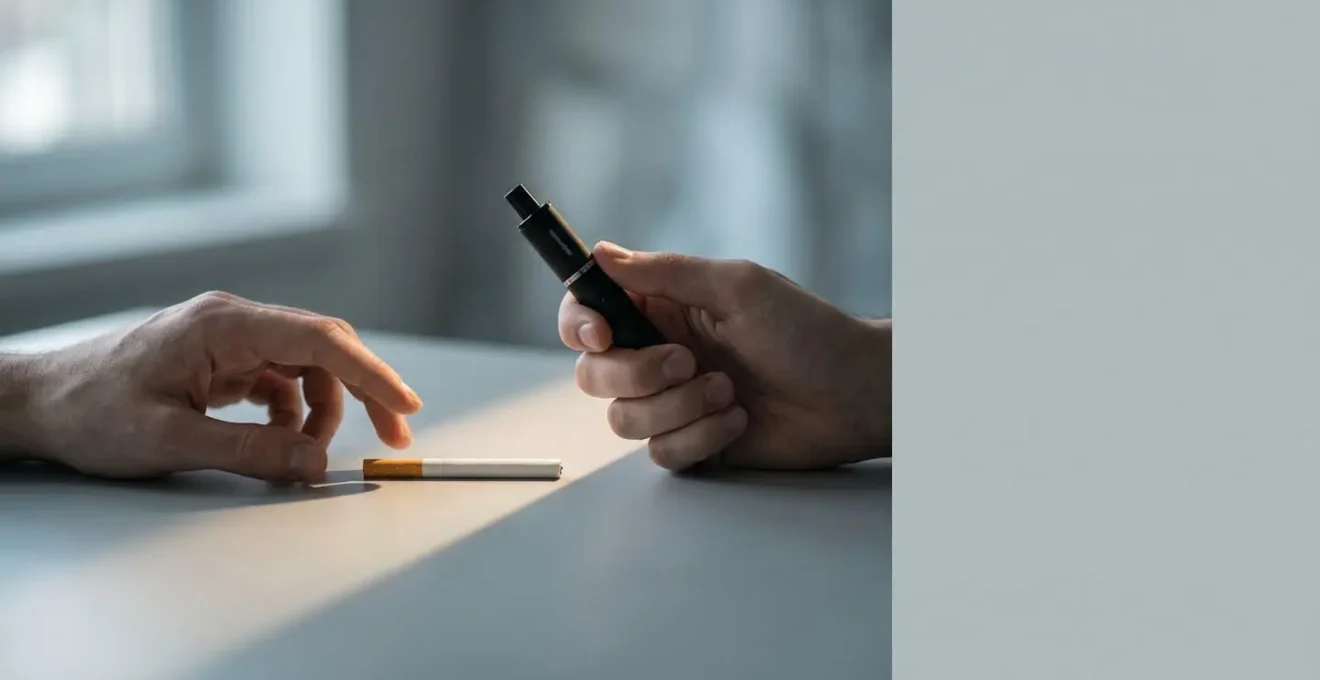
The breakthrough cigarette craving you experience isn’t a failure of willpower; it’s a specific, predictable event caused by the mismatch between a cigarette’s sharp “nicotine signature” and the smoother delivery of your vape.
- Cravings are time-limited events (3-5 minutes) that you can strategise against, not endure.
- Your brain is craving not just nicotine, but the rapid peak and associated chemical rush that cigarettes provide and most vapes don’t replicate by default.
Recommendation: Shift from reactive vaping to strategic craving management by understanding the anatomy of your specific triggers and timing your vaping to pre-emptively block them.
You’ve done everything right. You switched from cigarettes to a vape, endured the initial discomfort, and maybe even felt a sense of freedom for a few days or weeks. Then, out of nowhere, it hits you: a tidal wave of a craving so intense, so specific for a *cigarette*, that your vape feels like a plastic toy in your hand. You give in, or you fight it off and feel shaken, wondering why this is so hard when you’re still getting nicotine.
This experience is the single most common frustration for switchers, and it’s not your fault. The common advice—”just vape more” or “be strong”—ignores the fundamental truth of the matter. You’re not fighting a simple urge; you’re fighting the ghost of a highly optimized drug delivery system. A cigarette is more than nicotine; it’s a rapid, spiky, chemical cocktail that your brain has been trained to expect. Your vape, while cleaner and safer, delivers nicotine on a different timeline and with a different chemical signature.
But what if you could stop being a victim of these ambush cravings and become a strategist? What if, instead of white-knuckling through the urge, you could dismantle it? This isn’t about willpower. It’s about intelligence. The key is to stop thinking about “cravings” as a monolithic monster and start dissecting their anatomy: their triggers, their predictable duration, and the precise biochemical void they represent.
This guide will equip you with the strategic knowledge to do just that. We will deconstruct the craving phenomenon, identify its weak points, and show you how to use your vape not just as a substitute, but as a precise tactical tool to anticipate, block, and ultimately dismantle the power of cigarette cravings for good.
This article dissects the anatomy of a cigarette craving for those who have switched to vaping. We’ll explore why these urges feel so powerful and provide a strategic framework to overcome them. Here is the roadmap for taking back control.
Summary: Deconstructing the Cigarette Craving While Vaping
- Why Cravings Feel Unbearable for 3 Minutes Then Suddenly Disappear?
- Which 5 Situations Trigger Your Strongest Cigarette Cravings?
- How to Vape Before Your Morning Coffee to Block the Post-Coffee Craving?
- Which Breathing Techniques Reduce Cravings When Vaping Isn’t Enough?
- When to Expect Your Hardest Craving Week After Switching to Vaping?
- Why Your Vape Delivers Nicotine but Doesn’t Satisfy Like a Cigarette?
- Why 35mg Nicotine Salt Feels Smoother Than 6mg Freebase Nicotine?
- Why Do You Still Crave Cigarettes 3 Weeks After Switching to Vaping?
Why Cravings Feel Unbearable for 3 Minutes Then Suddenly Disappear?
The first piece of strategic intelligence you need is that a craving has a life cycle. When a craving hits, it feels like an overwhelming, permanent state. Your mind races, bargaining and catastrophizing. But this is a cognitive illusion. The intense, physical demand for a cigarette is a temporary neurological storm, not a constant pressure. Your primary task is not to defeat it in a pitched battle, but simply to outlast its very short lifespan.
The acute, unbearable phase of a nicotine craving is surprisingly brief. In fact, research confirms that each craving typically lasts only between 3 to 5 minutes. The feeling may linger as a dull psychological ache, but the ferocious, all-consuming peak passes quickly. This single fact changes the game. It reframes the experience from an endless ordeal to a finite, manageable event. You are not fighting a war; you are waiting out a timer.
Thinking of it this way is a powerful psychological shift. The team at Touch of Vape, who work with switchers daily, highlight this as a critical mindset change.
The single most useful thing we tell customers going through this is that each craving is time-limited. Three to five minutes and it passes. That changes the experience from something overwhelming to something you can actually wait out.
– Touch of Vape team, Touch of Vape Health Blog
Your job, as a craving strategist, is to have a plan for those 300 seconds. It could be a walk around the block, a glass of water, or a specific breathing exercise. The goal is to distract and deflect until the wave crests and breaks on its own. It will always break. Knowing its expiration date is your first and most powerful weapon.
Which 5 Situations Trigger Your Strongest Cigarette Cravings?
A craving rarely appears in a vacuum. It’s triggered by a cue—a situation, an emotion, a time of day—that your brain has associated with smoking for years. While you are getting nicotine from your vape, you are missing the powerful ritual and the specific context. Identifying your personal high-risk situations is the second step in building your strategic defence. The biochemical peak of withdrawal happens early, but the psychological triggers are what cause relapse weeks or months later.
The most vulnerable period is right at the start. Most withdrawal symptoms emerge early, and a clinical study on early abstinence found that craving intensity and a deficit in response inhibition occur within the first 24 to 72 hours. During this window, your ability to resist is at its lowest, and your triggers are at their most powerful. While everyone is different, cravings are commonly sparked by these five situations:
- The Morning Coffee or Tea: For many, the first cigarette of the day is inextricably linked with their morning beverage. It’s a powerful one-two punch of stimulation that your brain deeply misses.
- After a Meal: The “full stop” at the end of a meal. This is less about nicotine and more about a deeply ingrained ritual that signals satiety and a moment of pause.
- Drinking Alcohol: Alcohol lowers inhibitions and increases cravings. The association between drinking and smoking is one of the strongest and most difficult triggers to decouple.
- Moments of High Stress or Boredom: You used cigarettes as a tool for everything—a crutch during stress, a filler for empty moments. Your brain still reaches for that old, familiar tool when these emotions arise.
- Social Cues: Seeing friends or colleagues smoke, or even just being in a place you used to smoke (like a pub garden), can trigger an intense, almost nostalgic craving.
Your Action Plan: Trigger Identification Audit
- List Your Triggers: For the next 48 hours, keep a small notebook or a note on your phone. Every time you feel a craving for a cigarette, write down what you were doing, who you were with, and how you were feeling.
- Rank by Intensity: At the end of the 48 hours, review your list. Which situations produced the most intense, gut-wrenching cravings? Identify your top 3 “danger zones.”
- Analyse the ‘Why’: For each top trigger, ask what the cigarette provided in that moment. Was it a pause? A social lubricant? A stress-reliever? A reward? Be honest. This is the “job” you need to hire your vape (or another coping mechanism) to do.
- Develop a Counter-Move: For each top trigger, create a specific, pre-planned action. Example: “If I crave a cigarette with my morning coffee, I will take three deep breaths and vape *before* I even take the first sip.”
- Integrate and Practice: Start implementing your counter-moves. The goal is to build a new routine, overwriting the old neural pathway. It will feel forced at first, but with repetition, the new behaviour will become automatic.
These situations are your battlefield. Knowing them in advance allows you to prepare your defences rather than being ambushed. Your vape is part of the solution, but the strategy is knowing when and how to deploy it.
How to Vape Before Your Morning Coffee to Block the Post-Coffee Craving?
The morning coffee craving is a classic ambush. For years, you’ve trained your brain that the bitter taste of coffee is immediately followed by the sharp, rewarding hit of a cigarette. It’s one of the most powerful conditioned responses a smoker has. Simply trying to “vape through it” reactively often fails because by the time the craving hits, it’s already a full-blown emergency. The solution is to be strategic: you must vape *before* the trigger, not after.
Think of your brain’s nicotine receptors like parking spaces. When you wake up, most of them are empty. The caffeine in coffee sends a signal that a rush of nicotine is coming to fill them. A cigarette does this almost instantly. A vape is slower. If you drink your coffee first, the craving alarm bells will be screaming before your vape has even had a chance to get nicotine into your system. You’ll be playing catch-up, and it will feel unsatisfying.
The strategy is to pre-load your nicotine receptors. You need to occupy those parking spaces with nicotine from your vape *before* the coffee even touches your lips. This way, when the caffeine signal arrives, the receptors are already satisfied. The craving alarm never goes off, or if it does, it’s a faint echo rather than a deafening siren.
Here is the tactical plan:
- Vape First, Sip Second: The moment you wake up, before you even start the kettle, take 5-7 deep, intentional puffs from your vape. If you use a high-strength nicotine salt device, this will be especially effective.
- Wait Two Minutes: Give the nicotine a moment to be absorbed and reach your brain. Don’t rush this. This is the crucial window where you are pre-empting the craving.
- Prepare Your Coffee: Now, go ahead and make your coffee or tea as you normally would.
- Sip and Vape Concurrently: As you drink your coffee, you can continue to vape normally. You’ll likely find you need to vape less, and the experience is more about enjoying the flavour and warmth, rather than desperately trying to quell a raging urge.
This single change in your morning routine can completely transform your relationship with vaping and eliminate the most common point of failure for new switchers. It’s the difference between being reactive and being strategic. You’re not just fighting a craving; you’re preventing it from ever being born.
Which Breathing Techniques Reduce Cravings When Vaping Isn’t Enough?
There will be moments, especially during times of high stress, when even the most strategic vaping doesn’t seem to touch the sides of a craving. This is because the craving is not just for nicotine; it’s a full-body physiological event. It often involves shallow breathing, muscle tension, and a racing mind. In these moments, you need a tool that addresses the physical and mental components of the craving, not just the chemical one. This is where controlled breathing becomes an indispensable ally.
The act of smoking itself involves a form of deep breathing. You take a long, slow drag and then exhale. This ritual has a calming effect, separate from the nicotine. When you switch to vaping, you might lose this paced, meditative aspect. A simple breathing exercise can replicate this calming effect and directly counteract the physiological stress of a craving. It’s not a distraction; it’s a direct intervention.
The power of this is not just anecdotal; a randomized study of 96 smokers found that a brief deep breathing exercise resulted in a significant and immediate reduction in the urge to smoke. It works by activating the parasympathetic nervous system, which is the body’s “rest and digest” system, calming the “fight or flight” response that a strong craving can trigger.
One of the most effective techniques is called Box Breathing. It’s simple, discreet, and can be done anywhere:
- Step 1: Exhale. Gently push all the air out of your lungs through your mouth.
- Step 2: Inhale. Inhale slowly and deeply through your nose for a count of four. Feel your belly expand.
- Step 3: Hold. Hold your breath for a count of four. Try not to tense up.
- Step 4: Exhale. Exhale slowly through your mouth for a count of four, pushing the air out from your abdomen.
Repeat this cycle 3-5 times. The beauty of this technique, as highlighted in research, is its precision. A study from Duke University noted that “Controlled deep breathing significantly reduced smoking withdrawal symptoms, including craving…while resulting in the maintenance of baseline arousal (wide awake, able to concentrate) levels.” This is key: it calms the craving without making you feel sleepy or unfocused. It’s a scalpel, not a sledgehammer, for managing the moment your vape can’t reach.
When to Expect Your Hardest Craving Week After Switching to Vaping?
One of the most dangerous myths in smoking cessation is that the path is a straight line. Many people assume that cravings will be terrible on day one and then steadily decline until they vanish. This is a recipe for disappointment. The truth is that the journey has predictable “danger zones”—specific periods where you are statistically more likely to relapse. Knowing when these are coming allows you to prepare for them.
The first and most obvious danger zone is the initial withdrawal period. The physical symptoms of nicotine withdrawal are most acute in the first few days after quitting cigarettes. Even if you’re vaping, your body is adjusting to a different method of intake and detoxing from the thousands of other chemicals in tobacco smoke. Unsurprisingly, clinical evidence shows that cravings peak within the first 72 hours. During this period, your body is screaming for what it’s used to. This is the phase of raw, biochemical warfare. It’s intense, but it’s also short-lived.
The second danger zone is far more insidious because it arrives when you think you’ve made it. It’s the challenge that emerges around week three or four. By this point, the acute physical withdrawal is over. Your friends have stopped congratulating you. The initial burst of motivation and pride has faded into the daily grind. This is the psychological danger zone.
The Non-Linear Relapse Pattern
A comprehensive review of withdrawal research revealed this critical pattern. While most withdrawal symptoms, including cravings, typically return to pre-cessation levels by 30 days, the researchers identified a non-linear relapse risk. After the initial 72-hour peak, a secondary challenge emerges around week 3-4. This is a period where initial motivation often wanes, and the psychological habits and triggers resurface with a vengeance, creating a significant risk of relapse just when a person feels they should be in the clear.
This is when a seemingly random trigger—a stressful day at work, a night out with friends—can suddenly bring on a massive craving that feels just as strong as the ones from day one. Because it’s unexpected, it’s often the one that leads to relapse. You must be prepared for this “three-week wall.” Acknowledge it, know that it’s normal, and double down on your strategies. This is not a sign of failure; it’s a predictable and manageable part of the process.
Why Your Vape Delivers Nicotine but Doesn’t Satisfy Like a Cigarette?
This is the core of the frustration. You’re holding a device, inhaling nicotine, but some part of your brain is still screaming that something is missing. The reason lies in the fundamental differences between combustion and vaporisation, and what they deliver to your lungs and brain. It’s not just about nicotine; it’s about the speed, the sensation, and the associated chemical cocktail that your vape doesn’t replicate.
First, there’s the “nicotine signature.” A cigarette is a masterclass in rapid drug delivery. When you light tobacco, it doesn’t just release nicotine; it creates nicotine freebase, a form that is rapidly absorbed by the lungs and hits the brain in under 10 seconds. This creates a sharp, pronounced “spike” in nicotine levels, which is highly rewarding. Most vapes, especially with freebase nicotine, deliver it more slowly and smoothly, creating a gentle curve rather than a spike. Your brain, conditioned for the spike, interprets this smoother delivery as “less satisfying.”
Second is the chemical cocktail. Cigarette smoke contains over 7,000 chemicals, including compounds like monoamine oxidase inhibitors (MAOIs). These MAOIs act like antidepressants, enhancing the effect of dopamine in the brain and making the nicotine hit feel even more rewarding. Vapour is significantly cleaner and does not contain these synergistic compounds. You are withdrawing not just from nicotine, but from a complex chemical cocktail your vape doesn’t provide.
Finally, there’s the physical sensation. Cigarette smoke is hot, harsh, and full of particulate matter. This creates a distinct “throat hit” and feeling of fullness in the lungs. Vape aerosol is a cooler, finer mist. Even with a good throat hit, the sensation is different. Acknowledging this difference is crucial. This is why simply switching devices isn’t a guaranteed path to success for everyone; strategy is required. While vaping is a powerful tool, a 2022 machine learning study found that approximately 19.6% of smokers who took up vaping successfully quit smoking for at least 6 months, indicating that for many, the switch alone is not enough to overcome the deeply ingrained satisfaction of a cigarette.
Why 35mg Nicotine Salt Feels Smoother Than 6mg Freebase Nicotine?
If the problem with standard vapes is that they don’t replicate the “nicotine signature” of a cigarette, then nicotine salts are the industry’s answer to that problem. The confusion for many is how a liquid with a much higher number (e.g., 35mg) can feel less harsh than one with a much lower number (e.g., 6mg). The answer lies in chemistry and its effect on your body.
The nicotine traditionally used in e-liquids is called “freebase” nicotine. It has a higher pH, which makes it more alkaline. This alkalinity is what causes the harsh “throat hit” when you inhale it, especially at higher concentrations. Trying to vape freebase nicotine at the levels found in a cigarette would be intolerably harsh for most people. This is the “freebase ceiling”—you can’t get the nicotine concentration high enough to satisfy a heavy craving without causing severe throat irritation.
Nicotine salt is different. It’s created by adding an acid (like benzoic acid) to freebase nicotine. This process lowers the pH, making the resulting vapour much smoother and less alkaline. This is why a 35mg or 50mg nicotine salt e-liquid can be inhaled comfortably, whereas a 35mg freebase liquid would be unbearable. As Oxford Academic researchers in the Nicotine & Tobacco Research journal noted, this allows for “increased systemic absorption…possibly because of…less irritation at higher nicotine concentrations.” It removes the harshness barrier, allowing for a much higher dose of nicotine to be delivered comfortably.
This smoothness is paired with another crucial advantage: speed of absorption. The chemical structure of nicotine salts, particularly those using benzoic acid, allows them to be absorbed by the body more rapidly, more closely mimicking the speed of a cigarette. In fact, pharmacokinetic research in rats demonstrated that nicotine benzoate formulations had the fastest absorption rate (Tmax) compared to other forms. This combination of a smooth inhale and fast absorption means nicotine salts can create a sharper, more defined nicotine “spike” in the brain—much closer to the satisfying signature of a cigarette. For a switcher battling intense breakthrough cravings, using a low-power device with high-strength nicotine salt is often the most effective tactical choice.
Key Takeaways
- A cigarette craving is a temporary neurological event, typically peaking for only 3-5 minutes. Your goal is to outlast this brief window, not fight an endless battle.
- Relapse risk is not linear. Be prepared for two “danger zones”: the first 72 hours (biochemical withdrawal) and week 3-4 (psychological triggers and waning motivation).
- The “satisfaction gap” is real. Your vape lacks the rapid nicotine spike and associated chemicals of a cigarette. Nicotine salts are specifically designed to bridge this gap by offering a faster, smoother delivery.
Why Do You Still Crave Cigarettes 3 Weeks After Switching to Vaping?
You’ve navigated the treacherous first 72 hours. You’ve been vaping diligently, perhaps even using high-strength nicotine salts. And yet, here you are, three weeks in, and a powerful, visceral craving for a cigarette hits you like a freight train. This is perhaps the most bewildering and demoralising moment for a switcher. It feels like a total failure, a sign that vaping isn’t working. It is not. It is a predictable and explainable phenomenon known as the “psychological echo.”
By week three, the purely physical need for nicotine is being well-managed by your vape. The craving you are now experiencing is less about the chemical and more about the deep, psychological chasm the ritual of smoking has left behind. For years, a cigarette wasn’t just a nicotine delivery device; it was a punctuation mark for your day. It was a reward after a task, a tool for a five-minute break, a social crutch, a moment of solitude. Your vape replaces the nicotine, but it doesn’t automatically replace these deeply ingrained psychological functions.
This three-week mark is often where the novelty of vaping wears off, and the reality of the behavioural change sets in. You’re no longer just fighting a chemical dependency; you’re actively rewiring years of behavioural conditioning. This is hard work, and it’s why even interventions with proven effectiveness don’t have a 100% success rate. As a point of comparison on the tenacity of nicotine addiction, a 2025 Massachusetts General Hospital clinical trial on vaping cessation showed a significant difference between groups using medication and a placebo, underscoring that even for established vapers, overcoming the habit often requires more than just willpower.
So when that three-week craving hits, recognise it for what it is. It’s not your body crying out for nicotine. It’s your brain’s memory of a ritual. It’s the “ghost limb” of your old habit. The strategic response is not to doubt your vape, but to consciously build new rituals. If the craving hits after a meal, don’t just vape; get up and walk around the kitchen. If it hits during a work break, use a breathing exercise for two minutes before you vape. You must actively give your vape a new “job” and a new ritual to replace the old one. This is the final piece of the puzzle: conquering the psychological echo.
Understanding the anatomy of your craving is the first and most critical step. Now that you are armed with this strategic intelligence, the next phase is to actively apply it. Begin by auditing your personal triggers, choosing the right nicotine formulation for your needs, and practising the proactive techniques that will dismantle cravings before they can take hold.