You believe the craving is just for nicotine. The reality is that smoking is a ‘behavioural duet’ of chemical dependency and sensorimotor ritual. This article reveals why your vape often satisfies only half of this complex addiction, leaving the physical habit unfulfilled. It provides a psychological framework to help you understand this disconnect and consciously rebuild the complete sense of satisfaction you are missing.
You’ve made the switch. You’re holding a vape, getting the nicotine your body expects, yet something feels profoundly… off. Your hands feel strangely empty, your coffee break incomplete, the craving after a meal is a ghost that your vape can’t seem to fully exorcise. It’s a common and deeply frustrating experience for many who transition from smoking, leading to the question: “If I’m getting the nicotine, why do I still feel this pull towards a cigarette?”
The standard advice is often to “just give it time” or “try a different flavour.” But this overlooks the powerful psychological and behavioural programming you’ve built over thousands of cigarettes. The satisfaction you derived from smoking was never just about the chemical hit. It was a complex, deeply ingrained ritual involving physical sensation, timing, and motor memory.
The key to understanding this disconnect is to stop seeing your addiction as a single entity. Instead, we must recognise it as a behavioural duet: the partnership between chemical dependence and the physical, sensorimotor ritual. Your vape may be a stellar soloist in delivering nicotine, but it’s leaving the other half of the duet, the deeply rehearsed physical performance, without a partner. This article will deconstruct that duet, explaining why your hands feel lost, why rituals matter, and how you can coach your new vaping habit to perform both parts of the satisfaction score, creating a new, more complete harmony.
To navigate this complex but solvable issue, we will explore the psychological and physiological components of your lingering cravings. This guide provides a structured path to understanding and finally satisfying them.
Contents: Understanding and Rebuilding Your Smoking Rituals
- Why Your Hands Feel Empty 20 Times a Day After Quitting Cigarettes?
- Which Vape Devices Feel Most Like Holding a Cigarette in Your Hand?
- How to Replace Your After-Meal Cigarette Ritual With Satisfying Vape Sessions?
- Why Chewing and Fidgeting Increases After Switching: The Oral Fixation Solution?
- When Does the Hand-to-Mouth Habit Finally Fade for Most Ex-Smokers?
- Why Your Vape Delivers Nicotine but Doesn’t Satisfy Like a Cigarette?
- When to Take MTL Puffs to Replace Your 10 Daily Cigarette Breaks?
- Why Do You Still Crave Cigarettes 3 Weeks After Switching to Vaping?
Why Your Hands Feel Empty 20 Times a Day After Quitting Cigarettes?
That feeling of emptiness in your hands is not your imagination; it’s a form of neurological withdrawal. For years, you’ve performed a specific, repetitive action: the hand-to-mouth gesture of smoking. This has created a powerful sensorimotor loop in your brain. Each cigarette reinforced a pathway that connected a physical action with a chemical reward. The average 20-a-day smoker performs this action over 70,000 times a year. Removing the cigarette leaves this deeply grooved neural pathway expecting a signal that never arrives.
This isn’t just psychological. Proprioception, your brain’s sense of its own body’s position and movement, is deeply involved. As one research team noted on the subject of motor skills, “The proprioceptive information about the hand’s position is taken into consideration by the motor system as feedback which is required for smooth and skilled movement execution.” Your brain has learned the exact weight, texture, and position of a cigarette to execute this “skilled movement” flawlessly. A vape, especially a differently shaped one, doesn’t provide the same feedback, creating a sense of awkwardness or dissatisfaction.
The power of this physical action is so significant that it can reduce cravings on its own. In fact, research demonstrates that participants holding nicotine-free e-cigarettes experienced a significant drop in cravings, far more than those who couldn’t perform the hand-to-mouth action. This proves the craving isn’t just for nicotine, but for the completion of the physical ritual itself. Your hands don’t just miss holding something; they miss performing a specific, deeply learned, and neurologically rewarding task.
Which Vape Devices Feel Most Like Holding a Cigarette in Your Hand?
Since a significant part of the hand-to-mouth satisfaction is tied to physical feedback, the design of your vape device plays a crucial role. The goal is not just to find a nicotine delivery system, but a tactile replacement that satisfies your brain’s proprioceptive expectations. This involves considering three key physical attributes: weight, diameter, and texture. Many switchers initially gravitate towards small, lightweight pod systems, only to find them unsatisfying because they lack the physical presence of a cigarette.
A device that mimics the cylindrical shape and approximate diameter of a cigarette can be far more effective in satisfying this physical need. Pen-style vapes or “cig-a-likes” are designed specifically for this purpose. The familiar grip activates the same muscle memory, sending a more “correct” signal back to your brain. The weight is also a factor; a device with a bit of heft can feel more substantial and deliberate to hold, mimicking the intentionality of holding a cigarette, as opposed to a feather-light plastic object that feels incidental.
The texture and material of the device also contribute to the tactile experience. A smooth, cold metallic surface provides a very different sensory input than the soft, paper-like filter of a cigarette. Some users find that devices with a matte or slightly textured finish offer a more satisfying and secure grip, which can be critical in replicating the sensory part of the habit.
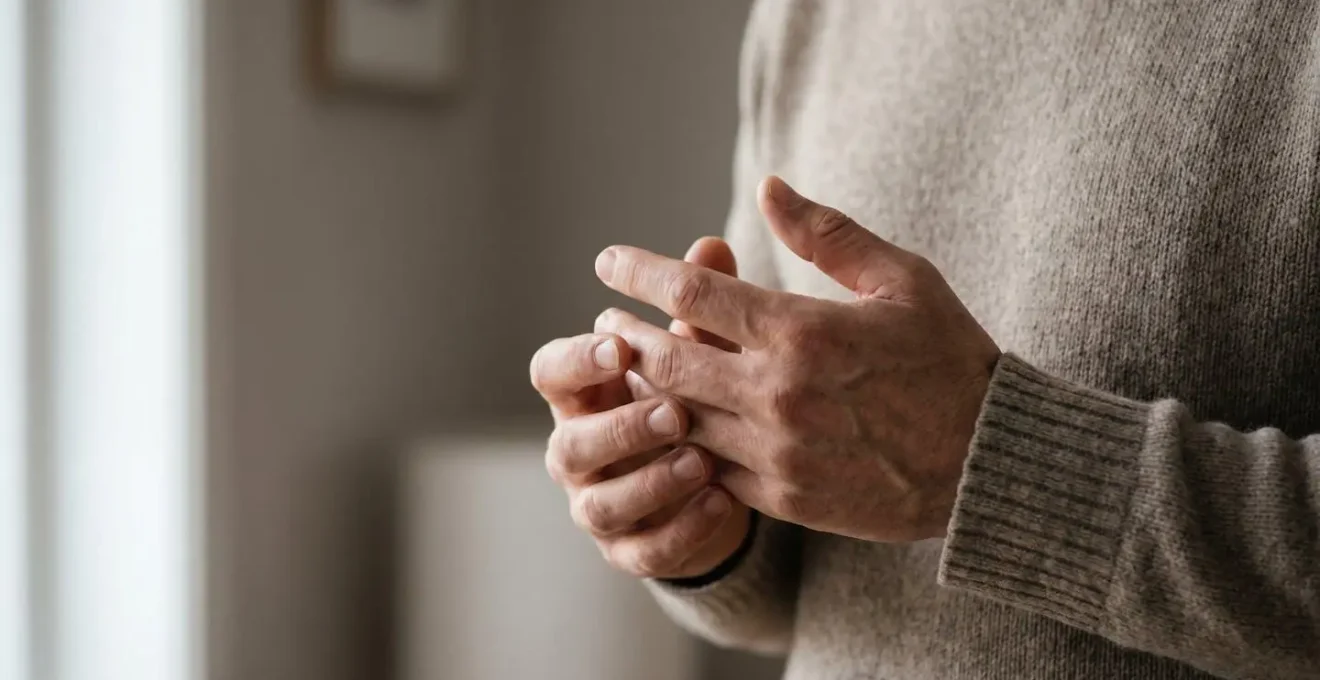
As the image above illustrates, the contact between your fingers and the device is a landscape of sensory information. The pressure, the grip, the texture—all of it is part of the ritual. The ideal device for you is one that feels right in your hand, not just the one with the most advanced features. Experimenting with different shapes and weights is a valid and important part of finding a truly satisfying replacement.
How to Replace Your After-Meal Cigarette Ritual With Satisfying Vape Sessions?
The after-meal cigarette is often the hardest to replace because it’s a classic example of a “trigger.” Your brain has built an ironclad association: End of Meal = Cigarette. Simply vaping in the same spot at the same time might not be enough to break this powerful connection, because the vape is not yet part of that specific ritual. The solution lies in consciously deconstructing the old ritual and building a new one, a process we can call Ritual Scaffolding.
The first step is to create a clear environmental break. Instead of staying at the table where you used to smoke, physically move to a new, designated vaping spot. This could be a balcony, a different chair by the window, or even just stepping outside. This change of scenery acts as a pattern interrupt, signalling to your brain that a new sequence of events is beginning. It separates the act of vaping from the ghost of the cigarette ritual.
Next, you must make the vaping session a distinct and intentional event. This isn’t about mindlessly puffing until the craving subsides; it’s about creating a new sensory experience. A powerful technique is to use a specific e-liquid flavour that you reserve *exclusively* for this post-meal moment. A dessert or coffee flavour can act as a “second course,” complementing the meal and creating a new, positive sensory association. This special flavour becomes the new reward signal for your brain.
Your Action Plan: The Ritual Scaffolding Method
- Change Location: Deliberately move to a balcony, a designated chair, or an outdoor space to create a clear separation from the old eating-and-smoking environment.
- Use a Specific Flavour Profile: Reserve a special dessert or coffee-flavoured e-liquid exclusively for this post-meal session to create a new, complementary sensory cue.
- Set a Defined Timer: Use a 5-minute timer on your phone to create clear boundaries for your vape session, mimicking the finite duration and defined end-point of a cigarette.
Finally, a cigarette has a natural endpoint. A vape does not, which can lead to unsatisfying, continuous puffing. By setting a 5-minute timer for your vape session, you recreate this finite structure. When the timer goes off, the session is over. This builds a new, structured ritual with a clear beginning, middle, and end, giving it the same psychological weight as the cigarette break it replaced.
Why Chewing and Fidgeting Increases After Switching: The Oral Fixation Solution?
If you’ve found yourself chewing on pens, biting your nails, or constantly snacking since switching to vaping, you’re experiencing a classic symptom of unresolved oral fixation. This is a direct consequence of the behavioural duet being incomplete. As the MELO Labs Research Team states, “Oral fixation is a conditioned behavior built over years of repetitive hand-to-mouth motions.” Your vape might be handling the hand-to-mouth motion, but it may not be fully satisfying the “mouth” part of the equation.
A cigarette provides a specific type of oral stimulation. The filter has a certain texture and resistance, and the act of drawing on it involves a specific set of facial muscles. Some vape drip tips don’t offer the same tactile feedback. This can leave the “oral” component of your sensorimotor loop feeling under-stimulated, prompting your brain to seek that stimulation elsewhere—through chewing, snacking, or fidgeting with things in your mouth.
The good news is that this is typically a temporary phase. Your brain is simply trying to fill a sensory gap. For most people, this heightened need for oral stimulation is a peak withdrawal symptom that gradually fades. According to behavioural research, this oral fixation typically peaks in the first few weeks after quitting and most people notice a significant improvement within 2-3 months as the brain adapts. The key is to manage it constructively during this period.
The solution is not to fight it, but to redirect it. Instead of reaching for unhealthy snacks, have healthy alternatives on hand like crunchy vegetables, sugar-free gum, or even a simple toothpick. Some vapers find that experimenting with different drip tip shapes and materials can also help. A longer, narrower drip tip, or one made from a softer material, can sometimes provide a more satisfying oral sensation, helping to close that sensory gap and reduce the urge to chew on other things.
When Does the Hand-to-Mouth Habit Finally Fade for Most Ex-Smokers?
The persistent hand-to-mouth habit fades not on a fixed schedule, but at the pace of your brain’s own rewiring—a process known as neuroplasticity. For years, smoking forged and strengthened neural circuits linking the physical action to a reward. Stopping this action doesn’t instantly erase these circuits; it simply stops reinforcing them. The habit fades as new, stronger pathways are formed and the old ones are pruned away from lack of use.
This isn’t just a theoretical concept; it’s a measurable biological process. Neuroscience research shows that smoking cessation boosts BDNF levels, a crucial protein that stimulates neuroplasticity. This protein acts like a fertiliser for your brain, helping it to grow new connections and develop “abstinence-related adaptations” that actively counter the old tolerance-related pathways. Your brain is literally rebuilding itself to function without the old habit.
The timeline for this is highly individual, but scientific studies provide a hopeful window. It’s not a matter of “if,” but “when” and “how.” The brain actively begins this reallocation process as soon as you manage withdrawal.
Case Study: Brain Rewiring During Smoking Cessation
A recent longitudinal fMRI study tracked smokers through a 5-week cessation program. The results were illuminating: successful quitters showed measurable and adaptive reductions in the connectivity between brain networks responsible for salience (i.e., “what’s important”) and executive control. In simple terms, their brains progressively learned to ‘un-tag’ the hand-to-mouth action as a high-priority event. This research demonstrated that neural circuit reallocation is not a vague hope but a progressive and measurable process that begins within weeks of stopping the old habit.
So, when does the habit fade? It fades when the new rituals you build—like your structured vape breaks—become more reinforced than the ghost of the old one. It fades as your BDNF levels rise and your brain’s natural plasticity gets to work. For most, significant progress is felt within the first 2-3 months, but the key is to actively build new habits, not just passively wait for the old one to disappear.
Why Your Vape Delivers Nicotine but Doesn’t Satisfy Like a Cigarette?
Here we arrive at the most subtle and powerful component of the behavioural duet: the hidden pharmacology of a cigarette. You’ve been led to believe you’re addicted to nicotine. That’s true, but it’s an incomplete truth. You are, more accurately, addicted to the unique and rapid-delivery cocktail found in cigarette smoke, and nicotine is only one part of it.
Cigarette smoke contains thousands of chemicals, including compounds that act as Monoamine Oxidase Inhibitors (MAOIs). Monoamine oxidase is an enzyme in your brain that breaks down “feel-good” neurotransmitters like dopamine. By inhibiting this enzyme, cigarettes ensure that more dopamine hangs around in your synapses after a puff. This creates a synergistic effect: nicotine triggers the release of dopamine, and the MAOIs prevent it from being cleaned up too quickly. This results in an amplified and prolonged feeling of reward and satisfaction.
As research on the topic clearly states, this MAO inhibition may “promote the reinforcing actions of nicotine, thereby enhancing the addictive properties of cigarettes.” Vapes, which deliver relatively clean nicotine without these additional MAOIs, can therefore feel less satisfying. You’re getting the primary note (nicotine) but missing the rich, harmonic undertones (the MAOI effect) that your brain has come to associate with true satisfaction. It’s the difference between hearing a single instrument and a full orchestra.
This explains why the initial switch can feel so hollow. Your brain’s reward system, accustomed to this potent one-two punch, is now receiving only one part of the signal. It’s a less intense, less “complete” feeling. Recognising this is not a sign of failure; it is a crucial insight. It validates your feeling that “something is missing” and shifts the focus from a perceived lack of willpower to a real, pharmacological difference between the two delivery systems.
When to Take MTL Puffs to Replace Your 10 Daily Cigarette Breaks?
Replacing your scheduled cigarette breaks requires moving from a reactive to a proactive mindset. Instead of waiting for a craving to strike and then reacting with a frantic series of puffs, the goal is to maintain a stable level of satisfaction by anticipating your needs. This involves structuring your vape sessions to mirror the timing and purpose of your old cigarette breaks, using mindful Mouth-to-Lung (MTL) puffs.
Start by identifying your most critical “anchor” breaks. These are the non-negotiable cigarettes you used to have—the first one in the morning, the one after lunch, the one ending your workday. Your initial strategy should be to protect these anchors. Set alarms on your phone for these specific times and dedicate 5-10 minutes to a structured session of 10-15 slow, deliberate MTL puffs. This proactive scheduling maintains your body’s expected nicotine rhythm and prevents the desperate, craving-driven vaping that feels so unsatisfying.
Beyond these anchors, you can use a “bookending” technique and what we might call “trigger-based micro-dosing” to handle the other moments. Here’s a practical approach:
- Morning Anchor: Establish your first vape break at your typical first cigarette time (e.g., set a 9:30 AM alarm). Take 10-15 intentional MTL puffs to honour your body’s established nicotine schedule.
- Workday Bookends: Create two non-negotiable sessions that mark the boundaries of your workday—one to start and one to end. This provides psychological containment and structure.
- Trigger-Based Micro-Dosing: For the smaller breaks, link 2-3 MTL puffs to recurring micro-events. Just finished a big email? Take two puffs. About to make a phone call? Take two puffs. This replaces a full 5-minute break with a quick, satisfying dose that manages cravings without disrupting your flow.
The overarching goal for the first 2-4 weeks is to replace a reactive craving response with proactive maintenance dosing. You are not just killing cravings; you are retraining your brain to expect satisfaction at new, predictable intervals, preventing the deep withdrawal spikes that send you reeling.
Key Takeaways
- Smoking addiction is a ‘behavioural duet’ of chemical need and physical ritual; vaping often only addresses the chemical part.
- Cigarette smoke contains MAOIs that enhance nicotine’s effect, a ‘kick’ that standard vapes do not replicate.
- Consciously rebuilding rituals (Ritual Scaffolding) is as critical as managing nicotine intake for long-term satisfaction.
Why Do You Still Crave Cigarettes 3 Weeks After Switching to Vaping?
Three weeks in, you’ve passed the peak of physical withdrawal. You’re vape-literate. Yet, a sudden, sharp craving for a cigarette can still ambush you. This baffling experience is often the result of what we can call a pharmacokinetic mismatch. In simpler terms, it’s not just about *how much* nicotine you get, but *how fast* it gets to your brain.
A cigarette is a brutally efficient drug delivery device. When you inhale, the nicotine, vaporised in the burning tip, travels to your lungs and is absorbed into the bloodstream, reaching your brain in as little as 10-20 seconds. This creates a rapid, intense spike in nicotine levels. Vapes, while effective, are generally slower. The time to peak nicotine concentration can be significantly longer. As pharmacokinetic research reveals, the time to peak nicotine concentration for a cigarette is around 5 minutes, while for some non-inhaled nicotine products it can be over 20 minutes. This difference between a sharp ‘spike’ and a gentle ‘curve’ is something your brain registers as a profound difference in satisfaction.
This is compounded by the MAOI effect we discussed earlier. Your brain’s memory of a “real” satisfying hit is not just of nicotine, but of the rapid spike combined with the amplified dopamine effect from MAO inhibition. A sudden stressor or trigger can activate this powerful memory, and your brain cries out not just for nicotine, but for the specific, immediate, and potent relief it remembers from a cigarette. When your vape provides a slower, more rounded delivery, it can feel like a pale imitation in that moment of intense craving.
Understanding this is incredibly freeing. The craving at three weeks isn’t a sign that vaping is failing or that you are weak. It is a physiological echo, a memory of a specific chemical event that your vape is not designed to replicate perfectly. The solution is not to chase that spike, but to ride out the craving (which typically lasts only a few minutes) and trust in the new, more stable satisfaction curve you are building with your structured vaping routine.
By understanding these deeper mechanics of ritual, chemistry, and timing, you can now move from simply replacing nicotine to consciously rebuilding a new, more satisfying habit that works for you, finally silencing the echo of the cigarette for good.