Smoking Cessation
Quitting smoking remains one of the most challenging health decisions you’ll ever make, yet it’s also one of the most rewarding. For decades, smokers had limited options: quit cold turkey and endure brutal withdrawal, or rely on patches and gum that addressed nicotine but ignored the ritual. Vaping has fundamentally changed this landscape by tackling both the chemical addiction and the behavioral patterns that keep you reaching for cigarettes.
This comprehensive resource unpacks every critical aspect of smoking cessation through vaping. You’ll understand why your first attempt might feel unsatisfying, what happens in your body during those crucial first 72 hours, how to match your nicotine strength to your smoking habit, and why simple devices outperform complicated setups. Whether you’re researching options before your quit date or struggling three weeks into your transition, the strategies and timelines explained here will help you navigate the journey from smoker to ex-smoker.
Why Traditional Cessation Methods Leave Half the Battle Unfought
Nicotine replacement therapies like patches and gum achieve roughly 10-15% success rates in clinical trials. The reason isn’t mysterious: they deliver nicotine efficiently but completely abandon the behavioral component of smoking. Your brain has spent years linking specific moments—finishing a meal, stepping outside with colleagues, driving to work—with the physical act of smoking.
Vaping addresses this gap by replicating the hand-to-mouth motion, the inhale-exhale rhythm, and the brief pause in your day that cigarettes provided. Recent UK trials show success rates climbing to 18-20% when vaping is combined with behavioral support, outperforming traditional nicotine replacement by nearly double. The method works not despite mimicking smoking, but precisely because it does.
Cold turkey approaches fail differently. Withdrawal symptoms peak within 72 hours, creating a window where physical discomfort amplifies psychological cravings. Without any nicotine management, you’re fighting both battles simultaneously. Studies consistently show that quit attempts supported by some form of nicotine replacement—whether pharmaceutical or behavioral—succeed more often than willpower alone.
Choosing Your First Vaping Device: Why Simplicity Beats Features
The vaping market overwhelms new users with options: pod systems, sub-ohm tanks, variable wattage mods, rebuildable atomizers. This complexity creates a paradox where the cheapest devices and the most expensive devices both lead to failure, while mid-range simplicity succeeds.
The Budget Device Trap
Devices under £10-15 typically suffer from inconsistent vapor production, leaking, or poor battery life. When your device fails during a craving, the nearest corner shop sells cigarettes, not replacement coils. Approximately 70% of users who start with ultra-budget devices return to smoking within the first month, not because vaping failed them, but because their device did.
The Complexity Problem
Conversely, advanced devices with adjustable wattage, temperature control, and rebuildable coils demand knowledge you don’t yet have. You need to understand coil resistance, power curves, and e-liquid compatibility. This learning curve introduces friction during the critical first week when simplicity and reliability matter most.
The Sweet Spot: Simple Pod Systems
Devices in the £20-40 range with prefilled or refillable pods, fixed power output, and draw-activated firing succeed because they eliminate decision fatigue. You inhale, you get vapor, you satisfy the craving. The device matches a cigarette’s simplicity while delivering reliable nicotine. Success rates for users who start with appropriately-matched devices exceed 60% at the three-month mark.
Matching Nicotine Strength to Your Smoking Habit
The single most common mistake new vapers make is choosing nicotine strength based on what “sounds right” rather than what matches their consumption. A pack-a-day smoker who selects 3mg freebase nicotine in a pod system will experience constant under-dosing, triggering the exact withdrawal symptoms they’re trying to avoid.
Nicotine salt e-liquids, available in 10mg and 20mg concentrations in TPD-compliant regions, deliver nicotine more efficiently to your bloodstream. A 20-cigarette-per-day smoker typically needs 18-20mg to feel adequately satisfied. A 10-cigarette-per-day smoker often finds 10-12mg sufficient. These aren’t arbitrary numbers—they’re based on the nicotine absorption curves that replicate what you’re accustomed to receiving.
Under-dosing creates a vicious cycle: you vape constantly trying to satisfy cravings, experience throat irritation from excessive puffing, declare vaping “doesn’t work,” and return to cigarettes. The solution isn’t to vape more; it’s to use the appropriate nicotine concentration from day one. You can always reduce later—the priority now is successfully replacing cigarettes.
The First 72 Hours: What Your Body Actually Experiences
The mythology around quitting smoking often exaggerates the timeline. The physical nicotine withdrawal from cigarettes peaks within 48-72 hours and substantially resolves within a week. What persists for weeks or months are behavioral cravings and habit patterns, not acute chemical withdrawal.
Hour by hour, expect these changes: Within 8 hours, oxygen levels in your blood normalize. Within 24 hours, carbon monoxide completely leaves your system. Between 24-48 hours, many people experience headaches, irritability, and difficulty concentrating—this is your brain adjusting to consistent nicotine delivery rather than the rapid spikes cigarettes provided.
Vaping throughout this period maintains stable nicotine levels, preventing the dramatic crashes that make cold turkey so miserable. You’ll still feel “off” because your body is clearing thousands of other chemicals, but you’re not simultaneously fighting nicotine starvation. Most users report that by day four or five, the physical discomfort has substantially decreased, leaving only the psychological attachment to cigarettes.
Why Your Vape Feels Different: Understanding the Absorption Gap
Cigarettes deliver nicotine to your brain in approximately 10-15 seconds through a combination of pulmonary absorption and chemical additives that enhance delivery. Vaping takes 20-30 seconds, nearly twice as long. This delay creates the single most common complaint from new vapers: “I’m getting nicotine, but it doesn’t satisfy the same way.”
The solution isn’t to switch back to cigarettes, but to adjust your vaping pattern during the first month. Instead of taking three quick puffs and putting the device down, you need 5-7 deliberate draws to reach equivalent satisfaction. Think of it like drinking espresso versus filter coffee—different delivery mechanisms for the same active ingredient require different consumption patterns.
Additionally, cigarettes trigger dopamine release through compounds beyond nicotine itself. Your brain is temporarily “expecting” these other chemicals and feels unsatisfied when they’re absent. This sensation fades within 2-3 weeks as your neurochemistry recalibrates, but it explains why week three often feels harder than week one. You’re not failing—you’re experiencing a completely normal adjustment period.
Managing Cravings: The 3-Minute Window
Cravings follow a predictable pattern: they intensify rapidly, peak around 2-3 minutes, then dissipate regardless of whether you act on them. The cigarette doesn’t eliminate the craving—it distracts you while the craving naturally subsides. Understanding this pattern transforms your strategy.
When a craving hits, use your vape immediately rather than trying to resist. Take 5-7 deliberate puffs over 90 seconds, then put the device down and engage in a brief activity: walk to another room, drink water, check your phone. By the time you complete this 3-minute cycle, the craving has passed through its natural peak.
Certain situations trigger disproportionately strong cravings: after meals, with morning coffee, during work breaks, after stressful events, and in social settings where you previously smoked. These aren’t random—they’re conditioned responses your brain has built over years. The solution isn’t avoidance, but deliberate replacement. Vape immediately before your morning coffee to front-load nicotine. Replace your after-meal cigarette with a specific vape session. The ritual matters as much as the nicotine.
Breaking Behavioral Chains: The Hand-to-Mouth Habit
After several weeks smoke-free, many ex-smokers report that physical nicotine cravings have vanished, yet they still feel compelled to “do something with their hands” 15-20 times per day. This is habit memory—your brain has automated the smoking sequence so thoroughly that it runs like a background program.
Vaping satisfies this behavioral need initially, but it shouldn’t become a permanent substitute unless you consciously choose that path. The hand-to-mouth habit typically fades within 8-12 weeks for most people, though stressful situations can temporarily revive it months later. You’ll notice the urge spacing out: instead of 20 times daily in week four, it’s 10 times daily in week eight, then 3-4 times daily in week twelve.
Some ex-smokers strategically use 0mg nicotine e-liquid during this phase, maintaining the ritual without chemical dependence. Others simply reduce vaping frequency naturally as the behavioral compulsion weakens. There’s no “correct” timeline—only your own journey toward whatever endpoint you’ve chosen, whether that’s occasional vaping, continued nicotine use, or complete cessation.
The Dual-Use Trap: Why “Cutting Down” Often Backfires
It seems logical: smoke 5 cigarettes per day while vaping the rest, gradually reducing until cigarettes disappear. Research consistently shows this approach fails. Dual use doesn’t reduce harm proportionally—smoking even 3-5 cigarettes daily maintains nearly 70% of the cardiovascular risk of smoking a full pack.
More critically, every cigarette you smoke reinforces the neural pathways you’re trying to break. Your brain learns that when vaping doesn’t satisfy, cigarettes will. This creates a hierarchy where cigarettes remain the “real” solution and vaping is merely a partial substitute.
Successful transitions typically involve a clean break: a designated quit date where cigarettes stop completely and vaping begins. You can prepare by using your vape alongside cigarettes for a week beforehand, learning how to use the device before you depend on it. But once you cross the quit date, committing fully to vaping gives your brain permission to recalibrate toward this new nicotine source.
Comparing Vaping to Other Cessation Methods
Prescription medications like varenicline (Champix) work by blocking nicotine receptors in your brain, reducing both satisfaction from smoking and withdrawal severity. Success rates range from 20-25% in clinical trials, slightly higher than vaping alone but accompanied by side effects including nausea, vivid dreams, and mood changes in some users.
Nicotine patches provide steady background nicotine but eliminate behavioral satisfaction. Gum offers some oral fixation but requires specific chewing techniques and tastes medicinal. Neither replicates the throat hit, hand-to-mouth motion, or visible vapor that make vaping psychologically satisfying.
Combining methods often yields the best results: vaping for behavioral satisfaction plus NHS Stop Smoking Service support for accountability and expert guidance. Free services provide counseling, progress tracking, and prescription options if needed. Studies show that behavioral support increases success rates by 30-40% regardless of which nicotine replacement method you choose.
Milestones That Matter: Tracking Your Progress
The first week smoke-free feels monumental because it is—you’ve broken the acute physical dependence. The one-month mark represents surviving your first full cycle of trigger situations: the stressful workday, the weekend social event, the monthly deadline. By three months (90 days), your success probability jumps dramatically; relapse rates drop below 20% once you’ve reached this threshold.
These milestones aren’t arbitrary. Neurological research shows that habit reformation requires 60-90 days of consistent new behavior to overwrite old patterns. Your brain needs this time to accept vaping (or abstinence) as the new normal rather than a temporary deviation from smoking.
Track these wins concretely: money saved, cigarettes not smoked, improved lung function. Physical improvements appear faster than you expect—cardiovascular function measurably improves within two weeks, taste and smell return within a month, and chronic cough typically resolves within 6-8 weeks. These tangible changes reinforce that your effort is producing real results.
The Nicotine Reduction Journey: When and How to Step Down
Not everyone chooses to reduce nicotine, and there’s no medical requirement to do so if vaping satisfies you without cigarettes. But if complete nicotine independence is your goal, the timeline matters. Attempting to reduce too early—within the first 3-6 months—often triggers relapse because your cessation hasn’t fully solidified.
Once you’ve been stably smoke-free for at least six months, stepping down from 20mg to 10mg, then 6mg, then 3mg, then 0mg becomes feasible. Each reduction should last 6-8 weeks minimum, allowing your brain to adjust. The jump from 3mg to 0mg often feels disproportionately difficult because you’re finally eliminating the chemical entirely, not just reducing it.
At 0mg, you’re maintaining only the behavioral habit. Some people continue at this level indefinitely, finding it harmless and satisfying. Others gradually reduce usage frequency until they forget to vape for entire days. The final step—putting down the 0mg vape—happens naturally for most people rather than requiring a formal “quit vaping” date.
Why Vaping Doesn’t Work for Everyone
Approximately 15-20% of smokers try vaping and genuinely don’t find it satisfying, even with correctly matched devices and nicotine levels. Some report that the vapor triggers coughing or throat irritation that doesn’t improve. Others find the flavor options overwhelming or unpleasant compared to tobacco.
For this group, other methods deserve consideration. Prescription medications, nicotine patches, or behavioral therapy-only approaches may succeed where vaping failed. The goal is smoking cessation through whatever evidence-based method works for you individually, not adherence to a single approach.
Equally important: relapse doesn’t mean failure. Smoking three cigarettes after two weeks smoke-free doesn’t erase 14 days of progress. It’s information about which triggers need stronger strategies, not proof that you’re incapable of quitting. Most successful ex-smokers made 5-7 quit attempts before achieving long-term cessation. Persistence matters more than perfection.
Smoking cessation through vaping works by addressing both components simultaneously: nicotine delivery and behavioral satisfaction. Understanding the mechanics—absorption timelines, device selection, craving patterns, milestone significance—transforms this from a willpower battle into a manageable, strategic process. Whether you’re researching before your quit date or struggling through your third week, the evidence-based strategies outlined here provide a roadmap toward becoming and remaining smoke-free.

Why Does 0mg E-Liquid Feel… Wrong? A UK Vaper’s Guide to a Successful Switch
Making the final jump to 0mg e-liquid often feels like a letdown because you’re losing more than just nicotine: you’re losing critical sensory and chemical feedback loops. The “throat hit”…
Read more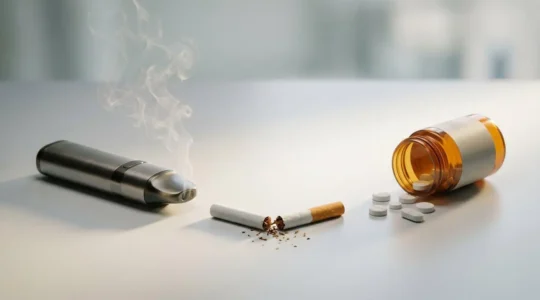
How Does Vaping Compare to Prescription Medications Like Champix for Quitting?
Vaping’s higher success rates in UK trials are not just about nicotine; they are about effectively replacing the behavioural ritual of smoking, a factor that patches and gums miss. Vaping…
Read more
Why a Vape Backup Crushes Cold Turkey for Quitting Smoking
Quitting smoking with a vape isn’t about replacing one habit with another; it’s a strategic project to dismantle your smoking identity and build a new one. The high failure rate…
Read more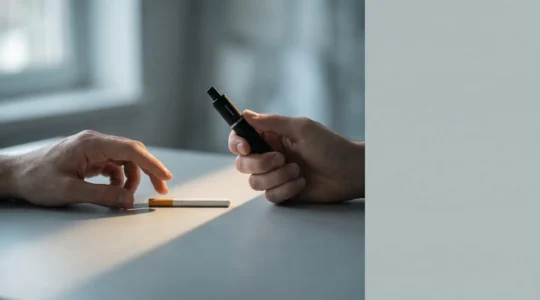
Why Does One Cigarette Craving Destroy Weeks of Progress Even While Vaping?
The breakthrough cigarette craving you experience isn’t a failure of willpower; it’s a specific, predictable event caused by the mismatch between a cigarette’s sharp “nicotine signature” and the smoother delivery…
Read more
Why Does Your Vape Satisfy Nicotine Cravings but Not the Urge to Do Something With Your Hands?
You believe the craving is just for nicotine. The reality is that smoking is a ‘behavioural duet’ of chemical dependency and sensorimotor ritual. This article reveals why your vape often…
Read more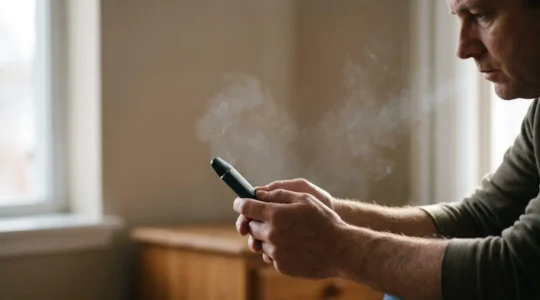
Why Do You Still Get Headaches and Irritability After Switching to Vaping?
The frustrating withdrawal symptoms you feel despite vaping are not a sign of failure, but a predictable ‘Satisfaction Gap’ caused by a biochemical mismatch between cigarettes and vapes. Cigarettes deliver…
Read more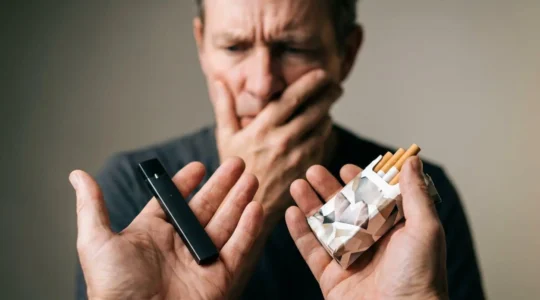
Why Most First Vapes Fail: How to Choose the Right Kit to Finally Quit Smoking
Success in vaping isn’t about features or flavours; it’s about precisely matching a device’s nicotine delivery to your unique smoking habit. Most beginner failure stems from a “satisfaction gap”—where a…
Read more
Why Do You Still Crave Cigarettes 3 Weeks After Switching to Vaping?
Your persistent cigarette cravings are not a sign of failure but a predictable neurochemical echo that your vape, despite delivering nicotine, cannot fully silence. Cigarettes deliver nicotine plus other chemicals…
Read more