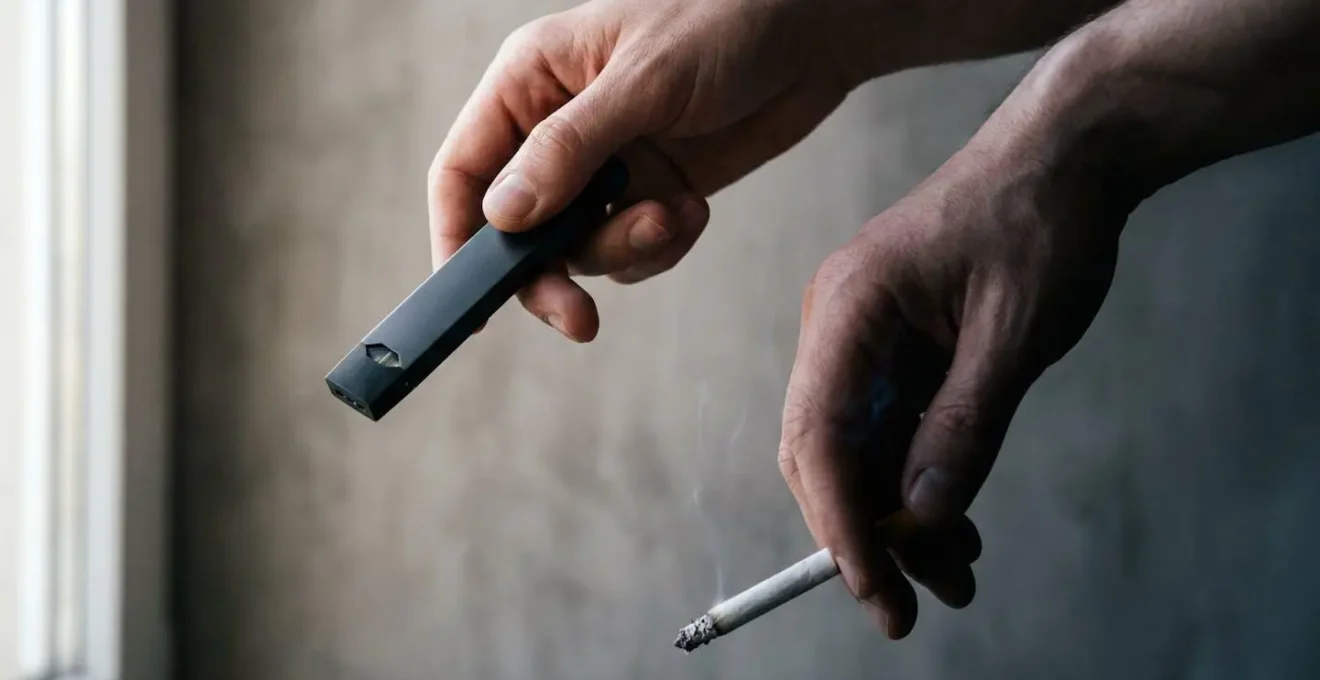
Modern pod systems succeed because they’re designed to deliver cigarette-like satisfaction instantly, solving the core problems that made older vapes fail you.
- They use nicotine salts for a faster, smoother ‘hit’ that properly manages cravings, unlike the harsh, slow-acting vapes of the past.
- Simple, low-maintenance kits prevent the technical issues, dead batteries, and general faff that often leads new users back to smoking.
Recommendation: Match a simple, refillable pod kit with the right nicotine salt strength to your specific smoking habit for the highest chance of success and maximum cost savings.
Alright, let’s have an honest chat. You’re thinking about making the switch, or maybe you’ve tried it before—one of those big, clunky mods or a cheap cigalike from the corner shop—and it just didn’t stick. You ended up back on the cigarettes, feeling a bit let down and maybe thinking vaping just isn’t for you. As a vape shop specialist here in Manchester for the past eight years, I’ve seen that exact story play out hundreds of times.
Most of the advice you find online is either shouting about being “95% safer” or throwing a thousand bewildering fruit flavours at you. But none of that helps when, two hours into your day, that familiar craving kicks in and your vape just isn’t hitting the spot. For a long-term smoker, it’s not about the novelty; it’s about finding a reliable tool that genuinely replaces the cigarette. The satisfaction, the ritual, the throat hit—it all has to be there.
Here’s the secret they don’t tell you: it wasn’t your willpower that failed. It was the technology. The game has completely changed. Modern pod systems are not just another e-cigarette; they are a different beast entirely. They’re specifically engineered to provide the rapid satisfaction and behavioural substitution that a smoker needs to make the transition feel less like a compromise and more like a genuine upgrade.
In this guide, I’m going to walk you through exactly why these new devices work where others failed. We’ll cover how to choose the right one for you (not for a cloud-chasing teenager), how to use it properly without coughing your lungs up, and how it will genuinely save you a small fortune. Let’s find you the right tool for the job, one that fits seamlessly into your life.
This article breaks down everything you need to know, from the science of satisfaction to the practical pounds and pence. Here’s what we’ll cover to make sure your switch to a pod system is a lasting success.
Summary: Why Modern Pod Vapes Are the Key to Quitting Smoking for Good
- Why Did Your First E-Cigarette Fail but Modern Pods Actually Satisfy Cravings?
- Closed Pods or Refillable Pods: Which Saves You £500 per Year in the UK?
- The Pod Mistake That Makes 40% of New Vapers Return to Smoking Within a Month
- How to Adjust Your Pod System for the Perfect Throat Hit Without Coughing?
- When to Increase Your Puff Frequency: The First 30 Days With a Pod System
- Why Simple Kits With Fewer Settings Have Higher Quit-Smoking Success Rates?
- How Much Would You Save Switching From Disposables to a £25 Starter Kit?
- Why Do 60% of First-Time Vapers Choose the Wrong Kit and Return to Cigarettes?
Why Did Your First E-Cigarette Fail but Modern Pods Actually Satisfy Cravings?
If you’ve tried vaping before and went back to smoking, you’re not alone. The primary reason older e-cigarettes failed so many smokers was their inability to match the speed of a cigarette. A cigarette delivers a nicotine ‘hit’ to the brain in seconds, and early vape devices just couldn’t compete. They delivered nicotine slowly and inefficiently, leaving you puffing away but still feeling that nagging, unsatisfied craving. It felt like drinking a weak, lukewarm cup of tea when you desperately needed a strong espresso.
Modern pod systems cracked this code with two key innovations: nicotine salts and improved device efficiency. Unlike the ‘freebase’ nicotine used in older liquids, nicotine salts are absorbed by the body much more quickly and provide a smoother experience at higher concentrations. This gives you that crucial, near-instant craving relief. In fact, research from the National Cancer Institute demonstrates that just 10 puffs from a modern pod system can deliver significantly more nicotine than the same number of puffs from an older device. It finally achieves craving-response parity with a cigarette.
This isn’t just a minor improvement; it’s a fundamental change that makes all the difference. Studies have found that pod-based vapes are significantly more effective at reducing withdrawal symptoms and cravings than even nicotine gum. Why? Because they don’t just replace the nicotine; they replace the sensation of satisfaction. This is the core reason why, for the first time, a vaping device can feel like a true substitute rather than a disappointing alternative.
Closed Pods or Refillable Pods: Which Saves You £500 per Year in the UK?
Once you’ve decided a pod system is the right tool, the next question is about convenience versus cost. You’ll see two main types on the shelf: prefilled (or ‘closed’) pods and refillable (‘open’) pods. A closed pod system, like an Elf Bar ELFA or a Vuse, uses disposable cartridges that you throw away when they’re empty. They are incredibly simple—just click a pod in and go. A refillable system requires you to buy bottles of e-liquid and top up the pod yourself. It’s a tiny bit more effort, but this is where the serious savings are.
Let’s be blunt: if you are a regular smoker, using disposable vapes long-term is a massive waste of money. They are the most expensive way to vape. A refillable pod system, however, offers dramatic savings over both disposables and, of course, cigarettes. While a starter kit might cost you £20-£25 upfront, the ongoing running cost plummets. The numbers clearly show that the small effort of refilling a pod yourself pays huge dividends over the year.
This table breaks down the typical annual costs for a moderate vaper in the UK, showing just how the options stack up. The initial investment in a refillable kit is paid back within weeks.
| Vaping Option | Initial Cost | Weekly Cost | Annual Cost | Annual Savings vs Disposables |
|---|---|---|---|---|
| Disposable Vapes (1 every 2 days) | £0 | £21-£35 | £730 | — |
| Prefilled Pod Kit (e.g., Elf Bar ELFA) | £20-£25 | £12-£18 | £644-£660 | £70-£86 |
| Refillable Pod Kit + E-liquid | £20-£25 | £7-£10 | £360-£385 | £345-£370 |
| Source: Based on 2ml daily consumption, UK retail prices 2025. Refillable calculation includes £240 e-liquid + £120 replacement coils/pods annually. | ||||
Ultimately, the choice is yours. Prefilled pods offer maximum convenience, but if you’re looking to save a significant amount of money—we’re talking hundreds of pounds a year—a refillable pod system is, without question, the smartest financial choice.
The Pod Mistake That Makes 40% of New Vapers Return to Smoking Within a Month
Right, this is probably the most important piece of practical advice I can give you. The single biggest mistake a new vaper can make has nothing to do with flavour or nicotine strength. It’s letting your device’s battery die. This sounds trivial, but it’s the critical failure point. Imagine you’re out, the craving hits, you reach for your vape, and… nothing. The battery is dead. The immediate, easy solution is the newsagent across the road selling a pack of 20. Game over.
This “failure point anxiety” is real, and it’s why ensuring 100% uptime for your device is non-negotiable in the first few months. The data backs this up entirely. A UK longitudinal study published in BMC Medicine found that inconsistent, non-daily vaping was associated with a staggering 65% relapse rate back to smoking, compared to just 34.5% for those who vaped daily. If your device isn’t available the moment you need it, your chances of success are cut in half.
So, what’s the simple, foolproof solution? It’s what I call the ‘two is one, one is none’ strategy. Buy two identical, inexpensive pod kits. Keep one on charge while you use the other. When you leave the house, take both. One lives in your pocket, the other in your bag or car. This completely eliminates the risk of being caught out. It’s a small £20-£25 investment in what is essentially a success guarantee.
As you can see, it’s not about having a fancy device; it’s about having a reliable system. This strategy removes the primary technical reason for failure, allowing you to focus on managing your transition without the background anxiety of a dying battery. It’s the best tip I give to any new switcher, and it works.
How to Adjust Your Pod System for the Perfect Throat Hit Without Coughing?
One of the first hurdles for many new vapers is the cough. You take your first puff expecting it to feel like a cigarette, but instead, you end up in a coughing fit. It’s off-putting and makes you think you’re doing something wrong. The truth is, your body just isn’t used to inhaling vapour, and most people instinctively try to inhale a vape the same way they would a cigarette, which is a mistake.
Cigarette smoke is hot and harsh, and smokers learn a specific draw technique. Vapour from a pod system is cooler and much smoother, especially with nicotine salts. As one Vaping Technology Researcher noted, “Pod systems paired with nic salts replicate the sensation of smoking more closely… The fast nicotine delivery mimics the experience of a cigarette.” The key is learning how to inhale this vapour correctly to get the satisfying “throat hit” without irritating your airways.
The technique is called Mouth-to-Lung (MTL) inhaling, and it’s a two-step process. You’re simply recreating the way you likely smoked. Instead of pulling the vapour directly into your lungs in one big breath (Direct-to-Lung, which causes coughing), you first draw it into your mouth.
Your Action Plan: The 5-Step MTL Inhalation Technique
- Draw vapour slowly and gently into your mouth for 3-5 seconds, as if sipping from a straw. Do not inhale into your chest.
- Hold the vapour in your mouth for a second or two. This allows some nicotine to be absorbed and lets the vapour cool slightly.
- Now, open your mouth and take a secondary breath of fresh air, drawing the vapour from your mouth down into your lungs.
- Exhale slowly and steadily. A rushed exhale can be harsh on a throat that is still healing from years of smoking.
- Wait at least 30-60 seconds between puffs, especially in the first few days. This gives your throat time to acclimatise.
Mastering this simple technique is a game-changer. It delivers a smooth, satisfying experience that feels familiar and controlled, eliminating the cough and allowing you to enjoy the device as the effective tool it’s designed to be.
When to Increase Your Puff Frequency: The First 30 Days With a Pod System
A common question I get is, “How much should I be vaping?” People worry they are using their device too much. The answer is simple: in the beginning, you should vape as much as you need to not smoke. Don’t count your puffs. Don’t set a timer. Your goal for the first month is 100% abstinence from cigarettes, and your vape is the tool to achieve that.
You need to unlearn the rigid structure of “smoke breaks.” A cigarette is a finite event; you light it, smoke it to the end, and that’s it for an hour. A vape is different. It’s there for you to take a puff or two whenever a craving starts to bubble up. Think of it less as a scheduled break and more as on-demand craving management. That’s precisely why it’s so effective. The International Tobacco Control Four Country Survey confirmed that the overwhelming majority, 92.3% of ex-smokers who now vape, report using their device specifically to manage cravings and stay off cigarettes.
It’s about behavioural substitution. Research shows that vaping is powerful because it replaces the physical, psychological, and social rituals you used to get from smoking. The hand-to-mouth action, the feeling of inhalation, the momentary pause in your day—your pod system now fulfils all those roles. So, if you’re stressed and would have reached for a cigarette, reach for your vape. If you’ve just finished a meal, have a few puffs. Use it to replace the cigarette in every scenario. Over time, you will naturally find your own rhythm and your usage will likely decrease, but for the first 30 days, your only job is to not light up. Give yourself permission to use the tool as needed.
Why Simple Kits With Fewer Settings Have Higher Quit-Smoking Success Rates?
When you first look at vapes, it’s easy to get drawn in by devices with screens, adjustable wattage, and multiple buttons. They look more advanced, so they must be better, right? Wrong. For a smoker trying to quit, complexity is the enemy. Every extra setting is another potential point of confusion and frustration. This is the concept of cognitive load—the more you have to think about using the device, the less likely you are to stick with it when a craving hits.
The beauty of a modern pod system is its simplicity. The best starter kits have no screens, no menus, and often not even a button. You just inhale, and it works. This is called ‘auto-draw’, and it’s designed to perfectly replicate the action of smoking. It removes all the technical barriers, making the device as intuitive and reliable as a pack of cigarettes. You don’t have to worry if you’re on the right setting; the device is pre-set to provide the optimal experience for a new user.
As one UK vape retail expert put it, “A 30W adjustable pod-mod sounds better than an 18W auto-fire kit, but the simpler kit usually delivers the better first month for an ex-smoker.” The goal isn’t to become a hobbyist who understands coil resistance and wattage curves. The goal is to stop smoking. A simple, reliable tool is always better than a complex one for that job.
Look for a device that feels like an elegant tool, not a gadget. Its purpose is to deliver satisfaction with minimum fuss. By choosing a simple kit, you free up your mental energy to focus on the most important part of the journey: breaking the habit and adjusting to life without combustible tobacco.
How Much Would You Save Switching From Disposables to a £25 Starter Kit?
Many people get their first taste of vaping with a disposable, like an Elf Bar or a Lost Mary. They’re available everywhere and seem convenient. But if you use them for more than a week or two, you are setting money on fire. The cost adds up incredibly fast. A refillable pod kit, which you can buy for about £25, is vastly cheaper in the long run.
Let’s look at the raw numbers. A regular disposable user can easily spend £35-£40 a week. In contrast, once you have your £25 refillable kit, your only weekly cost is a bottle of e-liquid, which is typically £4-£5 and lasts for days. A cost analysis from UK vape retailers shows a typical monthly spend of £72 for disposables versus just £28 for a refillable setup. That’s a saving of over £500 a year, and for heavier users, it’s often closer to £860.
The break-even point—the moment your initial £25 investment has paid for itself—comes surprisingly quickly. For a moderate to heavy user, you’ll be in profit by the end of your second or third week. This table shows how the weekly costs compare and when you start saving money.
| Usage Pattern | Disposables (Weekly) | Refillable Kit (First Month) | Refillable Kit (Ongoing Weekly) |
|---|---|---|---|
| Light User (1 disposable every 2 days) | £21 (3 disposables) | £25 kit + £4 e-liquid = £29 | £4-£5 (e-liquid only) |
| Moderate User (1 disposable daily) | £35-£42 (5-7 disposables) | £25 kit + £6 e-liquid = £31 | £6-£8 (e-liquid + occasional coil) |
| Heavy User (2 disposables daily) | £70-£84 (10-14 disposables) | £25 kit + £10 e-liquid = £35 | £10-£12 (e-liquid + coils) |
| Break-even point: Week 2 for heavy users, Week 3 for moderate users, Week 4 for light users. Based on UK 2025 retail prices. | |||
Beyond the cost, refillable kits are also much better for the environment than single-use disposables. The choice is clear: disposables are a good way to try vaping for a weekend, but a refillable starter kit is the smart, sustainable, and financially savvy choice for anyone serious about making the switch.
Key Takeaways
- Satisfaction is Key: Modern pods work because nic salts deliver nicotine as fast as a cigarette, satisfying cravings effectively where old tech failed.
- Simplicity Wins: Over-complicated devices are a common failure point. A simple, auto-draw pod kit with a good battery is the best starting point for a smoker.
- Ensure Uptime: The biggest mistake is running out of power or liquid. Having a backup device or pod is a non-negotiable investment in your success.
Why Do 60% of First-Time Vapers Choose the Wrong Kit and Return to Cigarettes?
It’s a tough statistic, but it’s true: a large number of people who try vaping for the first time don’t stick with it. Yet, we know it can be an incredibly effective tool. The latest data from Action on Smoking and Health (ASH) shows that 53% of the UK’s current vapers are ex-smokers, which equates to 3 million people. So what separates the success stories from those who relapse? More often than not, it’s choosing the right kit from day one.
The “wrong kit” is usually a mismatch between the device’s capabilities and the smoker’s habits. A heavy, 20-a-day smoker who buys a low-powered, low-nicotine device will feel underwhelmed and unsatisfied. A light, social smoker who gets a powerful kit with high-strength nicotine will feel sick and overwhelmed. Success hinges on finding the “satisfaction threshold” from the very first puff. It’s about matching the tool to your specific needs.
Instead of picking a device based on its colour or a recommendation from a friend who has been vaping for years, you need to diagnose your own smoking profile. This self-diagnosis guide will help you align your past habits with the right type of pod kit and nicotine strength to give you the best possible start.
- Heavy Smoker (20+ cigarettes/day): You need immediate and effective satisfaction. Choose a 20mg nicotine salt e-liquid paired with a simple pod kit that has a tight, cigarette-like draw (MTL) and an auto-draw feature. A battery of at least 1000mAh is essential. Expect to vape frequently.
- Moderate Smoker (10-19 cigarettes/day): You have a bit more flexibility. A 10mg or 20mg nicotine salt is a good starting point. A pod kit with a slightly adjustable airflow can help you fine-tune the experience. An 800-1000mAh battery should be sufficient.
- Light Smoker (5-9 cigarettes/day): Your biggest risk is choosing a strength that is too high. Start with a 5mg or 10mg nicotine salt. A pod with a slightly looser draw may feel more comfortable for you.
- Social Smoker (less than 5/day): A low-strength 3mg or 6mg e-liquid, possibly even freebase nicotine, is likely all you need. Be cautious of chain-vaping a low-strength liquid, as the habit can creep up.
The first 72 hours are critical. Your goal is to match or even slightly exceed the nicotine intake you had from cigarettes to crush the initial cravings. You can always adjust and taper down your nicotine strength later, once you are confidently smoke-free.
Look, making the switch is a significant step, and the perfect kit is simply the one you’ll actually use every day. Start with this advice, find a simple device that matches how you smoked, and give yourself a fair shot. You’ve got this.