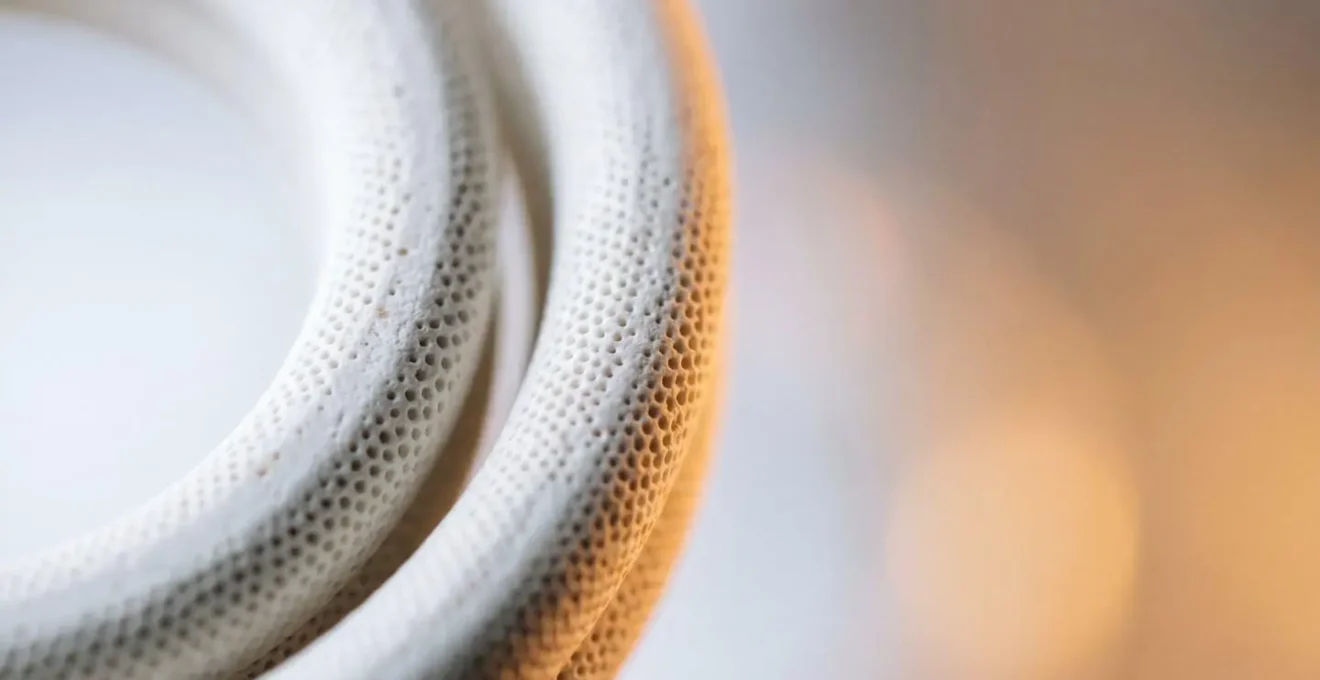
Ceramic coils offer superior flavour purity and longevity due to their material properties, but their safety and performance depend entirely on manufacturing quality and using the correct e-liquid.
- The risk of inhaling harmful particles from high-quality, intact ceramic coils is negligible, according to independent tests.
- Their main advantage is thermal stability and chemical inertness, preventing burnt tastes and reactions with e-liquid, unlike cotton.
Recommendation: Choose ceramic coils for thinner (50/50) e-liquids and flavour purity, but always source them from reputable brands to avoid risks associated with poor manufacturing.
For any UK vaper navigating the world of coils, the term “ceramic” is loaded with promise and confusion. On one hand, it’s marketed as a revolutionary step towards a cleaner, purer, and safer vaping experience. The claims of longevity and unparalleled flavour fidelity are tempting. On the other hand, whispers and warnings of microscopic particles and potential health risks create a fog of uncertainty. This isn’t just about choosing hardware; it’s about understanding what you’re inhaling.
The typical advice often boils down to simplistic binaries: cotton burns, ceramic doesn’t; mesh gives more vapour, ceramic gives more flavour. While these statements hold a kernel of truth, they fail to address the core of the controversy. They don’t explain the fundamental material science that dictates why these coils perform so differently, nor do they equip you with the knowledge to critically evaluate the claims and risks for yourself.
But what if the key wasn’t simply choosing a side in the ceramic vs. mesh debate, but understanding the underlying physics? The truth is that the “safest” or “best” coil is a complex equation of material integrity, thermal dynamics, and user habits. This article will move beyond the marketing hype and the scaremongering. We will dissect the technology from a specialist’s perspective, examining how ceramic heats liquid, the reality of the particle risk, how its flavour profile compares to modern mesh, and crucially, how to use and maintain it correctly. By understanding the ‘why’, you can make an informed choice that truly suits your vaping style and priorities.
To navigate this complex topic, we will break down the science, address the controversies head-on, and provide practical guidance. Explore the sections below to gain a complete understanding of ceramic coil technology.
Summary: Why Ceramic Coils Claim to Be Safer but Remain Controversial Among Vapers?
- Why Ceramic Coils Heat E-Liquid Differently Than Cotton-Wrapped Wire?
- Is There Really a Risk of Inhaling Ceramic Particles From Damaged Coils?
- Do Ceramic Coils Actually Deliver Cleaner Flavour Than Mesh Coils?
- Which Pod Systems Use Ceramic Coils and What E-Liquids Work Best With Them?
- How to Clean Ceramic Coils Without Damaging Their Porous Structure?
- Why Mesh Coils Heat 200% More E-Liquid Surface Than Traditional Wire?
- Are Food-Safe Flavourings Actually Safe to Inhale When Heated?
- Why Does Your Coil Burn Out in 4 Days When Others Last 3 Weeks?
Why Ceramic Coils Heat E-Liquid Differently Than Cotton-Wrapped Wire?
The fundamental difference between ceramic and traditional cotton-wrapped wire coils lies in the physics of heat transfer and material properties. A cotton wick acts as a simple delivery system, soaking up e-liquid and bringing it into contact with a hot metal wire. The heat is intense and localised. A ceramic coil, however, is an integrated heating system. The wire is often embedded within a microporous ceramic structure, turning the entire unit into a single, cohesive heating element.
This design leverages two key properties of ceramic: thermal stability and controlled porosity. Unlike cotton, which can scorch and burn above 240°C, ceramic materials are incredibly resilient. As an expert in vaporizer technology, Kevin Vaporizer, notes in a technical analysis, “The ceramic pore effect, including the artificial control of the pore size, will be a little more accurate than the natural cotton microporous will be.” This means the e-liquid isn’t just touching a hot wire; it’s seeping into a network of tiny, evenly heated pores within the ceramic itself. This results in a more gradual and distributed vaporisation process, often perceived as a smoother draw with less risk of a ‘hot spot’ burning the liquid.
Furthermore, the material’s inherent resistance to extreme temperatures is remarkable. Advanced ceramic materials like alumina and silicon carbide resist temperatures exceeding 1700°C, far beyond anything a vape device could produce. This high thermal inertia means the coil heats up and cools down slightly slower than a thin wire, but it holds a stable temperature much more effectively during a puff. This stability prevents the wild temperature fluctuations that can degrade flavour compounds and lead to the dreaded dry hit when a cotton wick can’t keep up.
Is There Really a Risk of Inhaling Ceramic Particles From Damaged Coils?
This is the most significant controversy surrounding ceramic coils and the primary source of vaper anxiety. The fear stems from the theoretical risk of the porous ceramic material degrading, breaking down, and releasing microscopic silica particles that could be inhaled, potentially leading to a serious lung condition known as silicosis. This concern is not entirely unfounded in theory, but the practical risk, according to available evidence, appears to be minimal for coils from reputable manufacturers.
To address these fears, independent testing has been conducted. In one notable instance, independent testing revealed that no particulate matter could be found after passing vapour through a filter paper. This suggests that a properly manufactured and functioning coil does not shed particles into the aerosol. The key words here are “properly manufactured.” The structural integrity of the ceramic is paramount.
Much of the controversy was amplified by a competitive analysis rather than a peer-reviewed scientific study, which highlights the importance of critically evaluating sources of information.
The Uwell Controversy: A Lesson in Critical Analysis
A significant portion of the “ceramic dust” fear can be traced back to an analysis published by the manufacturer Uwell. According to a report on Versed Vaper, Uwell used microscopy to examine competitor coils, suggesting that small pieces could break off and that manufacturing residue might remain. They raised concerns about silica powder being carried by air moving at high speeds through the tank. However, critics were quick to point out that Uwell did not have a ceramic coil product on the market at the time, leading many to interpret their “findings” as a strategic marketing move to create fear, uncertainty, and doubt about their competitors’ products rather than a good-faith public health warning. This incident serves as a powerful reminder to consider the source and potential bias of any safety claim.
While a physically damaged or poorly made coil could theoretically pose a risk, the evidence suggests that high-quality, medical-grade ceramic is exceptionally stable. The real takeaway is not to fear all ceramic, but to insist on purchasing from brands with stringent quality control and transparent manufacturing processes.
Do Ceramic Coils Actually Deliver Cleaner Flavour Than Mesh Coils?
The question of flavour superiority between ceramic and mesh coils is not about which is “better,” but which flavour profile you prioritise. It’s a trade-off between purity and intensity. Ceramic coils are lauded for their flavour purity, a direct result of their material composition. As the technical team at Vaporesso explains, “A ceramic coil contains nothing that will interact with or react with the taste of your e-liquid.” Ceramic is an inert, glass-like material. It doesn’t impart any taste of its own, unlike a cotton wick which can sometimes introduce a subtle background note, especially before it’s fully broken in.
This inertness means you taste the e-liquid and nothing but the e-liquid. Complex dessert or fruit blends can shine, with subtle notes becoming more discernible because there’s no organic material to interfere. The even, gentle heating of the ceramic also helps prevent the “caramelisation” of sweeteners on the coil surface, which can mute flavour over time. The result is a clean, crisp, and consistent taste from the first puff to the last.
Mesh coils, on the other hand, excel at producing flavour intensity and volume. Their advantage lies in a completely different physical principle: massive surface area. Instead of a single wire, a mesh coil is a perforated sheet of metal that heats up instantly and evenly across its entire broad surface. This design vaporises a much larger amount of e-liquid with every puff. As a result, according to recent vaping technology analysis, this wider surface ensures more e-liquid is vaporised at once, leading to richer, bolder flavours and denser clouds. The experience is often described as warmer, wetter, and more powerful. If you prefer a big, impactful hit of flavour, mesh is often the preferred choice. The trade-off can sometimes be a loss of subtlety, as the sheer volume can overwhelm the more delicate notes in a complex blend.
Which Pod Systems Use Ceramic Coils and What E-Liquids Work Best With Them?
While once a dominant force in innovation, many mainstream pod system manufacturers have shifted towards mesh coils for their powerful performance with popular high-VG liquids. However, ceramic technology remains a crucial component in certain specialised devices and is still championed by brands like Vaporesso with their CCELL coil line. You will often find ceramic coils in pod systems designed for mouth-to-lung (MTL) vaping, where flavour clarity is prioritised over massive cloud production.
The key to using ceramic coils successfully is understanding their wicking properties. As the Lost Vape technical team points out, “Ceramic’s microporous structure has a slower wicking speed, making it ideal for thinner liquids (50/50 VG/PG or Nic Salts). High-VG liquids can lead to dry hits due to viscosity.” This is the single most important piece of practical advice for any ceramic coil user. The fine pores that provide such excellent, even heating struggle to absorb thick, viscous high-VG (70% VG or more) e-liquids quickly enough. Chain-vaping a thick liquid in a ceramic coil is a recipe for a dry hit, which, while not damaging the coil itself, is an unpleasant experience.
For this reason, ceramic coils are the undisputed champions for nicotine salt e-liquids and standard 50/50 VG/PG freebase liquids. The thinness of these liquids allows them to wick efficiently into the ceramic, ensuring the coil is always saturated. This pairing delivers a smooth, flavourful, and satisfying vape that is perfectly suited to lower-power pod devices.
Application with Thicker Oils: The Mellow Fellow Case
The unique properties of ceramic coils make them exceptionally well-suited for vaporising liquids that are even thicker than high-VG e-juice, such as cannabis distillates and oils. The company Mellow Fellow, for example, switched entirely to ceramic coils to handle viscous cannabis oils. They found that cotton struggled to absorb these thick substances, leading to clogs and burnt tastes. The superior heat resistance and controlled heating of ceramic provided a more consistent experience, preserved delicate terpene flavours, and eliminated the burnt taste that occurred when wicks dried out. This demonstrates the core principle: ceramic excels with specific liquid types where its properties provide a distinct advantage.
How to Clean Ceramic Coils Without Damaging Their Porous Structure?
The idea of “cleaning” a vape coil is appealing, especially for a durable material like ceramic. The promise of extending coil life and saving money is a powerful motivator. While it’s true that ceramic is more cleanable than a cotton-wicked coil, the process requires care, and expectations should be managed. You cannot restore a heavily used, gunked-up coil to a ‘like-new’ state, but you can perform light maintenance to improve its performance and longevity.
The main culprit in coil degradation is the caramelisation of sweeteners and flavourings, which builds up and clogs the porous structure. The simple advice often given is, as Vapenav’s technical guide puts it, “Ceramic is easier to clean just wipe it down.” This is an oversimplification. Wiping the exterior does nothing for the residue trapped deep within the pores. A more effective cleaning involves using the coil’s own heat or a solvent like high-proof alcohol.
A common method is the “dry burn.” This involves removing the coil from the tank, pulsing the fire button at a very low wattage until the ceramic glows gently, and burning off the accumulated residue. This must be done with extreme caution. Overheating can crack the ceramic or damage the internal heating wire. It should only be done for a second or two at a time. After a gentle dry burn, you can carefully brush the surface with a small, soft brush to remove the ashen residue.
Your Action Plan: Safe Ceramic Coil Cleaning
- Disassemble and Rinse: Carefully remove the coil from your pod or tank. Rinse it under warm running water to remove any loose e-liquid residue from the exterior.
- Alcohol Soak (Deep Clean): For a more thorough clean, submerge the coil in a small container of high-proof isopropyl alcohol or unflavoured vodka for a few hours. This will help dissolve the gunk within the pores.
- Thorough Rinse: After soaking, rinse the coil extensively under warm water for several minutes to remove all traces of alcohol. This step is non-negotiable for safety.
- Complete Air Dry: Let the coil air dry completely for at least 24 hours. Any trapped moisture will cause spitting and poor performance when heated. Do not try to speed this up with a hairdryer.
- Prime and Re-use: Once bone dry, reinstall the coil, fill your tank, and let it sit for at least 10-15 minutes to fully prime the ceramic with new e-liquid before firing.
Why Mesh Coils Heat 200% More E-Liquid Surface Than Traditional Wire?
The dominance of mesh coils in the current vaping landscape isn’t just marketing; it’s based on a simple but revolutionary change in heating element geometry. A traditional coil is a single round wire, usually Kanthal or stainless steel, wrapped into a spiral. When you fire your device, the electricity flows along this single, linear path. The total surface area making contact with the e-liquid-soaked wick is limited to the exterior surface of that one wire.
A mesh coil, in contrast, replaces this single wire with a perforated sheet of metal. Think of it like a tiny piece of metallic screen or netting. This design dramatically increases the surface area that comes into contact with the e-liquid. As the Vaporesso Engineering Team explains, “Unlike traditional round-wire coils that heat in a single spiral line, the mesh structure provides a larger heating surface area. This results in more even heating, faster ramp-up time, and more consistent flavour output.” Instead of one concentrated line of heat, you get an entire plane of heat, distributed evenly across the wick.
This massive increase in heated surface area has two immediate effects. First, it vaporises significantly more e-liquid with each puff, resulting in denser, larger clouds. Second, it heats this liquid more efficiently and evenly, which many users find produces a richer and more intense flavour. The ramp-up time is almost instantaneous, eliminating the slight delay you can sometimes feel with thicker, complex coils. This efficiency also contributes to better device battery life and, as some studies suggest, can even extend the lifespan of disposable vapes, with recent vaping technology studies showing that mesh coils can provide 50-100 more puffs before performance drops.
The “200% more surface area” figure often cited is a generalisation, but it illustrates the scale of the difference. By spreading the electrical load over a wider area, mesh technology fundamentally changes the vaping experience, prioritising volume and intensity.
Are Food-Safe Flavourings Actually Safe to Inhale When Heated?
This is a critical and nuanced question at the heart of vaping safety. The distinction between “safe to eat” and “safe to inhale” is not trivial. Our digestive system is well-equipped to process a wide range of compounds, but our lungs are far more delicate. A compound that is perfectly harmless when ingested can be an irritant or worse when aerosolised and inhaled.
The most famous example of this is diacetyl, a buttery-flavoured compound that is safe to eat but is known to cause a rare lung disease called bronchiolitis obliterans (nicknamed “popcorn lung”) when inhaled in high concentrations by factory workers. This became a major point of concern for vaping. However, it’s vital to view this risk with context. As the UK Government Health Authority has stated, “Diacetyl is contained in cigarette smoke, but it is banned as an ingredient in UK-regulated nicotine vapes and e-liquids.” Thanks to the EU Tobacco Products Directive (TPD) enacted in 2016, any legally sold e-liquid in the UK cannot contain diacetyl. This regulation is a crucial safeguard for UK vapers.
Furthermore, the exposure levels are vastly different. Even before the ban, comparative exposure studies revealed that a heavy smoker could be exposed to 750 times more diacetyl from cigarettes than a vaper was from e-liquids containing it. While the ideal exposure to any potentially harmful compound is zero, the relative risk was dramatically lower.
The “Popcorn Lung” Panic and Regulatory Response
A 2015 study from Harvard researchers sparked widespread panic when it found diacetyl and a similar compound, acetyl propionyl, in a number of sweet e-liquids. Vaping360 reports that the researchers correctly identified these diketones as ‘an avoidable risk.’ The vaping industry and public health bodies largely agreed. This led to many responsible e-liquid manufacturers voluntarily reformulating their products even before the official ban. In the UK and EU, the TPD made this mandatory. It’s crucial to note that despite the panic, there has never been a single medically confirmed case of “popcorn lung” caused by vaping. The regulations put in place show that the system can work to identify and remove potentially harmful, though not acutely dangerous, ingredients from the supply chain.
While the diacetyl issue has been effectively regulated away in the UK, it serves as a powerful lesson. The ongoing safety of vaping relies on vigilant regulation and continuous research into the long-term effects of inhaling various flavour compounds. As a consumer, the safest path is to always buy TPD-compliant e-liquids from reputable UK vendors.
Key takeaways
- Coil longevity is determined by a combination of material science (ceramic vs. cotton), user habits (sweeteners, chain vaping), and e-liquid properties (VG/PG ratio).
- Ceramic’s heat resistance provides a base for longer life, but it is not immune to clogging from sweeteners.
- Mesh and wire coils burn out faster due to cotton degradation and heat stress, not just sweetener gunk.
Why Does Your Coil Burn Out in 4 Days When Others Last 3 Weeks?
This vast difference in coil lifespan is one of the most frustrating and confusing experiences for a vaper. The answer almost always lies in a combination of three factors: your e-liquid, your vaping habits, and your coil material. There is no single “magic” coil that lasts for weeks under all conditions; longevity is a system, not a feature.
First, consider the material. Ceramic’s core advantage is its resistance to heat damage. As material engineering data demonstrates, ceramic can withstand extreme temperatures without degrading, which contributes to a significantly longer potential lifespan. Cotton, on the other hand, is an organic material that will inevitably break down with repeated heating and cooling cycles. A single bad dry hit can scorch a cotton wick, killing the coil instantly. Ceramic is immune to this specific failure mode.
However, ceramic’s strength is also its weakness. While it doesn’t “burn,” its microporous structure is highly susceptible to being clogged by e-liquid sweeteners. Sucralose, a common additive, does not vaporise cleanly and leaves behind a dark, sticky residue. On a cotton coil, this gunk sits on the surface, but in a ceramic coil, it works its way deep into the pores, eventually restricting liquid flow and strangling the flavour. This is why two people using the same ceramic coil can have wildly different experiences; the person vaping a clear, unsweetened liquid might get three weeks, while the person vaping a sweet dessert flavour might find it clogged in four days.
The table below, based on an analysis of coil degradation factors, summarises these complex trade-offs.
| Degradation Factor | Cotton Coils | Ceramic Coils |
|---|---|---|
| Heat Damage Susceptibility | High – deteriorates with repeated heating/cooling cycles | Low – withstands temperatures >1700°C without degradation |
| Dry Hit Impact | Severe – burns wick material, instant coil death | Minimal – heat-resistant ceramic prevents damage |
| High-VG Liquid Compatibility | Good – fast wicking speed | Poor – slower wicking can cause dry hits with viscous liquids |
| Sweetener Buildup | Moderate – caramelization on cotton fibers | Higher risk – clogs microporous structure more quickly |
| Flavor Degradation Timeline | 3-7 days – cotton taste develops, flavor becomes muted/burnt | 2-3 weeks – stable flavor profile maintained longer |
By understanding these material properties and making conscious choices about your e-liquid and hardware, you can move from being a confused consumer to an informed vaper, tailoring your setup to achieve the perfect balance of flavour, safety, and performance for your specific needs.