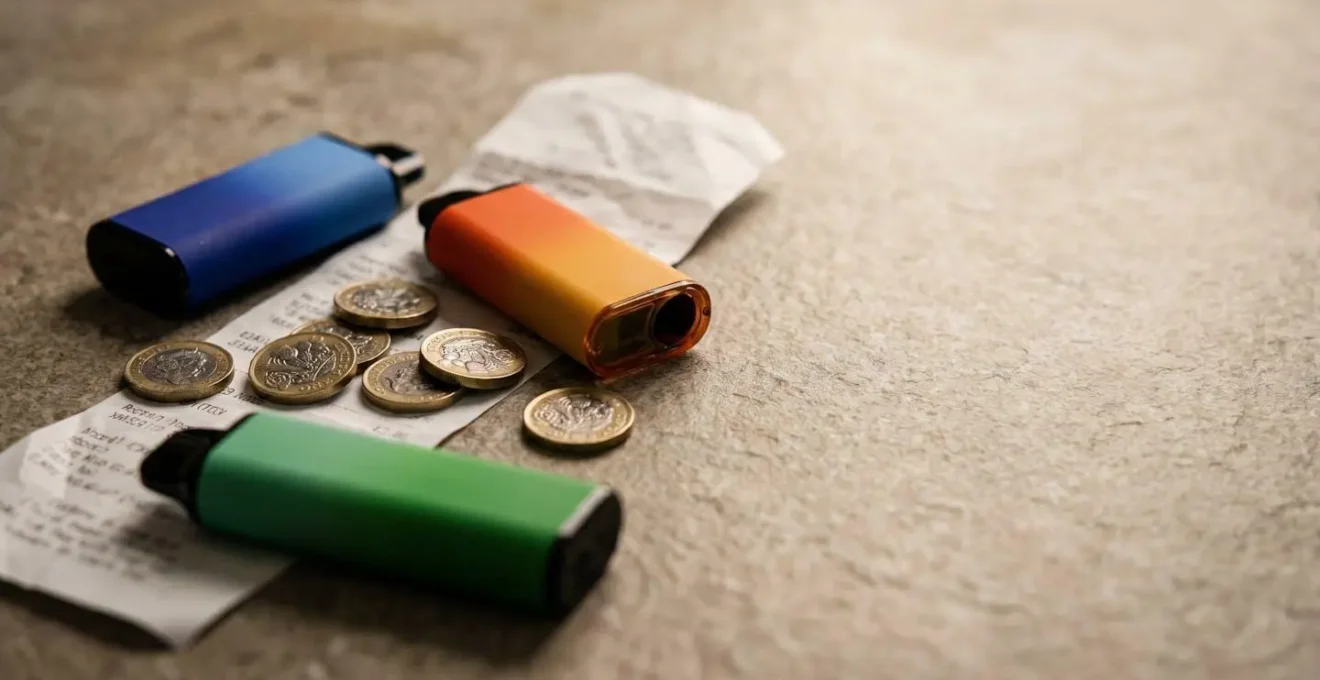
Your £7 disposable vape isn’t just a purchase; it’s a high-cost convenience loan that can cost heavy users over £1,000 per year.
- The advertised “600 puffs” is a laboratory maximum, not a real-world guarantee, leading to an unpredictable “performance lottery.”
- A staggering portion of the UK market consists of dangerous, non-compliant counterfeits, posing significant financial and safety risks.
Recommendation: Investing just £25 in a refillable pod kit can slash annual vaping costs by over 80%, providing superior performance and a clear return on investment within the first month.
The frustration is a familiar one for many UK convenience buyers. You purchase a £7 disposable vape on Friday, expecting it to last the weekend, only for it to die out by Sunday evening. This cycle of repurchase feels convenient, but is it economically sound? For the heavy user, this seemingly small expense quickly aggregates into a significant monthly outgoing, often exceeding £100. The market champions the simplicity of disposables—no-fuss, no-mess, grab-and-go—and for many, this is a compelling proposition.
But what if this convenience is simply a well-marketed “tax”? As a vaping economist, it’s clear that the true cost of disposables isn’t the sticker price; it’s a complex equation of unpredictable performance, hidden environmental tolls, and the ever-present risk of counterfeit products. The decision to use disposables is less a simple purchase and more a short-term, high-interest loan on convenience. The key isn’t just to acknowledge they are more expensive long-term, but to precisely quantify that cost and understand the mechanics behind the expense.
This article provides a full economic audit of disposable vapes from the perspective of a budget-conscious UK user. We will dissect the cost-per-puff, expose why performance rarely meets expectations, quantify the environmental and financial risks, and calculate the exact return on investment (ROI) from graduating to a more sustainable pod system. By the end, you will have a clear financial framework to determine if the convenience is truly worth the price.
To navigate this comprehensive economic audit, this article is structured to address the most pressing financial and practical questions a disposable vape user faces. The following summary outlines the key areas we will investigate, from direct cost comparisons to the hidden risks of the market.
Summary: A UK User’s Economic Audit of Disposable Vapes
- How Much Would You Save Switching From Disposables to a £25 Starter Kit?
- Why Does Your “600 Puff” Disposable Run Out After 400 Puffs?
- The Environmental Cost of Throwing Away 5 Million Disposable Vapes Weekly in the UK
- The 5 Visual Signs Your Disposable Vape Is a Dangerous Counterfeit
- When to Graduate From Disposables: The 3 Signs You’re Ready for a Pod Kit
- Closed Pods or Refillable Pods: Which Saves You £500 per Year in the UK?
- The Environmental Cost of Throwing Away 5 Million Disposable Vapes Weekly in the UK
- Why Modern Pod Systems Outperform Cigarettes for 78% of UK Switchers?
How Much Would You Save Switching From Disposables to a £25 Starter Kit?
The primary allure of a disposable vape is its low initial cost. At around £7, it feels like a minor expense. However, for a heavy user replacing a device every two days, this “convenience tax” rapidly accumulates. An economic audit reveals a stark reality: this habit costs approximately £105 per month, or a staggering £1,260 per year. This is the baseline against which all alternatives must be measured. The high total cost of ownership (TCO) is driven entirely by the consumable nature of the product, offering zero long-term value or equity.
In contrast, investing in a £25 reusable starter kit fundamentally alters the economic equation. While the upfront cost is higher, the ongoing expenses for consumables—e-liquid and coils—are drastically lower. The return on investment is almost immediate. Even by the end of the first month, a user of a refillable pod kit has spent significantly less than a disposable user. The long-term savings are where the true value emerges. A user switching to a refillable pod system can expect to spend around £229 annually, representing a saving of £1,031 per year compared to disposables.
This dramatic difference is best understood at a granular level. According to price-per-puff analysis, disposables cost 80p per 100 puffs. For a refillable vape, that cost plummets to just 8p per 100 puffs—a tenfold reduction. The following table illustrates this financial chasm, making it clear that the disposable model is optimized for manufacturer profit, not consumer value.
| Device Type | Initial Cost | Monthly Consumables | Total Month 1 | Total Month 12 |
|---|---|---|---|---|
| Disposables (£7 every 2 days) | £7 | £105 | £105 | £1,260 |
| Prefilled Pod Kit | £25 | £40 (pods) | £65 | £505 |
| Refillable Pod Kit | £25 | £17 (e-liquid + coils) | £42 | £229 |
| Annual Savings: Prefilled pods save £755/year; Refillable pods save £1,031/year vs. disposables | ||||
Why Does Your “600 Puff” Disposable Run Out After 400 Puffs?
One of the most common frustrations for disposable vape users is the “performance lottery”—the vast difference between the advertised puff count and the real-world lifespan of the device. A product marketed as offering “600 puffs” often feels depleted after just 400, or sometimes even fewer. This isn’t necessarily false advertising, but it is a function of laboratory testing conditions that don’t reflect typical usage patterns. The 600-puff metric is usually based on a machine taking very short, one-second puffs. In reality, most users take longer, deeper puffs of two to three seconds, drastically reducing the total number of puffs the device can deliver.
Furthermore, the performance is not linear. The power and flavour delivery are at their peak when the battery is fully charged. As the small lithium-ion battery inside depletes, it experiences a phenomenon known as “voltage drop” or “battery sag.” This means that even if there is still e-liquid in the device, the battery no longer has enough power to heat the coil effectively. The result is a weak, unsatisfying vapour and a muted flavour, long before the device is truly “empty.” This progressive degradation makes the final 100-200 puffs of a disposable significantly less enjoyable than the first 100.
This inconsistent performance makes financial planning impossible. A device that lasts two days one week might barely last a day and a half the next, depending on usage intensity. This unpredictability is a hidden cost, forcing users to buy replacements more frequently than anticipated and making a mockery of any attempt to budget for the expense, a problem that simply doesn’t exist with rechargeable, refillable systems.
This visual metaphor of battery terminal wear captures the essence of voltage drop. Just as oxidation degrades a physical connection, battery sag degrades the user experience over the short lifespan of the device. This inherent flaw in the disposable model means you are paying for 600 “potential” puffs but only receiving around 400 “quality” puffs, further skewing the cost-to-value ratio against the consumer.
The Environmental Cost of Throwing Away 5 Million Disposable Vapes Weekly in the UK
Beyond the direct financial cost to the consumer, the disposable vape model imposes a significant and growing cost on the environment. The convenience of a “throwaway” product comes with a severe ecological price tag. Each disposable vape contains a plastic shell, a nicotine-infused wick, and, most critically, a lithium-ion battery. None of these components are biodegradable, and they are rarely disposed of correctly.
The scale of the problem in the UK is staggering. Fresh environmental impact data reveals that around 5 million disposable vapes are thrown away each week. To put that in perspective, the lithium being discarded in these vapes every year is equivalent to the amount needed to produce batteries for 5,000 electric vehicles. It’s a colossal waste of a finite and valuable resource, driven by a product designed for obsolescence.
This issue is compounded over time. Further research by Material Focus found that more than 1 billion vapes have been discarded in the UK over the past four years, creating a mountain of plastic and electronic waste. Because they are not classified under standard household recycling schemes, the vast majority of these devices end up in general waste, destined for landfills or incineration. This not only squanders resources but also introduces hazardous materials into the ecosystem, a hidden subsidy that society pays for the convenience of a few.
The 5 Visual Signs Your Disposable Vape Is a Dangerous Counterfeit
The high-demand, high-profit nature of the disposable vape market has created a perilous shadow industry: counterfeiting. For the budget-conscious buyer, the risk is not just financial but also a matter of safety. A cheap disposable might not be a bargain; it could be an unregulated and dangerous fake. The scale is alarming, as industry estimates indicate that between 40-60% of disposable vapes currently on sale in the UK are either non-compliant or outright counterfeit.
These illicit products are manufactured without any quality control, often using substandard batteries that can leak or fail, and containing e-liquids with unknown and potentially harmful ingredients. They bypass all UK regulations, such as the TPD (Tobacco Products Directive) rules, which limit nicotine strength and require safety warnings. The problem is so rampant that enforcement data from National Trading Standards shows that more than 1.19 million illegal vapes were seized in England in 2023-24 alone, a 59% increase on the previous year.
For a consumer, being able to spot a fake is a crucial act of financial and physical self-preservation. While counterfeiters are becoming more sophisticated, there are several red flags to look for. Paying attention to packaging details, build quality, and price can help you avoid becoming a victim of this widespread fraud. The following checklist provides a practical guide to identifying a potentially dangerous fake.
Your 5-Point Counterfeit Vape Detection Plan
- Packaging Quality Control: Examine the box and wrapper for blurred text, grammatical errors, or misspellings. Counterfeiters often use low-resolution scans of real packaging, resulting in poor print quality and flimsy materials.
- Authentication Code Verification: Locate the authentication sticker or QR code. A genuine product’s code will verify on the manufacturer’s official website. Be wary of missing codes, photocopied stickers, or QR codes that lead to a fake verification page.
- TPD Compliance Check: Inspect the device and packaging for mandatory UK warnings. Genuine vapes sold in the UK must display clear nicotine warnings and comply with TPD regulations (e.g., e-liquid volume limits). Missing, altered, or incorrectly worded warnings are a major red flag.
- Build Quality Assessment: Feel the device in your hand. Counterfeits often exhibit poor build quality, such as loose mouthpieces, rattling sounds when shaken, uneven seams, or signs of e-liquid leakage straight out of the box.
- Price Plausibility Test: Scrutinize the price. If a disposable is being sold for significantly less than the typical retail price at trusted vendors (e.g., £3 compared to the standard £5-£7), it is almost certainly a counterfeit. This “too good to be true” price is the most common lure.
When to Graduate From Disposables: The 3 Signs You’re Ready for a Pod Kit
For many, disposable vapes serve as an accessible entry point into vaping. However, there comes a point where the “convenience tax” and performance inconsistencies outweigh the initial benefits. Recognizing when you’ve reached this tipping point is the first step toward making a more economically sound decision. Graduating from disposables to a reusable pod kit is a natural progression driven by financial frustration and a desire for a better, more reliable experience.
The transition is often signaled by a few clear indicators. If you find yourself relating to these scenarios, it’s a strong sign that your vaping habits have outgrown the disposable model and you are primed to benefit from an upgrade. A £25 investment in a starter kit is not just a purchase; it’s a strategic move to reclaim control over your budget and your vaping experience. The initial learning curve is minimal, and the long-term rewards in both savings and satisfaction are substantial.
Here are the three definitive signs that you are ready to graduate from disposables:
- You’re Frustrated with the Performance Lottery: You’re tired of the unpredictability. Your disposables die at inconsistent times—sometimes lasting the promised two days, other times barely one. This makes budgeting a guessing game and leaves you feeling short-changed.
- You’re Tired of the Convenience Tax: The maths no longer makes sense. Spending £60 to £105 every month on throwaway devices feels unsustainable. You’re ready to make a small upfront investment to unlock significant long-term savings.
- You’re Curious About Customization: The limited flavour range of your preferred disposable brand is becoming restrictive. You want to try different nicotine strengths, explore the vast world of e-liquids, or even replicate your favourite disposable flavour with higher-quality, lower-cost “Bar Salts” e-liquids in a refillable device.
This image represents the confidence and control that comes with making the switch. It’s a move from being a passive consumer in a high-cost ecosystem to an empowered user making a deliberate, cost-effective choice.
Closed Pods or Refillable Pods: Which Saves You £500 per Year in the UK?
Once you’ve decided to graduate from disposables, the next economic decision is choosing the right type of pod system. The market primarily offers two options: closed pod systems (like Juul or Vuse) and open (refillable) pod kits. While both offer significant savings over disposables, they represent different points on the spectrum of cost, convenience, and control. A closed pod system offers a “middle ground.” You still buy pre-filled, brand-locked pods, which is highly convenient, but the cost is higher than buying bottled e-liquid. An open, refillable system provides the ultimate in cost savings and flavour freedom, as you can use any e-liquid from any brand.
From a purely economic standpoint, the refillable pod kit is the undisputed champion for long-term value. As the Univapez Cost Analysis highlights in “How Much Does A Vape Cost UK 2025: Complete Price Guide”:
Refillable vapes offer the best long-term value at £255-433 annually, compared to £1,260 for disposables—a saving of over £800 per year
– Univapez Cost Analysis, How Much Does A Vape Cost UK 2025: Complete Price Guide
This saving of over £800—and in many cases, over £1,000 for heavy users—is a powerful incentive. The trade-off is a minor increase in maintenance: refilling the pod once every couple of days and changing a coil once a week. For most, this small time investment yields an enormous financial return. The following table provides a clear overview of the cost and control spectrum, helping you identify which system best aligns with your priorities.
| Vaping System | Annual Cost (£) | User Control Level | Convenience Level | Best For |
|---|---|---|---|---|
| Disposable Vapes | £1,260 | Very Low (no customization) | Highest (zero maintenance) | Complete beginners seeking simplicity |
| Closed Pod Systems (e.g., Juul, Vuse) | £480-600 | Low (brand-locked flavors) | High (easy pod swap) | Users wanting simplicity with moderate savings |
| Refillable Pod Kits | £255-433 | High (any e-liquid brand) | Medium (weekly refills/coil changes) | Cost-conscious users seeking flavor variety |
| Advanced Mods | £300-500 | Very High (full customization) | Low (requires knowledge) | Enthusiasts prioritizing performance |
The Environmental Cost of Throwing Away 5 Million Disposable Vapes Weekly in the UK
The environmental audit of disposable vapes reveals not just waste, but also significant danger. When millions of lithium-ion batteries are incorrectly discarded into general waste bins, they pose a severe and tangible fire risk to waste collection vehicles and processing facilities. These hidden batteries are a menace to the UK’s waste management infrastructure.
Case Study: The Hidden Fire Risk in UK Waste Facilities
Veolia, one of the UK’s largest waste management companies, reported experiencing approximately one fire per day across its vehicles and waste facilities, likely caused by hidden lithium-ion batteries inside discarded vapes. Meanwhile, Biffa receives over 200,000 incorrectly recycled vapes every month through mixed recycling collections, highlighting both the scale of the problem and the lack of public awareness about proper disposal. These incidents not only cause millions of pounds in damage but also endanger the lives of waste management workers, a direct and hazardous consequence of the “throwaway” vape culture.
This case study illustrates a critical point: the cost is not just abstract environmental damage, but concrete, daily operational risks and financial losses for essential services. Every improperly disposed vape contributes to this risk. The responsibility ultimately falls on an industry that has promoted a product design with no clear, safe, and convenient end-of-life disposal pathway for the consumer. While some retailers offer take-back schemes, uptake is low, and public awareness remains minimal. This externalized cost—passing the risk and cleanup bill to public and private waste services—is a fundamental, unsustainable flaw in the disposable vape economic model.
Key Takeaways
- The “Convenience Tax” on disposables can cost a heavy user over £1,000 more per year compared to a refillable pod kit.
- The “600 puffs” claim is a lab metric; real-world usage is significantly lower due to factors like longer puff duration and battery voltage drop.
- Up to 60% of the UK disposable market may consist of dangerous, unregulated counterfeits, posing both financial and physical safety risks.
Why Modern Pod Systems Outperform Cigarettes for 78% of UK Switchers?
The economic argument for switching from disposables to pod kits is clear. But for many, the ultimate goal is to move away from combustible tobacco. Here, modern vaping technology, particularly pod systems, has proven to be a remarkably effective tool. It’s not just about saving money; it’s about finding a more successful way to quit smoking. In England, the data is compelling. A recent 2025 study found that e-cigarettes were the most commonly used cessation aid, involved in 40.2% of quit attempts, and were associated with the highest odds of success.
The reason for this high efficacy lies in a key technological innovation: nicotine salts. Early generations of e-cigarettes used “freebase” nicotine, which is harsh on the throat at the high concentrations needed to satisfy a smoker’s craving. This made the transition difficult for many. As researchers from the UCL Institute of Epidemiology & Health Care explain, modern devices solved this problem.
Modern pod-style devices and new disposables use nicotine salts rather than free-base nicotine. These newer products deliver higher levels of nicotine and, as a result, may be more effective for helping people stop smoking
– UCL Institute of Epidemiology & Health Care researchers, Associations of Prevalence of E-cigarette Use With Quit Attempts, Nicotine & Tobacco Research
This technology allows for a rapid, smooth delivery of nicotine that closely mimics the experience of a cigarette, but without the thousands of harmful chemicals produced by combustion. This makes modern pod systems a vastly superior tool for smoking cessation compared to older vape designs. They satisfy cravings more effectively, making it easier for users to stick with the switch and ultimately leave smoking behind. The move to a pod kit, therefore, isn’t just a cost-saving measure; for the 78% of UK switchers who find them effective, it’s a strategic investment in their long-term health.
By applying this economic audit to your own habits, you can move from being a passive consumer paying a steep convenience tax to an informed user making a strategic choice that benefits both your wallet and your long-term goals. Start by calculating your own monthly spend on disposables and compare it to the long-term cost of a refillable system.