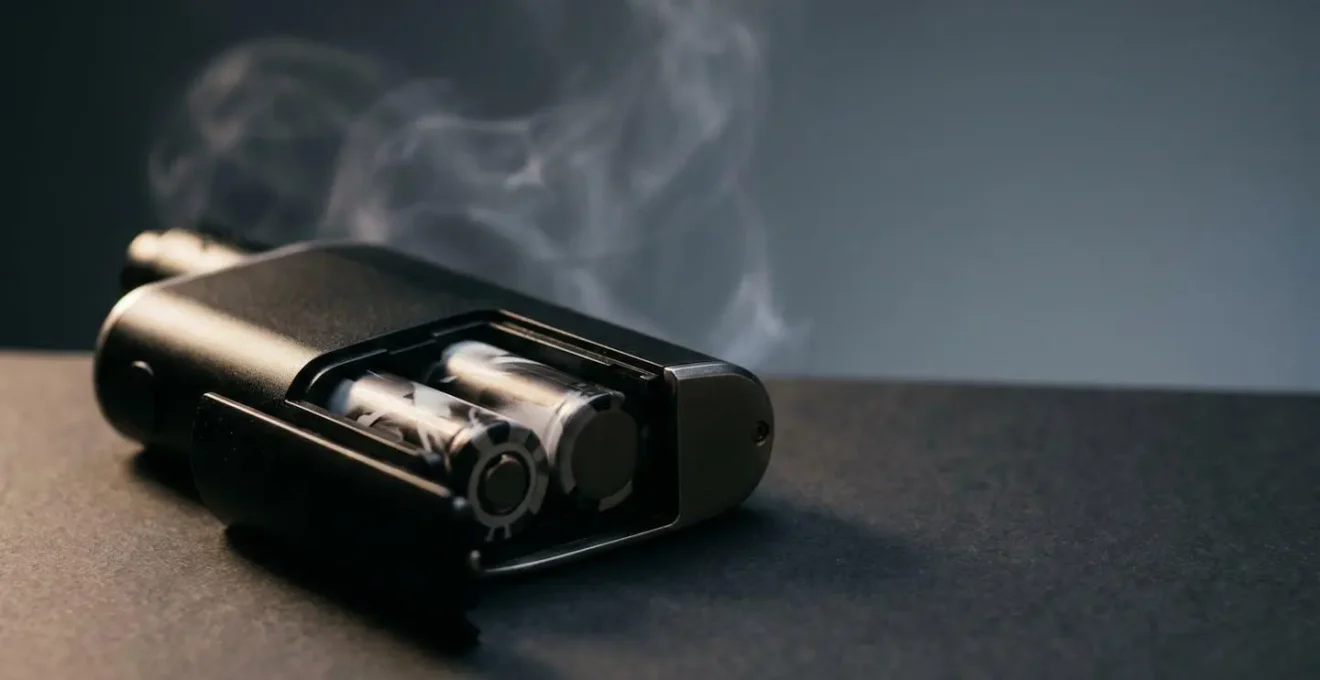
Your mod’s poor runtime is a symptom of electrical imbalance within the battery system, not just ‘old batteries’.
- Mismatched batteries, even from the same brand, create discharge asymmetry, forcing one cell to work harder and fail faster.
- USB charging introduces thermal load and uneven charging, accelerating chemical degradation and reducing overall capacity.
Recommendation: Treat your dual batteries as a single, balanced unit—always marry, charge, and rotate them together using an external charger to reclaim their full runtime potential.
It’s a familiar frustration for any dedicated UK vaper. You’ve invested in a powerful dual-battery mod, expecting all-day performance, only to see the battery indicator plummet to 50% before lunchtime and die completely by mid-afternoon. The common advice is a familiar chorus: “marry your batteries,” “use an external charger,” “buy a better brand.” While not incorrect, this advice often misses the fundamental technical reason for your problem. The issue isn’t just one weak battery; it’s a breakdown in the harmony of an entire electrical system.
Your dual-battery mod is not simply a container for two independent power sources. It’s a closed-loop system where each cell’s performance is intrinsically linked to the other. When this system becomes imbalanced—due to minute differences in age, capacity, or internal resistance—a catastrophic cascade begins. One battery is forced to compensate for the other’s weakness, leading to uneven discharge, increased strain, and a drastically shortened runtime for the pair. The 6-hour lifespan you’re experiencing isn’t a fault of the mod; it’s a clear signal of deep-seated system imbalance.
But what if the key to unlocking a true 12-hour runtime wasn’t just following the rules, but understanding the electrical principles behind them? This guide moves beyond the usual platitudes. We will deconstruct the critical factors that create charge and discharge asymmetry, from the hidden science of battery marriage to the thermal impact of your charging method. You will learn not just what to do, but how to diagnose the health of your battery system like a technician, ensuring every pair of cells delivers the maximum power and longevity they were designed for.
This article will guide you through the essential diagnostics and best practices to restore balance to your vaping setup. By understanding each component’s role, from initial purchase to daily rotation, you can transform your mod from a source of frustration into a reliable, all-day powerhouse.
Summary: A Technical Guide to Doubling Your Dual-Mod’s Battery Life
- Why You Must Always Buy Batteries in Pairs for Your Dual Mod?
- Series or Parallel Dual Mod: Which Configuration Suits 80W Daily Vaping?
- Why Charging Dual Batteries Separately Extends Their Life by 40%?
- The Warning Sign That Your Married Batteries Need Divorce and Retirement
- How Often Should You Swap Battery Positions in Your Dual Mod?
- When to Rotate Your Dual-Mod Batteries for Even Wear and Longer Life?
- Why Charging 18650s Through Your Mod Wears Them Out Faster?
- Why Does Your Mod Battery Last 6 Months When It Should Last 2 Years?
Why You Must Always Buy Batteries in Pairs for Your Dual Mod?
The practice of “marrying” batteries is the foundational principle of a balanced dual-cell system. It means purchasing two identical batteries at the same time, from the same batch, and dedicating them to be used exclusively as a pair for their entire lifespan. The reason for this strict protocol is to minimise variations in internal resistance (IR) and capacity from the very beginning. Even batteries from the same manufacturer can have slight performance differences between production runs. When you mix an old battery with a new one, or two batteries with different histories, you create an immediate system imbalance.
In this imbalanced state, the stronger battery (with lower IR) will discharge slightly faster and work harder to compensate for its weaker partner. The mod’s circuitry reads the combined voltage, but the load is not shared equally. This uneven strain causes the weaker battery to drain more rapidly, and the mod often shuts off prematurely, even when the stronger battery still holds a significant charge. This is why a mismatched pair might only give you six hours of use, while a perfectly matched, married pair can easily last twelve.
As a battery safety expert on the E-Cigarette Forum notes, true marriage is about total parity. The goal is to create a single, cohesive power unit from two cells. As they explain in their community guidelines:
Same Manufacturer, Same Model, Same mAh, same CDR value, this makes them close to almost equal capability. Bought together as a set, charged together as a set, used together as a set, never using them alone or with another set.
– Battery safety expert, E-Cigarette Forum community guidelines
Think of it as a two-person team running a marathon. If one runner is significantly fitter than the other, the team’s overall pace will be dictated by the slower runner, and the fitter one will be exhausted from trying to pull them along. Marrying batteries ensures you have two runners of identical fitness, running in perfect sync from start to finish.
Series or Parallel Dual Mod: Which Configuration Suits 80W Daily Vaping?
The configuration of your dual-mod—series or parallel—has a profound impact on how your batteries perform, especially at a consistent 80W output. Understanding the difference is key to managing runtime and battery stress. A mod’s configuration determines how it combines the power from the two cells to achieve the desired wattage.
In a series configuration, the mod stacks the voltage of the two batteries. Two 3.7V batteries become a 7.4V power source. To deliver 80W, the mod’s regulator chip then steps this high voltage *down*. This is highly efficient and puts less amp strain on each individual battery. For an 80W vape, a series mod provides a cooler, more efficient operation, which can contribute to better overall battery health and perceived runtime because the cells are under less stress.
Conversely, a parallel configuration keeps the voltage at 3.7V but doubles the capacity (mAh) and the amp limit. The mod’s chip must then boost the voltage *up* to deliver 80W. This boosting process is less efficient and draws a higher amperage from the batteries. While the total capacity is theoretically higher, the increased strain and inefficiency of the boost converter can lead to more heat and a faster-than-expected drop in voltage under load. For a daily 80W vaper, a series mod is technically the more efficient and less stressful configuration for the batteries, promoting a longer, more stable discharge cycle.
Why Charging Dual Batteries Separately Extends Their Life by 40%?
While the USB port on your mod seems convenient, it’s one of the primary culprits behind premature battery death and system imbalance. Relying on on-board charging is fundamentally inferior to using a dedicated external charger for two critical reasons: balanced charging and thermal management. An external charger analyses and charges each battery in an individual bay, ensuring both cells reach a full, identical state of charge. This is crucial for maintaining the “marriage.”
Most mods with USB charging capabilities have, at best, rudimentary balancing features. They often charge the batteries in series, and minor inaccuracies can compound over time. One cell might consistently end its charge cycle at 4.2V while the other only reaches 4.18V. This tiny difference creates an imbalance that worsens with every cycle, directly impacting your runtime. As the Vaporesso Technical Team points out, the benefits go beyond simple balancing.
External chargers distribute current more evenly and reduce strain on your mod’s circuitry.
– Vaporesso Technical Team, Vape Charging Guide: Maximize Battery Life
Furthermore, USB charging generates significant heat within the mod’s chipset. This heat radiates directly onto the batteries, which are also heating up from the charging process itself. Heat is the number one enemy of a lithium-ion battery’s longevity. This combined thermal load accelerates the degradation of the cell’s chemical components, permanently reducing its capacity. Industry analysis consistently shows that an external battery charger is recommended to ensure balanced charging and prolong battery life. By charging externally, you not only guarantee a perfect balance every time but also keep your batteries cool, preserving their chemical integrity and maximising their functional lifespan.
The Warning Sign That Your Married Batteries Need Divorce and Retirement
Even perfectly married batteries will eventually age and drift apart. The key is to recognise the signs of a failing marriage before it causes significant performance loss or a safety risk. This “divorce and retirement” process is a necessary part of battery lifecycle management. The most telling signs are not visible to the naked eye but can be measured with the right tools and attention to detail. Any physical damage to the battery wrap, however, is an immediate cause for retirement.
The single most important diagnostic metric is internal resistance (IR). As a battery ages, its IR increases, making it less efficient at delivering power. In a married pair, you are looking for the *difference* in IR between the two cells. A significant divergence indicates that one cell is degrading much faster than the other. Another clear symptom is the “False 50%”: your mod displays a half-full battery, but it dies after just a few puffs. This means one cell can no longer hold a charge under load, and its voltage is plummeting, dragging the pair down with it. Uneven temperatures after use or charging are also a red flag, as the warmer battery is working harder due to higher internal resistance.
Your Action Plan: Battery Health Diagnostic Checklist
- Use your external charger’s internal resistance (IR) test feature if available.
- Check if the IR difference between married batteries exceeds 20mΩ – this indicates retirement is needed.
- Measure resting voltage with a multimeter to the hundredth decimal (x.xx format) after batteries sit for 3-4 days.
- Perform a temperature test: after charging or heavy use, feel both batteries – noticeably different temperatures indicate high internal resistance in the warmer cell.
- Monitor for ‘False 50%’ symptom: if your mod shows 50% charge but dies after only a few puffs, one battery can no longer hold load.
How Often Should You Swap Battery Positions in Your Dual Mod?
Battery rotation is another non-negotiable practice for maintaining system balance, particularly in series mods. Even in the most well-designed devices, one battery slot often bears a slightly heavier electrical load than the other. This can be due to the physical length of the connections to the chipset or the design of the internal wiring. Over time, this small difference in strain will cause one battery to wear out faster than its partner, breaking the marriage. Swapping the batteries’ positions in the mod ensures this wear is distributed evenly between both cells.
The optimal frequency for rotation depends on your vaping intensity. Heavier users who place a greater demand on their batteries need to rotate more frequently to counteract the accelerated, uneven wear. A community expert on the UK-based Planet of the Vapes forum highlights the importance of this habit:
You should also switch the pair around regularly as well, as one of the battery slots will take more of the strain than the other.
– Planet of the Vapes community expert, Battery Marriage Best Practices Thread
A simple, effective rotation schedule is as follows:
- Chain Vaper (200+ puffs/day, 75W+): Swap battery positions with every single charge cycle.
- Moderate User (100 puffs/day, 50-75W): Swap battery positions every other charge cycle.
- Light User (<100 puffs/day, <50W): Swap battery positions at least once per week.
For any series mod, rotation with every charge cycle is mandatory for safety and performance, regardless of usage level. This simple habit of swapping the battery from the left bay to the right bay is one of the most effective ways to prolong the life and performance of your married pair.
When to Rotate Your Dual-Mod Batteries for Even Wear and Longer Life?
While knowing *how often* to rotate is important, understanding *when* and *how* to build this into a consistent habit is what truly ensures even wear and a longer lifespan for your married pair. The goal is to make rotation an automatic, thought-free part of your charging routine, eliminating any chance of forgetting. This is where a systematic approach, often called “habit stacking,” proves invaluable.
The best time to rotate is every time you remove the batteries from the mod for charging. Don’t wait until you’re putting them back in; make the decision part of the disassembly process. A proven method is to physically swap their positions as you place them into the external charger. For instance, the battery from the mod’s right slot always goes into the charger’s left slot, and the mod’s left battery goes into the charger’s right slot. This creates a consistent cycle of rotation that becomes second nature.
This disciplined approach ensures that both batteries experience the same conditions over their lifespan, not just within the mod but also within the charger, as some chargers may have slight variations between bays. It’s about controlling every variable to maintain perfect symmetry.
Case Study: The Habit Stacking Strategy for Battery Maintenance
Experienced vapers on forums like E-Cigarette Forum report success with systematic rotation habits. One popular method involves labeling batteries with dates and identifiers (e.g., Pair 1A, 1B). They then use the same charger slots consistently (e.g., A in slot 1, B in slot 3) and rotate which battery goes in which mod slot after every charge cycle. As confirmed by users sharing their long-term experiences, this disciplined approach, combined with never charging other batteries simultaneously on the same charger, ensures married pairs age evenly and maximises their functional lifespan.
Why Charging 18650s Through Your Mod Wears Them Out Faster?
The primary reason on-board USB charging is detrimental to battery health is thermal load. A lithium-ion battery is a sensitive chemical system, and its greatest enemy is heat. Heat accelerates the chemical reactions inside the cell, leading to faster degradation, reduced capacity, and a shorter overall lifespan. When you charge via USB, you are introducing two significant sources of heat directly into a confined space.
First, the charging process itself generates heat within the battery. Second, and more critically, the mod’s internal chipset and voltage regulation circuitry heat up considerably while managing the incoming power. This heat radiates through the mod’s body and directly onto the batteries. This creates a compounding effect where the batteries are being heated both internally by the charge and externally by the mod’s electronics. A battery health guide from Vaporesso offers a stark analysis of this process:
USB charging heats up the mod’s chipset, which in turn radiates heat directly onto the batteries. This heat, combined with the heat from charging itself, drastically accelerates the chemical degradation of the cells.
– Battery thermal analysis, Vaporesso Battery Health Guide
An external charger is designed to dissipate heat effectively and keep the batteries at an optimal temperature. Your mod is designed to regulate power for vaping, not for safe and efficient charging. Subjecting your batteries to this regular, intense thermal stress is a guaranteed way to reduce their lifespan from a potential two years of healthy cycles to just six months of disappointing performance.
Key Takeaways
- Short runtime is a symptom of system imbalance, not just a single bad battery.
- Marrying batteries (same model, same batch, same age) and using them as an exclusive pair is the foundation of a balanced system.
- External charging is superior as it ensures a balanced charge and avoids the damaging thermal load created by USB charging.
Why Does Your Mod Battery Last 6 Months When It Should Last 2 Years?
Your mod’s batteries are failing prematurely not because of a single catastrophic event, but due to an accumulation of seemingly minor imbalances and stresses. A quality 18650 battery is engineered for a healthy life of between 300 to 500 charge cycles. If you charge your mod once a day, this should equate to at least a year, and often closer to two years, of reliable service. When a pair fails in six months (around 180 cycles), it’s a clear sign that the system’s balance has been compromised from the start.
The primary driver of this accelerated failure is an unequal load. Consider that technical specifications show it is possible to draw 75-80 watts safely from a single high-quality 18650. In a dual-battery mod, this load should be comfortably shared. However, if one battery has a slightly higher internal resistance due to mismatched age, brand, or charging history, it cannot contribute its fair share. The stronger battery is forced to over-perform, enduring stress equivalent to a much higher wattage, while the weaker battery’s voltage sags, triggering the mod’s low-power cutoff long before the pair is truly depleted. This cycle of stress and imbalance, repeated daily, is what kills runtime.
Ultimately, achieving a 12-hour runtime is the result of a disciplined process. It begins with purchasing a perfectly married pair, continues with the exclusive use of an external charger to maintain balance and avoid heat, and is maintained through a consistent rotation schedule to ensure even wear. Neglecting any one of these three pillars—marriage, external charging, or rotation—introduces an imbalance that will inevitably cut your battery life in half.
Begin today by performing a full diagnostic on your current batteries using the checklist provided. Retire any imbalanced pairs and commit to the principles of system balance with your next set to finally achieve the all-day performance you expect from your device.