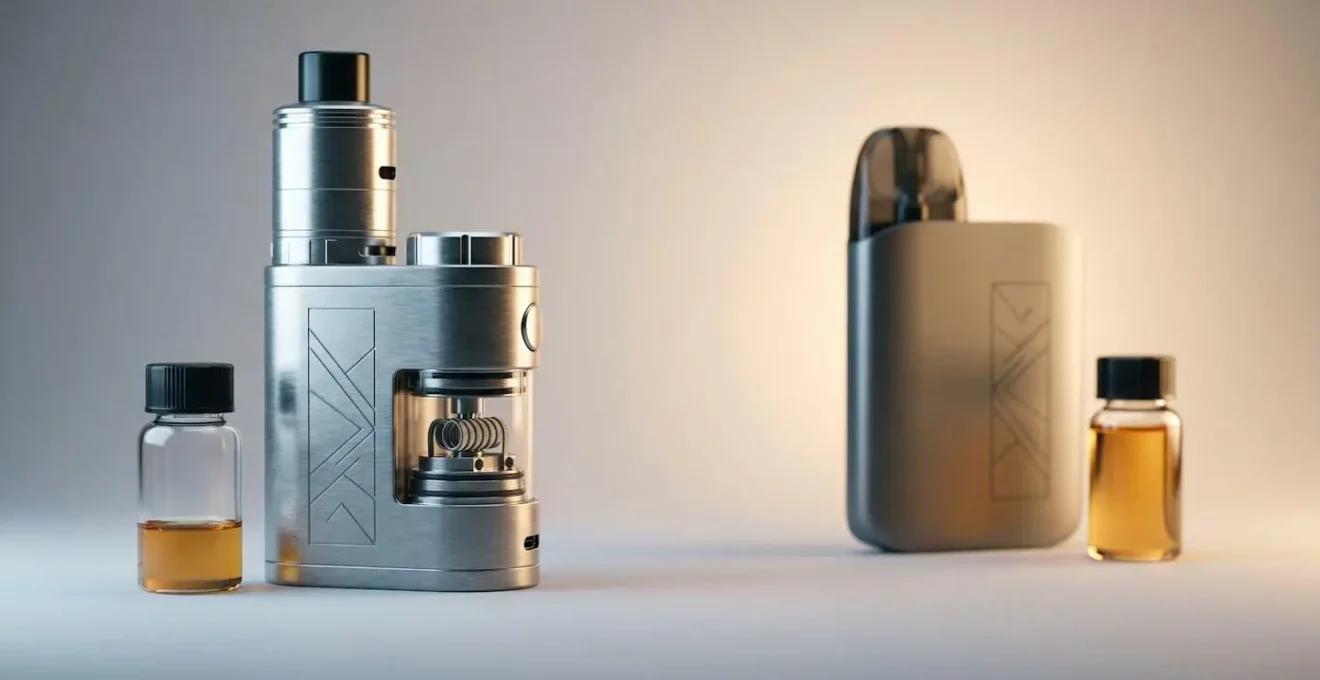
Your sub-ohm vape isn’t ‘wasting’ e-liquid; it’s efficiently converting more of it into denser flavour and vapour, a fundamental difference in physics from your old pod system.
- Power (watts) and vapour production are exponentially linked; doubling the power more than doubles the liquid consumption to achieve that performance.
- The high-power system requires thick, high-VG liquid to prevent leaks and lower nicotine strengths to avoid overwhelming side effects.
Recommendation: Stop fighting the physics. Instead, learn to control the variables—power, airflow, and liquid choice—to master your new device and its budget.
The moment of shock is familiar to every vaper who makes the leap from a discreet pod system to a powerful sub-ohm kit. You fill your gleaming new tank, take a few deeply satisfying, cloud-rich puffs, and set it down. An hour later, you pick it up to find the tank is half-empty. The immediate thought is often, “Is this thing broken? Why is it drinking my e-liquid?” You’ve just encountered the most significant trade-off in modern vaping: the price of power.
Many will offer simple answers: “it just makes bigger clouds,” or “the coils are different.” While true, these are symptoms, not the cause. The reality is that you haven’t just upgraded your device; you’ve stepped into a completely different class of engineering that operates on different principles. It’s like swapping a fuel-efficient city car for a performance sports car. The exhilarating power and performance come at the cost of higher fuel consumption, and understanding the mechanics behind that consumption is the key to mastering your new experience.
But what if the key to managing this new cost wasn’t about trying to make your sports car act like a city car? What if it was about learning to be a better driver? This article will move beyond the surface-level answers. We will dissect the entire system—from power and heat to fluid dynamics and nicotine delivery—to explain precisely why your sub-ohm setup demands more liquid. By understanding this ‘Thermodynamic Trade-off’, you’ll not only solve the mystery of the vanishing juice but also learn how to fine-tune your device for the perfect balance of performance and economy.
To fully grasp this shift, we’ll explore each component of the sub-ohm equation. This guide breaks down the core questions every new sub-ohm user asks, providing the technical-yet-simple explanations needed to turn confusion into control.
Summary: Understanding High E-Liquid Consumption in Sub-Ohm Vapes
- Why Sub-Ohm Coils Need 50W When Your Pod Only Needed 12W?
- Why High-PG Liquids Cause Leaking Disasters in Sub-Ohm Tanks?
- Why 12mg Nicotine Makes You Dizzy in a Sub-Ohm Tank but Felt Fine in a Pod?
- The Wicking Error That Floods Sub-Ohm Coils With Every Tank Refill
- How to Budget for Sub-Ohm Vaping Without Spending £100 Monthly on Juice?
- How to Match a 150W Mod With a Tank That Can Handle the Power?
- Why Cloud Competitions Require Dual Coils at 0.1 Ohms Minimum?
- Why Does Your 200W Mod Produce Less Vapour Than Your Friend’s 80W Setup?
Why Sub-Ohm Coils Need 50W When Your Pod Only Needed 12W?
The core of your e-liquid consumption issue lies in a simple physics principle: it takes energy to turn liquid into vapour, and creating a lot of vapour takes a lot of energy. Your 12W pod system was designed for efficiency, sipping power to create a modest amount of vapour. A sub-ohm device, by contrast, is designed for performance. Its goal is to generate massive amounts of heat very quickly over a large surface area. This requires a significant increase in power, or wattage.
This power difference isn’t trivial. According to technical specifications, while MTL pod systems operate in the 10-20W range, standard sub-ohm kits comfortably run between 30W and 100W. This isn’t arbitrary; it’s dictated by the coil’s resistance. A sub-ohm coil (meaning resistance below 1.0 ohm) allows more electrical current to flow through it with less opposition. To manage this increased current and generate the intense heat needed for dense vapour, the mod must supply significantly more watts. This process is the engine of your device, directly converting electrical energy into the thermal energy that vaporises your e-liquid.
The relationship is direct: more watts equal more heat, which equals faster vaporisation. As the E-Cigarette Direct Technical Team explains in their guide to voltage, watts, and ohms:
Lower resistance coils produce more flavour, vapour and heat at a lower voltage than higher ohm coils because they use more watts.
– E-Cigarette Direct Technical Team, The Vaper’s Guide to Voltage, Watts & Ohms
Think of it as the difference between boiling a small cup of water with a candle versus a large pot of water on a high-power gas stove. Both achieve the same end state (steam/vapour), but the stove uses vastly more energy to do it faster and on a larger scale. Your 50W setting is the gas stove, built for a high-volume, high-performance thermodynamic trade-off that prioritises vapour and flavour intensity over liquid conservation.
Why High-PG Liquids Cause Leaking Disasters in Sub-Ohm Tanks?
If you’ve just switched from a pod system, you likely have bottles of 50/50 PG/VG or even higher-PG e-liquid. Using this in your new sub-ohm tank almost certainly resulted in a sticky mess. This isn’t a fault in your tank; it’s a problem of fluid dynamics. Propylene Glycol (PG) is a thin, low-viscosity liquid, while Vegetable Glycerin (VG) is thick and viscous. Pod systems, with their tiny coil wicking ports, are designed for thin, high-PG liquid that can saturate the cotton easily.
Sub-ohm tanks are engineered completely differently. To cope with the intense heat from a 50W+ coil, they feature massive wicking channels and large airflow ports to feed the coil with liquid and cool it down. When you pour a thin, watery high-PG liquid into this system, it’s like trying to hold water in a net. The liquid flows straight through the large cotton ports and floods the coil chamber, eventually leaking out of the airflow holes. Industry guidelines confirm that sub-ohm devices require e-liquids with a minimum 70% VG / 30% PG ratio to function correctly.
The thick, honey-like consistency of high-VG liquid is essential. It moves slowly enough that it properly saturates the cotton without overwhelming it and pouring through. This perfect balance ensures the coil gets just enough liquid to vaporise at high power without either flooding (too much liquid) or causing a “dry hit” (too little liquid). This is a classic case of system mismatch: your hardware and your e-liquid were not designed to work together. Switching to a high-VG shortfill or “shake and vape” bottle is a non-negotiable step to prevent leaks and get the intended performance from your device.
Why 12mg Nicotine Makes You Dizzy in a Sub-Ohm Tank but Felt Fine in a Pod?
This is perhaps the most jarring experience for a new sub-ohm user. The 12mg or even 18mg nicotine e-liquid that provided a satisfying throat hit in your 12W pod suddenly becomes harsh, overpowering, and can leave you feeling light-headed or nauseous in your new 60W setup. This is because you are no longer just taking a puff; you are inhaling a significantly larger nicotine payload.
Remember, a sub-ohm device vaporises far more e-liquid per puff. As research on vaping pharmacokinetics shows, this directly multiplies the amount of nicotine delivered to your system in a single inhalation. If your sub-ohm vape uses four times the liquid per puff, it’s also delivering approximately four times the nicotine from that same 12mg liquid. Your body, accustomed to a small, steady dose, is suddenly hit with a massive spike, leading to the classic symptoms of nicotine over-intake: dizziness, headache, and nausea.
Case Study: Nicotine Yield at High Power
A peer-reviewed study published in the US National Institutes of Health’s digital archive measured the dramatic increase in nicotine delivery from high-power devices. The researchers found that when testing a sub-ohm device at 75W, the nicotine yield increased by 3.1 to 4.1 times compared to the same liquid in a low-wattage device. This scientific data confirms the real-world experience: high wattage directly and significantly amplifies nicotine absorption, making what was a normal strength in a pod system feel overwhelming in a sub-ohm tank.
This is why high-strength nicotine liquids often carry a “Not for sub-ohm use” warning. It’s a critical safety instruction. As the experts at Totally Wicked point out, the solution is a drastic reduction in nicotine strength.
Sub-ohm devices should be used with low nicotine strength e-liquids. Most sub-ohm vapers use e-liquids with less than 6mg of nicotine.
– Totally Wicked Technical Guide, Sub Ohm Vaping Guide
For most users transitioning, a 3mg nicotine strength is the ideal starting point for sub-ohm vaping. For very heavy smokers, 6mg might be necessary, but anything higher is generally considered excessive and unpleasant. You are getting your nicotine satisfaction not from a high concentration, but from the sheer volume of vapour produced.
The Wicking Error That Floods Sub-Ohm Coils With Every Tank Refill
You’ve switched to thick, high-VG liquid and lowered your nicotine, but you still experience a frustrating gurgle and leak every time you refill the tank. This common issue isn’t about the liquid anymore; it’s about pressure. Your vape tank is a sealed system that relies on a delicate vacuum to hold the e-liquid in the main chamber and prevent it from pouring through the wicking ports. When you open the top cap to refill, you break this vacuum, and the sudden change in pressure can force liquid into the coil’s chamber.
This is especially true for top-fill tanks. The act of sliding or unscrewing the top cap, and then closing it, can create positive pressure inside the tank, effectively pushing liquid out through the path of least resistance—your coil’s cotton. This results in flooding, gurgling, spitback, and leaks from the airflow holes. It’s not a design flaw but a law of physics that needs to be managed with correct technique.
Fortunately, preventing this is simple once you understand the principle. The goal is to equalize the pressure during refilling and re-establish the vacuum seal correctly. Mastering a few simple steps can eliminate refill-related flooding for good, turning a constant annoyance into a non-issue and ensuring a clean, consistent vape every time.
Your Action Plan: Preventing Tank Flooding During Refills
- Close the airflow control ring completely before you begin to open the top cap. This traps air and helps maintain pressure.
- Fill the tank, avoiding the central chimney. Don’t overfill; leave a small air bubble at the top to help create the vacuum.
- Once the top cap is securely screwed back on, immediately turn the tank upside down for a few seconds.
- With the tank still upside down, open the airflow control ring back to your desired setting.
- Turn the tank right-side up. This procedure helps re-establish the vacuum properly before liquid has a chance to flood the coil. Check O-rings for wear if leaking persists.
How to Budget for Sub-Ohm Vaping Without Spending £100 Monthly on Juice?
The sticker shock of sub-ohm liquid consumption is real. If you’re vaping the same amount of time as you did with your pod, you could easily be spending upwards of £100 a month on e-liquid. While sub-ohm vaping is inherently more consumptive, there are intelligent ways to manage this cost without sacrificing the experience. The key is shifting your mindset from “maximum power” to “optimal efficiency.”
First, acknowledge the facts. A 60W sub-ohm device will always use more liquid than a 15W pod. But it doesn’t have to be a 4x increase in all situations. Your vaping habit is a major factor. If you were taking 10-second puffs on your pod, continuing this on a sub-ohm device will drain the tank incredibly fast. Learning to take shorter, 3-4 second direct-lung puffs can drastically reduce consumption while still providing a satisfyingly dense cloud. Secondly, examine your wattage. Many modern mesh coils provide excellent flavour and vapour between 45-60W. Pushing it to 80W might only provide a marginal improvement in performance at a significant cost in liquid and battery life.
For those serious about vaporisation efficiency, exploring Temperature Control (TC) vaping is a game-changer. Instead of setting a wattage, you set a maximum temperature for the coil. The mod then delivers just enough power to reach and maintain that temperature, preventing overheating and unnecessary liquid burn-off. This results in a remarkably consistent vape and can significantly reduce liquid consumption. Additionally, buying larger “shortfill” bottles (50ml or 100ml) is far more economical than buying 10ml bottles. The unit price is lower, and you’re simply adding a nicotine shot to reach your desired 3mg or 6mg strength, which is the standard for sub-ohm users.
How to Match a 150W Mod With a Tank That Can Handle the Power?
Having a 150W or 200W mod is one thing; having a tank that can actually utilise that power is another entirely. Many vapers buy a high-power mod and pair it with a standard sub-ohm tank, only to find that vaping above 80W results in burnt-tasting, unpleasantly hot vapour. This is because most commercially available tanks are not built for such extreme wattage. It’s a classic system mismatch where one component out-specs the others.
The reality is that coil technology has practical limits. According to manufacturer specifications for the most common coils on the market, most sub-ohm coils perform optimally between 25-60W. Even high-performance mesh coils designed for cloud production are typically rated for a maximum of around 80-90W. Pushing them beyond this limit will cause the cotton to burn faster than it can wick liquid, leading to a nasty dry hit and a ruined coil. The 150W capability of your mod is largely headroom, not a target for daily use with a standard tank.
To genuinely handle 150W, a tank needs to be an engineering marvel specifically designed for extreme performance. As a technical analysis from Vape Green highlights, it’s about more than just the coil:
A tank needs two other things to handle 150W: massive airflow to dissipate the immense heat, and huge juice channels to keep the wicks saturated under extreme vaporisation rates.
– Vape Green Technical Analysis, What Is Sub Ohm Vaping? A 2026 Ultimate Guide
These features are typically found only in Rebuildable Dripping Atomizers (RDAs) or specialised high-performance Rebuildable Tank Atomizers (RTAs). For the vast majority of vapers using pre-made coil heads, the power rating printed on the side of the coil itself is the absolute limit you should respect. Matching your mod to your tank means understanding your tank’s limits and operating within them, not pushing your mod to its maximum just because you can.
Why Cloud Competitions Require Dual Coils at 0.1 Ohms Minimum?
Cloud competitions represent the extreme end of sub-ohm vaping, where the goal is pure, unadulterated vapour volume. The rules, such as requiring dual coils and specifying a minimum resistance like 0.1 ohms, are not arbitrary. They are rooted in the physics of vapour production and the crucial principles of battery safety. The primary reason for using dual (or more) coils is to dramatically increase the total surface area that is in contact with the e-liquid.
When you have two coils heating up simultaneously, you are vaporising liquid from two sources at once, effectively doubling your vapour production potential compared to a single coil at the same temperature. This increased surface area and heat flux lead to denser, larger clouds. As scientific aerosol measurements demonstrate, multi-coil atomizers operating at high heat produce vapour droplets with vastly increased volume concentrations, which is the technical definition of a “thick cloud.”
The 0.1 ohm minimum resistance, however, is almost entirely a safety rule. Ohm’s Law dictates that as resistance drops, the current (amperage) drawn from the battery increases. Pushing a battery beyond its continuous discharge rating (CDR) is extremely dangerous and can lead to catastrophic failure. The 0.1 ohm floor is a line in the sand designed to keep builds within the safety limits of the high-amperage batteries used by competitors.
Case Study: The 0.1 Ohm Safety Boundary
A safety analysis of Ohm’s Law demonstrates why competition limits are critical. For a dual-coil build at 0.1 ohms on a fully charged battery (4.2V), the current draw is 42 amps. This is already pushing the limits of the very best 18650 batteries. As the analysis explains, a typical high-drain battery with a 25-amp CDR should not be used with a build lower than 0.17 ohms to maintain a safety margin. The 0.1 ohm rule exists because it represents the absolute boundary of what is considered “safely” achievable by experts using specific hardware (like 21700 batteries with higher amp ratings) in a controlled environment. For average users, it’s a clear warning sign: don’t try this at home.
In essence, the dual coils provide the performance engine, while the 0.1 ohm minimum acts as the safety barrier, creating a framework for pushing vapour production to its very limits without crossing the line into recklessness.
Key Takeaways
- High wattage isn’t a goal; it’s a tool. True performance comes from a balanced system, not just a high number on the screen.
- The physical properties of your e-liquid (viscosity) and its chemical properties (nicotine strength) are just as important as your hardware settings.
- Understanding the ‘why’ behind the rules—like pressure, wicking, and battery safety—is what separates a frustrated user from a master vaper.
Why Does Your 200W Mod Produce Less Vapour Than Your Friend’s 80W Setup?
This is the ultimate paradox for many vapers and the final piece of the puzzle. You’ve invested in a powerful 200W mod, yet your friend with a seemingly modest 80W device is producing more impressive clouds. The answer is that raw, advertised wattage is often a misleading metric. True vapour performance comes from effective power delivery, which is a combination of battery quality, tank efficiency, and, most importantly, the sophistication of the mod’s chipset.
A high-quality 80W mod with a premium chipset (like a DNA or YiHi) and good batteries will deliver a true, stable 80 watts from the moment you press the fire button. In contrast, a budget 200W mod might suffer from “voltage sag” under load, where the batteries can’t supply the requested current, causing the actual power delivered to the coil to be much lower than what’s displayed on the screen. The chipset itself is also a major factor, as this expert hardware review explains:
A high-end DNA or YiHi chipset in an 80W mod might deliver a ‘truer’ 80 watts with a powerful ‘preheat’ or ‘punch’ setting. In contrast, a budget 200W mod’s chipset might have an inaccurate output or a sluggish ‘power curve’.
– Vaping Hardware Technical Review, Understanding Mod Chipset Efficiency
Ultimately, it’s a complete system working in harmony. Your friend’s 80W setup likely has a well-matched tank, an efficient coil, and a high-quality mod that delivers power instantly and accurately. Your 200W setup might be held back by an inefficient tank, a poorly performing coil, or a chipset that can’t live up to its own advertising. The table below illustrates how different coil resistances are designed for specific wattage ranges, showing that most vaping happens far below the 200W mark.
| Coil Resistance (Ω) | Recommended Wattage (W) | Vaping Style | Battery Efficiency |
|---|---|---|---|
| 1.2Ω | 8-15W | MTL (Mouth-to-Lung) | High – Extended battery life |
| 1.0Ω | 10-18W | MTL | High – Extended battery life |
| 0.8Ω | 15-25W | Restricted DTL | Moderate |
| 0.6Ω | 20-35W | DTL (Direct-to-Lung) | Moderate |
| 0.5Ω | 25-40W | DTL | Low – Higher consumption |
| 0.3Ω | 40-60W | DTL | Low – Higher consumption |
| 0.15Ω | 45-80W | Cloud Chasing DTL | Very Low – Rapid depletion |
This demonstrates that efficiency and system synergy trump raw power every time. Chasing the highest wattage number is a fool’s errand; the goal is to build the most efficient and balanced system for your chosen vaping style.
Now that you understand the complex interplay of power, physics, and chemistry, you can approach your device not with frustration, but with control. Start by ensuring your hardware is correctly matched, choose the right e-liquid, and find the lowest wattage that gives you a satisfying vape. This is the path to mastering the art of sub-ohm vaping.