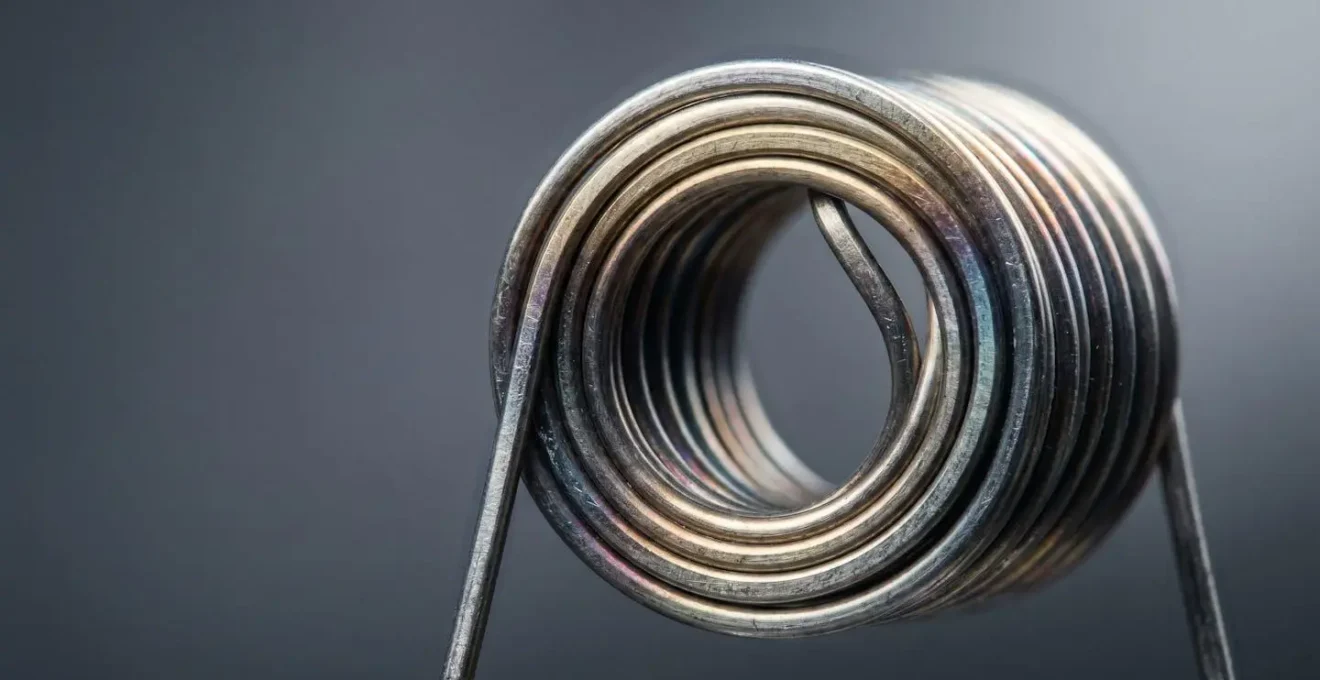
That harsh, burnt taste of a dry hit is the single biggest frustration for many vapers. While Temperature Control (TC) mode is often touted as the solution, simply turning it on isn’t enough. True mastery comes from understanding the underlying science: TC works by monitoring the predictable resistance change of your coil wire as it heats up, allowing the mod to intelligently cut power *before* the cotton can burn. This article demystifies that process, equipping you to troubleshoot issues and finally achieve a consistently perfect, flavourful vape.
There’s no worse feeling for a vaper than the sudden, acrid, throat-scorching assault of a dry hit. It ruins your e-liquid, your coil, and your moment. You’ve likely heard the common refrain from fellow vapers: “Just switch to Temperature Control mode.” It’s presented as a magical fix, a set-and-forget solution to eliminate burnt cotton forever. But for many who try it, the reality is more complicated, often involving confusing error messages, a weak vape, or the dreaded dry hits returning with a vengeance.
The problem is that most guides stop at the “what” without ever explaining the “why.” They tell you to use TC-compatible wire and set a temperature, but they don’t explain the physics that makes it all work. This leaves you powerless when things go wrong. If the real key to a flawless vape wasn’t just *using* TC, but truly *understanding* it? The secret isn’t in the mod’s menu; it’s in the properties of the metal wire itself and how your device reads its behaviour.
This guide breaks down that science. We will explore how your mod uses a simple physical principle to act as an intelligent guardian for your coil. We’ll cover which materials are best, how to dial in the perfect temperature for flavour, and—most importantly—how to diagnose and fix the common errors that send most people running back to the unpredictability of wattage mode. It’s time to move from being a user of technology to a master of it.
Summary: Why Does TC Stop Your Coil Burning? The Science of a Perfect Vape, Explained
- Why TC Mode Stops Power Before Your Cotton Burns: The Safety Mechanism Explained?
- Nickel, Titanium, or Stainless Steel: Which Wire Works Best in TC Mode?
- What Temperature Maximises Flavour for Bakery E-Liquids in TC Mode?
- Why TC Mode Shows Errors With Perfectly Good Coils: The Resistance Lock Fix?
- Which Budget Mod Chipset Delivers Reliable TC Under £50?
- Why Stainless Steel Changes Resistance When Heated: The TC Science Explained?
- Why Turning Up Wattage Makes Some Flavours Disappear Completely?
- Why Does Stainless Steel Work in Temperature Control When Kanthal Doesn’t?
Why TC Mode Stops Power Before Your Cotton Burns: The Safety Mechanism Explained?
Temperature Control mode stops power before your cotton burns because it isn’t actually measuring temperature; it’s measuring the predictable change in electrical resistance of the coil wire. As a TC-compatible wire (like stainless steel) heats up, its resistance increases in a known, linear way. Your mod constantly monitors this resistance value and, using a pre-programmed algorithm, calculates the coil’s corresponding temperature in real-time. When this calculated temperature reaches the limit you’ve set, the mod intelligently reduces or cuts power to prevent it from getting any hotter, thus protecting the cotton from scorching.
This process acts as an advanced safety system. A dry hit occurs when there isn’t enough e-liquid to cool the coil, causing it to rapidly overheat and burn the cotton wick. This not only tastes terrible but is also a significant health concern. As one piece of research demonstrates that dry hits can increase formaldehyde levels by 30 to 250 times compared to normal vaping. TC mode fundamentally prevents this scenario from occurring. As soon as the coil starts to dry out and its temperature spikes, the mod detects the corresponding rapid resistance increase and intervenes instantly.
As the experts on the Black Note Editorial Team explain in their “A Beginner’s Guide To Temperature Control Vaping”, the elegance of the system lies in its constant feedback loop. They note:
The mod detects resistance fluctuations, adjusting wattage in real-time to keep the coil from exceeding the set temperature.
– Black Note Editorial Team, A Beginner’s Guide To Temperature Control Vaping
This isn’t a simple on/off switch. A sophisticated TC chipset modulates the power smoothly, pulsing it just enough to keep the coil hovering at your target temperature. The result is a remarkably consistent and safe vape, where every puff tastes exactly like the first, free from the fear of a sudden, burnt-tasting dry hit. It transforms vaping from a game of chance into a controlled, repeatable science.
Nickel, Titanium, or Stainless Steel: Which Wire Works Best in TC Mode?
While Nickel (Ni200) and Titanium (Ti) were early pioneers, Stainless Steel (specifically SS316L) has emerged as the best all-around wire for Temperature Control mode. Its superiority lies in its unique versatility, safety profile, and flavour neutrality. Unlike Nickel and Titanium, which can *only* be used in TC mode, Stainless Steel works perfectly in both TC and standard wattage modes, offering vapers maximum flexibility without needing to swap coils.
The primary reason for Stainless Steel’s dominance is its balanced Temperature Coefficient of Resistance (TCR). It has a predictable enough resistance change for TC mode to work reliably, but not so extreme that it becomes unstable. Nickel, by contrast, has a very high TCR, which can lead to over-sensitivity and inaccuracy on less-advanced chipsets. Titanium offers a good middle ground but has been associated with safety concerns regarding the potential release of titanium dioxide if overheated, making it less popular today.
This illustration highlights the distinct physical characteristics of the common TC wire materials, which influence their performance.
An industry analysis points to SS316L as the top choice. It has become the default TC wire due to its dual compatibility, a relatively low nickel content which reduces allergy risks for sensitive users, and a cleaner, more neutral flavour profile compared to its counterparts. This means you taste more of your e-liquid and less of the wire itself, a crucial factor for flavour connoisseurs. For these reasons, if you’re starting with TC or looking for the most reliable and versatile option, SS316L is the undisputed champion.
What Temperature Maximises Flavour for Bakery E-Liquids in TC Mode?
To maximise flavour for bakery e-liquids in TC mode, you should aim for a temperature range between 190°C and 220°C (375°F to 430°F). This specific range allows the complex blend of flavour compounds found in dessert and bakery profiles to vaporise correctly. Lower temperatures in this range will accentuate creamy, custardy base notes, while higher temperatures will bring out the richer, toasted, and caramelised elements, mimicking the Maillard reaction that occurs in actual baking.
Unlike simple fruit flavours that can be vibrant at lower temperatures, bakery profiles require more thermal energy to fully develop their intended taste. The flavourings used to create notes of crust, biscuit, caramel, and vanilla have different volatilisation points. Setting your temperature too low will result in a muted, incomplete taste, often dominated by just the sweetness or a single creamy note. Conversely, setting it too high can scorch the delicate notes and introduce a bitter, burnt-sugar taste, which is precisely what you are trying to avoid.
According to flavour chemistry analysis, the optimal experience is found within a specific thermal window. One study on the subject confirms that, for most vapers, dessert and cream flavours perform optimally at a range that translates to roughly 177°C to 204°C, but many find bakery notes need a little more heat to shine. The key is to experiment within this recommended range to find the “sweet spot” for your specific e-liquid and atomiser setup. A method known as “temperature stepping” is the most effective way to do this.
Action Plan: Finding Your Bakery Flavour Sweet Spot
- Start at a baseline temperature of 190°C (375°F) to establish the e-liquid’s initial vaporisation threshold.
- Take 3-4 puffs at this starting temperature to assess the base notes, focusing on the creamy or vanilla elements.
- Increase the temperature in 5°C (or 10°F) increments every few puffs, paying close attention to how the flavour profile evolves.
- Monitor for specific flavour changes: notes of caramel and brown sugar often emerge around 200-210°C, while toasted crust characteristics appear closer to 220°C.
- Once you find the temperature that delivers the most balanced and delicious flavour, make a note of it for that specific e-liquid for future reference.
Why TC Mode Shows Errors With Perfectly Good Coils: The Resistance Lock Fix?
Temperature Control mode often shows errors with perfectly good coils because the mod has failed to establish an accurate room-temperature resistance baseline. The entire system relies on measuring the *change* in resistance from a cold starting point. If that starting point is wrong, every subsequent temperature calculation will also be wrong, leading to errors, poor performance, or the mod kicking you out of TC mode altogether. The solution is to manually “lock” the coil’s resistance when it is completely cool.
Think of it like setting the “tare” function on a kitchen scale to zero before you weigh ingredients. If you don’t zero the scale, your measurement will be off. Similarly, before you first fire a new coil, you must tell your mod, “This is the cold resistance. This is zero.” Most modern mods have a “Lock Resistance” or similar function in their settings. You should install your new coil and wick, let the entire atomiser cool to ambient room temperature for at least 10-15 minutes, and then activate this lock. This action provides the chipset with the crucial, stable reference point it needs for accurate calculations.
Technical analysis of TC systems confirms this is the single most critical step. The mod establishes a precise baseline, then constantly monitors how much the resistance increases during vaping. It converts this delta into a temperature reading. If you install a coil and fire it immediately, the initial heat can cause the “cold” reading to be slightly elevated. The mod then works from a flawed baseline, causing it to either hit the temperature limit prematurely (weak vape) or fail to recognise the resistance change correctly (kicking to wattage mode). Another common issue is unscrewing and re-screwing the atomiser while it’s still warm, which can trick the mod into re-reading the baseline at an elevated temperature.
Which Budget Mod Chipset Delivers Reliable TC Under £50?
While high-end DNA and YiHi chipsets are famous for their flawless Temperature Control performance, you can find reliable TC in mods under £50 by focusing on brands known for their competent, proprietary chipsets like Aspire (ASP chipset), Vaporesso (AXON chipset), and many from Innokin. These companies have invested heavily in developing chipsets that, while not as customizable as their premium counterparts, deliver accurate and consistent TC performance for the average user, especially with Stainless Steel wire.
The key to reliability in a budget mod is not the number of features, but the quality of the core temperature sensing algorithm. Cheaper, less reputable brands often include TC mode as a marketing bullet point, but the implementation is poor, leading to inaccurate temperature readings, weak power delivery, or constant errors. The Vaping360 editorial team highlights this, stating in their guide:
Mods from companies like Aspire, Vaporesso, Innokin, and Smoant have proven to be reliable in temperature control, although this varies between chipsets.
– Vaping360 Editorial Team, Beginner’s Guide for Vaping with Temperature Control
The most important factor is the chipset’s ability to accurately read and respond to resistance changes. A great way to test a mod’s TC fidelity before you even add e-liquid is the “Dry Cotton Burn Test.” A good chipset will quickly detect the temperature spike of the dry coil and display “Temp Protection,” leaving the cotton pristine. A poor chipset will fail to react in time, resulting in a singed or burnt wick.
When shopping on a budget, stick to the latest releases from these trusted manufacturers. A Vaporesso Target or an Aspire Zelos, for instance, will almost always provide a more satisfying and reliable TC experience than a no-name mod that promises more features for the same price. The quality of the vape is in the silicon, not the spec sheet.
Why Stainless Steel Changes Resistance When Heated: The TC Science Explained?
Stainless Steel changes resistance when heated due to a fundamental physical property of its metallic crystalline structure, known as the Temperature Coefficient of Resistance (TCR). In simple terms, as the metal’s atoms gain thermal energy (heat up), they vibrate more vigorously. This increased atomic vibration makes it more difficult for electrons to flow through the material, which manifests as an increase in electrical resistance. This change is predictable, consistent, and measurable, making it the perfect property for a mod to exploit for temperature sensing.
This isn’t a property unique to stainless steel; all metals exhibit some change in resistance with temperature. However, what makes certain grades of stainless steel (like SS316L, SS317L, and SS304) ideal for TC vaping is the *magnitude and linearity* of this change. Their TCR value is high enough to be easily and accurately measured by a decent mod chipset, but not so high that it becomes unstable or overly sensitive.
The internal structure of the metal is key. This image provides a conceptual look at how the material’s properties shift under thermal stress.
Different alloys have different TCR values. Technical specifications reveal that various stainless steel grades like SS 304, 430, and 316 grades all have distinct TCR values that a mod can be programmed to recognise. The mod’s firmware contains a profile for “SS” which tells it, “For every X amount of resistance increase I see, I know it corresponds to a Y degree increase in temperature.” By locking the cold resistance, you give the mod its starting point, and it can then accurately map the resistance change to a temperature scale, protecting your coil with scientific precision.
Why Turning Up Wattage Makes Some Flavours Disappear Completely?
Turning up the wattage makes some flavours disappear because the excessive heat is literally destroying the delicate aromatic compounds in your e-liquid before you can taste them. Each flavour molecule has a specific temperature range at which it best aerosolises (the “volatilisation point”). By simply cranking up the watts without control, you create a blast of intense, unregulated heat that can far exceed the optimal range for lighter, more volatile notes like fruits, florals, and subtle creams, effectively boiling them away or altering them into tasteless or unpleasant compounds.
Think of it like cooking. A chef wouldn’t cook a delicate fish fillet and a thick steak at the same high temperature. The fish would be destroyed while the steak might be perfectly cooked. E-liquids are the same. A complex blend might contain bright citrus notes that vaporise perfectly at 180°C, while the deeper bakery notes in the same liquid might need 210°C to come alive. In wattage mode, you are applying one blunt level of power. If you set it high enough to get the bakery notes, you’ve already obliterated the citrus. In contrast, scientific analysis shows TC mode allows you to target these specific temperature windows, preserving the full, intended flavour profile.
There is also a significant safety implication. Overheating e-liquid doesn’t just mute flavour; it can create unwanted byproducts. As one peer-reviewed research demonstrates that increasing voltage from 3.2 to 4.8V resulted in formaldehyde and acetaldehyde levels increasing by a factor of 4 to over 200. While this represents an extreme case, it highlights that excessive heat is detrimental to both flavour and safety. Temperature control solves this by acting as a governor, ensuring the coil never exceeds the temperature you set, thereby preserving the flavour integrity and reducing the risk of thermal decomposition of the e-liquid components.
Key takeaways
- The core of TC is locking your coil’s resistance at room temperature to give the mod an accurate baseline.
- Stainless Steel (SS316L) is the most versatile and recommended wire for TC due to its dual-mode compatibility and clean flavour.
- Finding the perfect flavour involves “temperature stepping” within the 190°C-220°C range, not just setting one temperature.
Why Does Stainless Steel Work in Temperature Control When Kanthal Doesn’t?
Stainless Steel works in Temperature Control while Kanthal doesn’t because Stainless Steel has a high and predictable Temperature Coefficient of Resistance (TCR), whereas Kanthal is specifically engineered to have a very low, stable TCR. In simple terms, Stainless Steel’s electrical resistance changes significantly as its temperature changes, and TC mods are designed to measure this change. Kanthal’s resistance, by design, remains almost perfectly constant whether it’s hot or cold.
A TC mod has no way to measure temperature directly. Its only tool is an ohmmeter. It works by saying, “I know what the resistance of this Stainless Steel coil is when it’s cold. As I apply power, I will watch the resistance climb. I know that an increase of X ohms equals a temperature of Y degrees.” This is the entire basis of TC. Kanthal’s stability makes it completely invisible to this system. When a mod applies power to a Kanthal coil, the resistance barely changes, so the mod has no data to work with. It’s like trying to measure speed with a broken speedometer; there’s no feedback.
As a Vaping360 technical analysis aptly puts it, the difference is one of intentional design versus a useful side-effect.
Kanthal was engineered for stable resistance in heating elements. Stainless Steel was not; its change in resistance is a side-effect of its crystalline structure.
– Vaping360 Technical Analysis, Vape Wires: Kanthal, Nichrome, Stainless Steel and More
This fundamental difference is easy to demonstrate yourself. If you build two identical coils, one from Kanthal and one from SS316L, and monitor their resistance on your mod, you will observe this principle in action. The Kanthal coil’s resistance will remain static when fired, while the Stainless Steel coil’s resistance will visibly climb on the screen. This visible change is the language that TC understands, a language that Kanthal simply cannot speak.
Armed with this scientific understanding of why your technology works, you are no longer just a user, but an operator. You can diagnose problems, optimise for flavour, and finally put an end to burnt hits. It’s time to revisit your setup, apply these principles, and unlock the consistent, perfect vape that Temperature Control promises.
Frequently Asked Questions about Temperature Control Mode
Why does my mod display ‘Temp Protection’ constantly?
“Temp Protection” is actually a success indicator, not an error. It means the chipset has detected the coil reaching your set temperature limit and is correctly cutting power to prevent overheating. If it activates immediately on every puff, it usually means your wattage setting is too high for your temperature limit (it’s reaching the temp too fast) or your temperature setting is too low for your wattage. Try lowering the wattage or raising the temperature slightly.
What causes ‘Atomizer Short’ errors in TC mode?
This error typically indicates a physical electrical short in your atomiser. The most common causes are the legs of your coil touching the deck, chamber, or post; individual wraps of the coil touching each other; or loose grub screws not making a solid connection. You should also check that your 510 connection on both the atomiser and the mod is clean and making solid contact.
Why does TC performance drift during extended vaping sessions?
This drift is often caused by heat saturation. As you chain-vape, the entire atomiser assembly heats up, not just the coil. This heat can travel down to the 510 connector and even affect the mod’s internal chipset, slightly altering the baseline resistance reading it’s working from. This causes the temperature calculations to become inaccurate over time. The solution is to allow the entire device to cool down to room temperature, then unlock and re-lock the resistance to establish a new, accurate baseline.