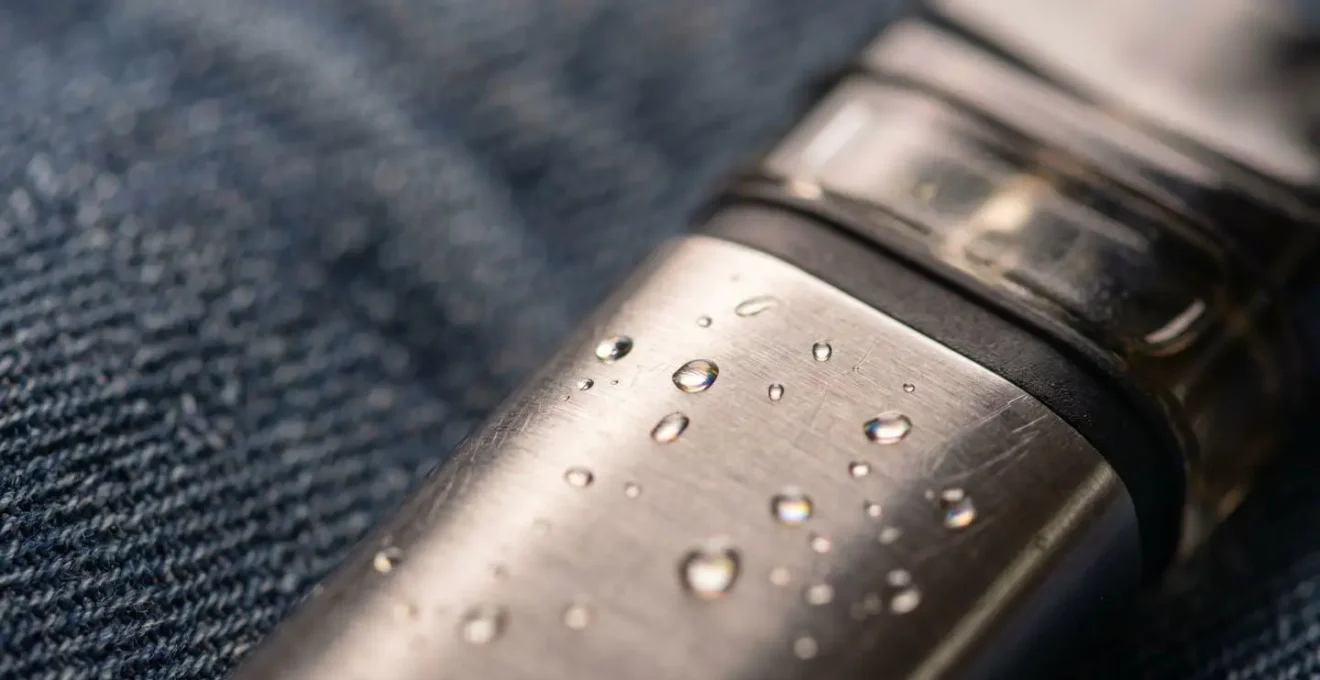
Stop blaming bad luck for vape leaks; you’re witnessing a predictable failure of engineering caused by physics you can control.
- Leaks are not random. They are caused by quantifiable changes in pressure (altitude), viscosity (heat), and seal integrity (wear and tear).
- The “Hostile Pocket Environment”—your body heat and movement—is the number one culprit, turning perfectly good e-liquid into a thin, leak-prone fluid.
Recommendation: Shift your mindset from simply ‘using’ your vape to ‘managing’ it as a piece of mechanical hardware. Understanding these forces is the only way to achieve a permanently leak-proof experience.
That familiar, sticky patch on your trousers. The faint, sweet smell that confirms your pocket, once again, has become a reservoir for expensive e-liquid. For any UK commuter, this is a uniquely frustrating cycle. You invest in a quality device, you follow the basic instructions, yet the leaks persist, turning your daily journey into a messy, costly affair. You’ve likely been told it’s your fault: you overfilled it, the coil is old, or you’re just unlucky.
The truth is far more systematic. These leaks are not random acts of betrayal from your device. They are predictable, repeatable failures of engineering under specific, stressful conditions. Your vape isn’t just a simple tube; it’s a finely balanced system of pressure vacuums, seals, and fluid dynamics. Every time you board a train, get in a lift, or simply walk around, you are subjecting this system to a series of rigorous engineering tests.
But if the problem is based on engineering principles, then so is the solution. This is not another list of generic tips. This is a device engineering analyst’s breakdown of the exact physical forces causing your vape to leak and the practical, systematic procedures to counteract them. We will move beyond the “what” and dive deep into the “why”—exploring the physics of pressure changes, the science of liquid viscosity, and the lifecycle of crucial components. By understanding the system, you can finally gain control over it.
This guide breaks down the core engineering challenges your vape faces and provides the technical solutions to master them. The following sections will equip you with the knowledge to diagnose and prevent leaks in any situation, from air travel to daily pocket carry.
Summary: The Engineering Behind a Leak-Proof Vape
- Why Does Your Vape Leak on Aeroplanes but Never at Home?
- How to Identify Tanks With Leak-Proof Seals Before Buying?
- How Often Should You Replace Your Tank’s O-Rings to Prevent Leaks?
- The Overfilling Mistake That Guarantees Your Tank Will Leak Within an Hour
- How to Store Your Vape Overnight Without Finding a Puddle in the Morning?
- Why Air Pressure Changes at Altitude Make Your Pod Leak E-Liquid?
- Why High-PG Liquids Cause Leaking Disasters in Sub-Ohm Tanks?
- Why Does Your Pocket Pod Leak Every Time You Travel by Train or Plane?
Why Does Your Vape Leak on Aeroplanes but Never at Home?
The sudden appearance of e-liquid on a plane isn’t a sign of a faulty device; it’s a textbook demonstration of Boyle’s Law. At ground level, the air pressure inside your tank is equal to the pressure outside. However, an aircraft cabin is not pressurised to sea-level. To reduce stress on the airframe, the air pressure is designed to mimic an elevation of up to 10,000 feet. This creates a significant pressure delta.
As the external pressure drops during ascent, the higher-pressure air trapped inside your tank expands. It needs to escape, and it takes the path of least resistance: pushing straight through the cotton wick and forcing your e-liquid out through the airflow holes. It’s not a leak in the traditional sense; your tank is being actively squeezed from the inside out by expanding air. This is a predictable physics problem, not a random hardware failure. The same, albeit less dramatic, effect can occur during travel on high-speed trains entering tunnels or even driving up a large hill.
The only way to combat this is to manage the pressure differential proactively. This involves either equalising the pressure by emptying the tank before travel or providing a sufficient buffer for the air to expand without displacing the liquid. Simply hoping for the best is a guarantee for a mess at cruising altitude. The key is to anticipate the pressure change and prepare the device’s internal environment accordingly.
How to Identify Tanks With Leak-Proof Seals Before Buying?
The most significant factor in a tank’s inherent leak resistance is its airflow design. This is a fundamental engineering choice that dictates how vulnerable the device is to the forces of gravity and pressure. Understanding this before you buy can save you a world of frustration. The two primary designs are bottom airflow and top airflow.
Bottom airflow systems draw air from the base of the tank, directly underneath the coil. This provides excellent flavour as the air path is short and direct. However, it creates a significant engineering challenge: the airflow holes are located below the e-liquid level. This means the only things preventing a catastrophic leak are a set of perfectly maintained O-ring seals and a stable pressure vacuum. If either fails, gravity will inevitably pull the liquid out of the base.
Top airflow tanks, by contrast, feature a “gravity-assisted design”. Air enters from ports located near the top of the tank, travels down an internal chimney to the coil, and then back up to the mouthpiece. With this design, the e-liquid would have to defy gravity and travel upwards to escape through the air inlets, making accidental leaks from pressure changes or jostling virtually impossible. While they can sometimes have a slightly longer air path, modern engineering has made the flavour difference negligible for most users. For a commuter, this design choice is the single most effective preventative measure you can take.
As the visual breakdown shows, the path the liquid must take to leak from a top airflow tank is far more complex and works against natural forces. This simple engineering difference is critical for anyone prioritising a leak-free experience during travel and daily carry.
This comparative analysis from vape technology specialists Vaporesso breaks down the core trade-offs of each design. The choice for a leak-averse commuter becomes clear.
| Airflow Type | Leak Resistance | Design Principle | Best Use Case |
|---|---|---|---|
| Top Airflow | Excellent (gravity works with you) | Air enters near drip tip, e-liquid must defy gravity to escape | Travel, pocket carry, beginners |
| Bottom Airflow | Moderate (requires perfect seals) | Air enters at base, direct over coil | Maximum flavor, stationary use |
| Side Airflow | Good (balanced compromise) | Horizontal air entry, hits coil sideways | All-around performance |
How Often Should You Replace Your Tank’s O-Rings to Prevent Leaks?
Thinking of O-ring replacement as a reactive repair—something you do only when a leak starts—is a fundamental mistake. From an engineering perspective, these small silicone seals have a predictable lifecycle. They are the primary gaskets preventing leaks in most tanks, and their integrity degrades over time due to a combination of compression, heat, and chemical exposure. A proactive, preventative maintenance schedule is essential.
The “Seal Integrity Lifecycle” is not always visible. An O-ring can look perfectly fine to the naked eye but have lost its elasticity and compressive strength. UV light, heat cycles from the coil, and even certain e-liquid flavourings (particularly acidic ones like citrus or cinnamon) cause microscopic cracks and hardening. This means the seal is no longer pliable enough to perfectly fill the tiny gaps in the tank’s threads, creating an invisible pathway for e-liquid to escape under pressure.
The frequency of replacement depends entirely on your usage patterns. A heavy daily user subjects their O-rings to constant compression and heat, shortening their effective lifespan dramatically compared to an occasional vaper. Adopting a schedule based on your habits, rather than waiting for failure, is the hallmark of proper device management.
Material Science: Viton vs Standard Nitrile O-Rings
Most vape tanks use standard nitrile or neoprene O-rings which offer good durability and heat resistance for normal use. However, advanced users experiencing frequent O-ring degradation with acidic e-liquids (citrus or cinnamon flavors) report significantly improved longevity when upgrading to Viton O-rings. Viton material provides superior heat and chemical resistance, though standard O-rings remain sufficient for the majority of vapers using non-acidic e-liquids. The key failure mode is invisible damage: UV light and certain flavorings cause microscopic cracks and elasticity loss over time, meaning seals may appear intact but lose compression effectiveness.
The Overfilling Mistake That Guarantees Your Tank Will Leak Within an Hour
The most common piece of advice to prevent leaks is “don’t overfill your tank,” but this is often misunderstood. The issue isn’t just about spillage; it’s about destroying the delicate pressure vacuum essential for your tank’s operation. Every properly functioning vape tank relies on a small pocket of air at the top to create negative pressure. This vacuum helps hold the e-liquid in the main reservoir, preventing it from freely flowing through the wicking ports and flooding the coil.
When you fill the tank to the absolute brim, you eliminate this air pocket. With no air to compress, screwing on the top cap pressurises the liquid itself. This positive pressure immediately forces the e-liquid into the only available exit: the cotton wicks. The coil becomes oversaturated and flooded, and the excess liquid then seeps out of the airflow holes. This is why a tank can be perfectly fine one moment and leaking profusely within an hour of being filled to 100% capacity.
To avoid this, a strict filling discipline is required. As a rule of thumb, experts recommend filling tanks to a maximum of 80-90% capacity, always leaving a small, visible air bubble at the top. This isn’t just a suggestion; it’s a critical engineering requirement for the system to function as designed. Mastering a precise filling technique is a non-negotiable skill for any vaper who wants to avoid leaks.
Action Plan: The Fill, Close, and Invert Technique
- Close the airflow control (AFC) ring completely before opening the tank to fill. This isolates the chamber from pressure changes.
- Fill the tank slowly to approximately 85% capacity, ensuring a visible air gap remains below the fill port. Avoid the central chimney.
- Seal the tank cap firmly but do not over-tighten, as this can deform or damage the top O-ring seal.
- Briefly invert the fully sealed tank upside down for 3-5 seconds. This action uses the air bubble to force the vacuum to seat correctly, pushing air towards the wicks and preventing liquid from immediately flooding them.
- Return the tank to an upright position and then open the airflow control to your desired setting before taking the first puff.
How to Store Your Vape Overnight Without Finding a Puddle in the Morning?
The mysterious overnight puddle is another problem rooted in simple physics: thermal contraction and passive wicking. When your vape is in use, the coil and the liquid around it are warm. As the device cools down overnight, the air and components inside contract, creating a slight pressure change that can push a small amount of liquid out. More significantly, gravity and capillary action don’t stop just because you’re asleep. If the tank is left on its side, liquid is constantly in contact with the wicking ports, allowing it to slowly and passively saturate the cotton and eventually seep into the coil chamber and out the airflow holes.
Proper overnight storage is a simple but crucial ritual. The goal is twofold: minimise the effects of gravity and prevent passive wicking. The most effective strategy for any tank or pod system is to store it vertically upright. In this position, gravity helps keep the e-liquid in the main reservoir, away from the wicking ports. For tanks, it’s also best practice to close the airflow control (AFC) ring completely. This seals the coil chamber, reducing air exchange and minimising the chance of any seepage.
For pod systems, an extra step is recommended: remove the pod from the battery device. This breaks the electronic connection and, more importantly, often lifts the base of the pod away from any contact points where liquid could slowly wick onto the device’s internal electronics. Storing the device near a heat source like a radiator or in a very cold spot like a car overnight will amplify thermal contraction and expansion, drastically increasing the likelihood of a leak.
Why Air Pressure Changes at Altitude Make Your Pod Leak E-Liquid?
While larger tanks have their own vulnerabilities to altitude, pod systems are uniquely susceptible due to their construction. The core issue lies in their simplified seal design. Unlike the robust, threaded systems with multiple O-rings found in sub-ohm tanks, pods typically rely on simpler press-fit or friction-fit seals. The pod is simply pushed into place, and the seal’s integrity depends on the precise tolerance between the pod and the coil or the device housing.
This design is cost-effective and convenient, but it’s inherently less resilient to pressure changes. The materials themselves can be a factor. Many pods are made from PCTG plastic, which is durable but has a small degree of flexibility. During a rapid pressure change, like ascending in a plane or even a fast lift in a tall building, this plastic can flex microscopically. It’s not enough to notice, but it’s enough to compromise the friction-fit seal for a split second, allowing the expanding internal air to push e-liquid out.
This vulnerability is a direct trade-off for the convenience and small form factor of a pod system. However, understanding this weakness allows for a clever workaround. Field testing has shown that by manually clearing the wick of excess liquid before an altitude change, you create a larger internal air pocket. This pocket acts as a buffer, giving the expanding air more space to occupy without exerting force on the e-liquid, significantly reducing the chance of a pressure-induced leak.
Pod High-Altitude Hack: Pre-Ascent Protocol
To prevent leaks during flights or mountain drives, a specific protocol can be followed. Before ascending, remove the pod from its battery. Seal the air intake hole at the pod’s base with a finger and take two or three gentle puffs from the mouthpiece. This manual suction clears excess e-liquid from the wick, pulling it back into the main reservoir. The now-cleared space in the wick creates an essential internal air pocket that can absorb the pressure expansion during ascent. The pod should only be re-inserted into the battery after reaching a stable, high altitude.
Why High-PG Liquids Cause Leaking Disasters in Sub-Ohm Tanks?
The relationship between your e-liquid’s viscosity and your coil’s design is one of the most critical, and often misunderstood, aspects of preventing leaks. Propylene Glycol (PG) and Vegetable Glycerin (VG) are the two main base liquids, and they have vastly different properties. PG is thin, watery, and carries flavour well. VG is thick, viscous, and produces dense vapour. The VG/PG ratio is therefore a direct control for the liquid’s overall viscosity.
A sub-ohm coil, designed for high power and large clouds, has very large wicking ports—the holes in the side that allow liquid to saturate the cotton. Using a thin, high-PG liquid (like a 50/50 blend) in a sub-ohm tank is like trying to hold water in a net. The liquid flows too easily through the large ports, overwhelming the cotton and flooding the coil chamber, resulting in immediate gurgling and leaking. Sub-ohm tanks are engineered specifically for the slow flow rate of thick, high-VG liquids (70% VG or higher).
However, there’s a hidden variable: heat. Even a perfectly matched high-VG liquid can become dangerously thin when heated. As a study on the effects of temperature on e-liquid shows, a 70/30 VG/PG blend at a warm 40°C can flow as easily as a 50/50 blend at room temperature. This is why your vape might start leaking on a hot day, if left in a car, or during a session of intense “chain-vaping” that heats the whole tank. Your liquid’s viscosity isn’t static; it’s a dynamic property that you must manage.
As this data from e-cigarette specialists Ecigone demonstrates, the wrong liquid for a given coil resistance is a primary cause of flooding.
| Coil Resistance | Recommended VG/PG Ratio | Viscosity Behavior | Risk of Flooding |
|---|---|---|---|
| > 1.0 ohm (MTL) | 50/50 PG/VG | Thin liquid wicks easily through small ports | Low |
| 0.6-1.0 ohm (Restricted DTL) | 60/40 to 70/30 VG/PG | Moderate viscosity balances wicking and control | Low to Moderate |
| < 0.6 ohm (Sub-Ohm) | 70/30 VG/PG or higher | Thick liquid prevents flooding through large wick ports | High if using 50/50 |
| < 0.3 ohm (High Power) | 80/20 VG/PG recommended | Very thick liquid required for massive wick openings | Very High if using high-PG |
Key Takeaways
- Leaks are predictable engineering failures, not bad luck. They are caused by pressure, viscosity, and seal degradation.
- The single biggest factor for commuters is the “Hostile Pocket Environment”: body heat thins your e-liquid while motion forces it out.
- Proactive prevention is key: choose top-airflow tanks, manage your liquid’s viscosity, and replace seals on a schedule, not after a leak starts.
Why Does Your Pocket Pod Leak Every Time You Travel by Train or Plane?
The frustration of a pocket-leak during travel is the result of a perfect storm of negative factors, a scenario we can call the “Hostile Pocket Environment.” It’s not one single thing, but the convergence of three simultaneous stressors that overwhelms your device’s defences. Understanding this three-factor model is the key to finally solving the problem.
First is body heat. Your pocket is a warm place, typically around 37°C. As we’ve established, heat drastically reduces e-liquid viscosity. Your carefully chosen 70/30 VG/PG blend effectively becomes a much thinner, more leak-prone liquid simply by being stored next to your body. Second is constant motion. The jostling from walking, sitting down on a train, and general movement creates kinetic energy. This motion, combined with gravity, forces the now-thinned liquid into the wick and coil assembly, far more aggressively than during stationary use. Third is debris. Pockets are full of lint and dust, which can easily block the tiny, precision-engineered air inlet holes on a pod. If these are blocked, the delicate pressure balance required for the pod to function is disrupted, often creating a vacuum that pulls liquid out when you next take a puff.
Research across vaping forums and user reports consistently shows that isolating a device from these three stressors is the most effective prevention strategy. Devices kept in a small, dedicated hard-shell case, even when carried in a bag, show significantly fewer leak incidents during travel than those carried loose in a pocket. The case acts as a shield, protecting the device from heat, insulating it from motion, and keeping it clear of debris. It’s a simple solution to a complex-sounding, but ultimately predictable, engineering problem.
The path to a leak-free experience is not about finding a magical, flawless device. It’s about understanding that your vape is a piece of mechanical hardware and treating it as such. By respecting the physical forces of pressure and viscosity, and by adopting a proactive maintenance and storage routine, you are no longer a victim of circumstance but the master of your device’s engineering. Start implementing these systematic solutions today to make sticky pockets a thing of the past.