In summary:
- Your metal drip tip burns your lips because of high thermal conductivity; materials like resin are 80 times less conductive and stay cool.
- The inner width (bore) of your drip tip is not just for looks; it fundamentally changes flavour concentration and vapour production, and must match your MTL or DTL style.
- Authentic resin has a distinct weight and sound; learning to spot fakes prevents cracking, yellowing, and a poor experience.
- Persistent pocket leaks are often caused by physics—temperature changes creating a pressure differential inside your tank—not just faulty seals.
That sharp, surprising sting of heat on your lips after a few consecutive puffs is a universally unpleasant experience for vapers. It’s a moment that breaks the enjoyment and makes you question your setup. Many vapers instinctively blame their coil or wattage, or simply accept that a hot drip tip is a necessary evil of chain vaping. The common advice is often to “just switch to a plastic one” or pick a tip that matches the colour of your mod, treating it as a purely aesthetic accessory.
This approach, however, misses the fundamental point. Your drip tip isn’t just a mouthpiece; it’s a critical component that dictates comfort, flavour delivery, and the overall ergonomic feel of your vape. The difference between a comfortable, flavourful session and a frustrating, lip-burning one often lies in understanding the material science behind that small piece. It’s not about avoiding metal, but about understanding thermal conductivity. It’s not just about colour, but about achieving aesthetic cohesion through finish and texture.
But what if the key wasn’t just in swapping materials, but in truly mastering the interaction between the drip tip’s design and your personal vaping style? This guide moves beyond the surface-level advice. We will explore the scientific reasons why resin stays cool while metal burns. We’ll decipher the language of bore sizes to perfectly match your MTL or DTL preference, teach you how to spot a cheap imitation that will fail you, and reveal the cleaning blind spot that most vapers miss. We will even expand this systems-thinking to related issues like mod heat and persistent leaks, turning you into an informed connoisseur of your own setup.
This article provides a comprehensive look at every aspect of your drip tip, transforming it from a simple accessory into a mastered tool for the perfect vape. Below is a summary of the topics we will cover to help you achieve ultimate comfort, performance, and style.
Summary: A Deep Dive into Mastering Your Drip Tip
- Why Resin Drip Tips Stay Cool When Metal Tips Get Burning Hot?
- Wide-Bore or Narrow-Bore Drip Tip: Which Matches Your MTL Style?
- How to Spot Fake Resin Drip Tips That Yellow and Crack Within Weeks?
- The Cleaning Step Most Vapers Skip That Breeds Bacteria on Their Drip Tip
- How to Choose a Drip Tip Colour That Complements Your Mod’s Finish?
- Why Your Mod Gets Dangerously Hot When Vaping Above 100W?
- How Often Should You Replace Your Tank’s O-Rings to Prevent Leaks?
- Why Does Your Pocket Always Have E-Liquid Stains After Carrying Your Vape?
Why Resin Drip Tips Stay Cool When Metal Tips Get Burning Hot?
The burning sensation from a metal drip tip isn’t a flaw in your vaping style; it’s a demonstration of basic physics. The core reason lies in a property called thermal conductivity—how efficiently a material transfers heat. Metals, like the stainless steel commonly used for drip tips, are excellent conductors of heat. This is great for a frying pan, but terrible for something you put on your lips.
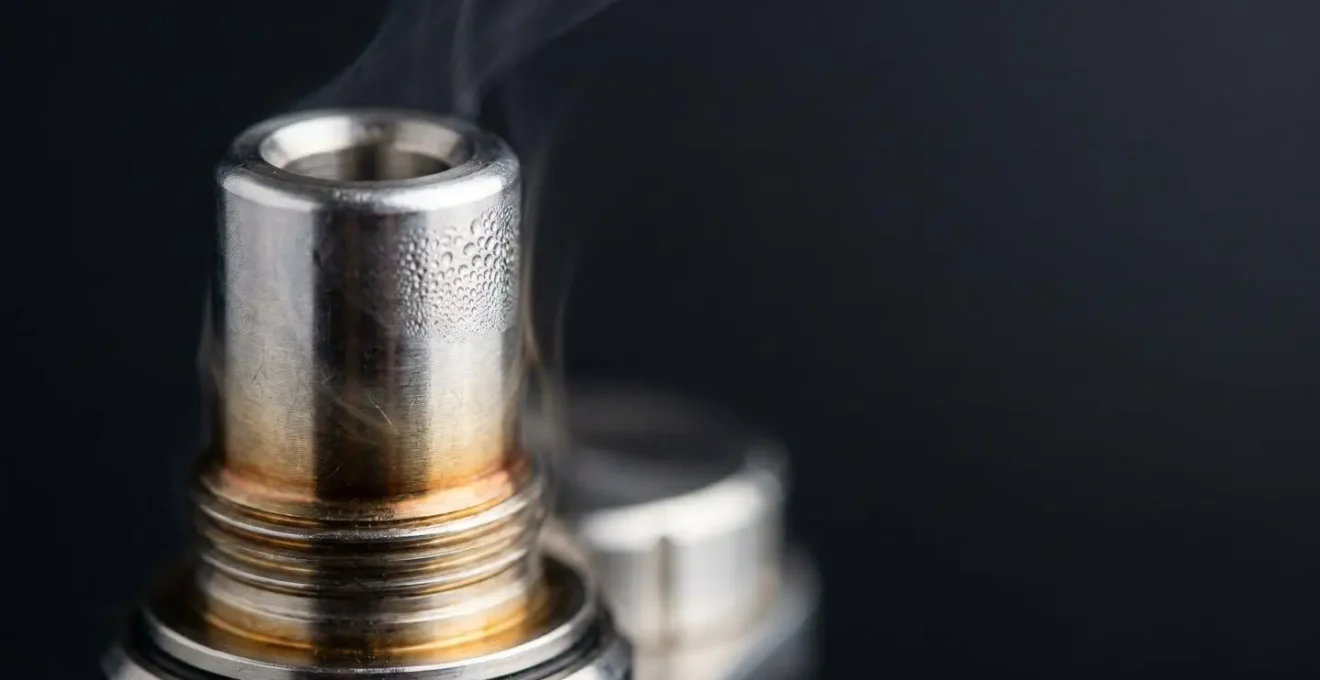
When you vape, the coil generates significant heat, which is transferred to the atomiser’s top cap and, subsequently, to the drip tip. For metal, this heat travels quickly and efficiently right to the end of the tip. According to material science data on drip tip thermal properties, stainless steel conducts heat at around 16 W/mK. In stark contrast, epoxy resin is an insulator, with a thermal conductivity of just 0.2 W/mK. This means metal is approximately 80 times more effective at transferring that uncomfortable heat to your lips.
As this visual comparison suggests, the heat from the atomiser saturates the metal tip almost instantly, while the resin tip effectively isolates that heat at the base. Materials like Delrin, Ultem, and TEFLON are also popular for their excellent insulating properties, providing a cool and comfortable experience even during intense chain vaping sessions. Choosing one of these materials is the single most effective way to eliminate lip burn.
Wide-Bore or Narrow-Bore Drip Tip: Which Matches Your MTL Style?
Beyond thermal comfort, the single most important functional characteristic of a drip tip is its internal diameter, known as the bore. This single dimension fundamentally alters the vaping experience, controlling everything from flavour intensity to cloud volume. Choosing the wrong bore for your vaping style is like trying to drink a thick milkshake through a coffee stirrer—it’s inefficient and unsatisfying.
For Mouth-to-Lung (MTL) vapers, who mimic the draw of a traditional cigarette, a narrow bore is essential. The restricted airflow concentrates the vapour, creating a denser, more intense flavour and a stronger throat hit. It slows down the vapour velocity, allowing you to savour the nuances of your e-liquid. As the experts at Armerah Vaping Guides note in their guide, A Guide to Choosing Your e-Cigarette Drip Tip or Mouthpiece:
A narrow bore creates a more concentrated and therefore stronger flavour for your ecig and gives a nice tight vape, best for flavour and taste connoisseurs.
– Armerah Vaping Guides, A Guide to Choosing Your e-Cigarette Drip Tip or Mouthpiece
Conversely, Direct-to-Lung (DTL) vapers, who inhale directly into their lungs for massive clouds, require a wide bore (often called an 810 drip tip). This maximises airflow, reduces heat, and allows for the huge vapour production they seek. The table below breaks down the key differences, helping you match the hardware to your habit.
| Bore Category | Inner Diameter | Vaping Style | Vapor Characteristics | Recommended Wattage |
|---|---|---|---|---|
| Narrow Bore (510) | Less than 9.5mm | Mouth-to-Lung (MTL) | Concentrated flavor, tighter draw, reduced vapor velocity | Below 20W |
| Wide Bore | 9.5mm to 11.5mm | Restricted Direct Lung | Increased airflow, moderate clouds | 20W – 50W |
| Extra Wide Bore (810) | 11.5mm to 14mm+ | Direct-to-Lung (DTL) | Maximum airflow, massive clouds, cooler vapor | Above 50W |
How to Spot Fake Resin Drip Tips That Yellow and Crack Within Weeks?
You’ve chosen a beautiful resin drip tip for its looks and thermal properties, but within a month, it’s yellowed, developed a hairline crack, and feels cheap. You’ve likely been sold a low-quality acrylic tip masquerading as authentic epoxy resin. While both are plastics, their durability, feel, and heat resistance are worlds apart. Mass-produced acrylic is brittle and susceptible to discolouration from UV light and certain e-liquids, while hand-poured epoxy resin is dense, durable, and chemically stable.
Telling them apart at the point of sale is crucial to avoid disappointment. You don’t need a lab; you can use your senses to perform a few simple physical tests. Authentic resin has a certain material integrity that cheap acrylic lacks. Before you buy, or if you suspect your current tip is an imposter, run through this quick diagnostic checklist to verify its authenticity.
Your Action Plan: Identifying Authentic Epoxy Resin
- Weight Test: Authentic epoxy resin has a dense, satisfying heft. Hold the tip in your palm—if it feels light and flimsy like a cheap toy, it’s likely acrylic.
- Tap Test: Tap the drip tip with your fingernail. True epoxy resin produces a sharp, clacky sound similar to a billiard ball. Cheap acrylic creates a dull, low-pitched thud.
- Visual Inspection: Examine the resin pattern’s depth. Authentic hand-poured resin has deep, seamless, three-dimensional swirls inside the material. Fakes often have shallow, printed-on patterns that look like a surface sticker.
- Seam Check: Look for a visible mould line running along the body. Mass-produced acrylic tips often show faint seams from the manufacturing process, while quality hand-finished resin tips are perfectly seamless.
- Heat Resistance Test: Gently warm the tip in your hands for 30 seconds. Cheap acrylic may feel slightly softer or more pliable, while high-quality epoxy resin will remain completely rigid and heat-stable.
These simple, non-destructive tests can save you from the frustration of a drip tip that degrades quickly. Investing in authentic resin isn’t just about aesthetics; it’s about a longer-lasting, more satisfying, and safer vaping experience.
The Cleaning Step Most Vapers Skip That Breeds Bacteria on Their Drip Tip
Most vapers are diligent about the basics of hygiene: a quick rinse of the drip tip under a tap or a wipe with a tissue. While this is better than nothing, it completely misses the primary location where bacteria and gunk accumulate. The most neglected and dirtiest part of your drip tip assembly isn’t the mouthpiece itself, but the hidden O-ring groove at its base.
Every time you vape, a tiny amount of e-liquid, condensation, and skin cells from your lips gets drawn down into the connection point. This mixture collects in the small channel where the O-ring sits, creating a perfect, sheltered, and nutrient-rich environment for bacteria to thrive. Because this area is sealed from view, it’s often forgotten during routine cleaning, leading to a buildup of brown, sticky residue.
As this image illustrates, the real cleaning work happens once the drip tip is removed from the atomiser. To properly clean your drip tip, you must first pop it off the tank. Use a cotton swab or a corner of a paper towel to thoroughly wipe out the O-ring groove on the drip tip and the corresponding inner wall of the top cap it plugs into. You will likely be surprised and disgusted by the amount of dark residue that comes out, even from a setup that looks clean on the surface. Performing this deep clean at least once a week is essential for a truly hygienic vape.
How to Choose a Drip Tip Colour That Complements Your Mod’s Finish?
Elevating your vape setup from functional to beautiful is an art. Many vapers stop at simply matching the primary colour of their drip tip to their mod, but achieving true aesthetic cohesion requires a more nuanced approach. It’s about harmonising textures, finishes, and accent colours to create a unified look. A glossy black drip tip on a matte black mod, for instance, can create a jarring visual disconnect despite being the “same” colour.
The secret is to think like a designer and apply the “Rule of Three.” This principle suggests that a visually pleasing design often repeats a colour or material in three places, creating balance and intention. For example, a silver mod, a tank with a silver accent ring, and a drip tip with a silver base. This creates a deliberate visual rhythm. If your mod is monochromatic, a vibrant resin tip can serve as a stunning accent piece, but its success depends on its finish matching the mod’s texture.
Case Study: The Hybrid Solution
Vapers who love the premium look of a polished stainless steel atomiser but hate the heat of a metal tip often feel aesthetically stuck. The solution is a hybrid drip tip. These designs combine a metal base that perfectly matches the finish of the tank with a mouthpiece made from a heat-resistant material like resin or Delrin. This offers the best of both worlds: the aesthetic cohesion of matched metals at the base and the functional comfort of a cool material on the lips. It’s a prime example of choosing a component that marries form and function.
To build your perfect setup, follow these design-minded steps:
- Identify Your Foundation: Start by noting your mod’s primary finish—is it matte, brushed, polished, or sandblasted? This is your starting point.
- Match Finish, Not Just Colour: Prioritise matching the texture. A matte resin tip will look far better on a matte mod than a glossy one.
- Apply the Rule of Three: Find a highlight colour or material and repeat it. A black mod with a carbon fibre inlay could be perfectly complemented by a tank with a black PVD coating and a black Delrin drip tip.
- Use Contrast Intentionally: For a bold statement, use a single, vibrant contrasting drip tip on an all-black or all-silver setup. This turns the tip into a deliberate focal point.
Why Your Mod Gets Dangerously Hot When Vaping Above 100W?
While this article focuses on the drip tip, a hot mod is a related and far more serious issue. When your entire device becomes uncomfortably warm, especially when vaping at high wattages (above 100W), it’s a clear signal that your batteries are under significant stress. This heat is not primarily coming from your atomiser; it’s being generated internally by the batteries themselves.
High-wattage vaping demands a very high discharge rate from your batteries. This process is not 100% efficient; some of the battery’s energy is lost as heat, a phenomenon known as internal resistance. The harder you push the batteries, the more heat they generate. This is compounded by using low-resistance coils (below 0.15 ohms), which draw even more current.
This isn’t just a matter of discomfort; it’s a critical safety issue. Lithium-ion batteries have a safe operating temperature range. As battery safety experts warn, heating batteries above 60°C permanently degrades their capacity and, in extreme cases, can lead to thermal runaway—a dangerous and irreversible chemical reaction. If your mod is too hot to hold comfortably, your batteries are almost certainly exceeding this safe temperature threshold. The best course of action is to stop vaping immediately, remove the batteries (if possible), and let them cool down in a safe place.
Regularly check your battery wraps for any nicks or tears, as a damaged wrap can cause a short circuit and extreme heat. Vaping safely at high wattages requires high-quality, authentic batteries from a reputable brand (like Molicel, Sony/Murata) and a deep respect for their limits.
How Often Should You Replace Your Tank’s O-Rings to Prevent Leaks?
O-rings are the unsung heroes of a leak-free vape tank. These small rubber or silicone rings create the tight seals that keep your e-liquid where it belongs. However, they are not immortal. Over time, constant pressure, heat cycles, and exposure to certain e-liquid ingredients cause them to degrade, lose their elasticity, and fail. There’s no fixed timeline for replacement, but you don’t have to wait for a pocket full of juice to know it’s time.
Instead of relying on a calendar, you should learn to recognise the physical symptoms of a worn-out O-ring. Proactive inspection during your regular cleaning routine is the key to preventing leaks before they start. When you disassemble your tank, take a moment to check the condition of each seal. Your tank is communicating its needs; you just need to learn the language.
Look out for these clear warning signs that an O-ring is compromised and needs immediate replacement:
- Visual Flattening: A fresh O-ring is perfectly round in its cross-section. A worn one will have a flattened or squared-off appearance where it has been compressed.
- Spinning Glass: After reassembly, if the glass section of your tank can spin freely with little to no resistance, it’s a major red flag. The O-rings have lost their grip and are no longer creating a tight seal.
- Squishy Assembly Feel: When screwing the tank base back on, it should feel snug and secure. If it feels mushy, loose, or doesn’t tighten down with firm resistance, your O-rings are likely degraded.
- Visible Damage: This is the most obvious sign. Check for any micro-tears, cracks, nicks, or frayed edges on the O-ring’s surface.
- E-Liquid Acceleration: If you frequently vape e-liquids with strong citrus, cinnamon, or heavy menthol flavours, you should inspect your O-rings more frequently (e.g., every two weeks), as these acidic compounds are known to accelerate the degradation of silicone and nitrile seals.
Key Takeaways
- Comfort is Science: Lip burn is a problem of thermal conductivity. Choosing a drip tip made from an insulating material like resin is the most effective solution for a cool vape.
- Bore is Function: The inner diameter of your drip tip is crucial. Match a narrow bore to your MTL setup for intense flavour and a wide bore to your DTL setup for maximum clouds.
- Leaks are Physics: Many pocket leaks are caused by a pressure differential from temperature changes. Closing your airflow and storing your vape upside down are simple, science-based fixes.
Why Does Your Pocket Always Have E-Liquid Stains After Carrying Your Vape?
It’s one of the most frustrating vaping experiences: you carefully place your vape in your pocket or bag, only to pull it out later and find it—and your pocket—covered in a sticky film of e-liquid. The common assumption is a faulty O-ring or a tank that wasn’t tightened enough. While those can be culprits, the most frequent cause of “pocket leak” is a simple law of physics: thermal expansion.
Your tank is a sealed vessel containing both liquid and air. When you move your vape from a cool, air-conditioned environment into the warmth of your pocket or a hot car, the air and liquid inside the tank expand. This expansion increases the pressure inside the tank, creating a positive pressure differential. This pressure needs to escape, and it forces e-liquid out through the path of least resistance—which are almost always the airflow holes at the base of your tank.
Case Study: The Pressure Differential Leak
When a vape is taken from a 20°C room and placed in a 35°C pocket, the air inside the tank expands, forcing e-liquid out through the coil and into the airflow channels. This is not a “leak” in the sense of a failed seal, but a predictable physical reaction to a change in environment. Understanding this mechanism is the key to preventing it, as it’s not a fault of the tank but a condition of its use.
You can’t change the laws of physics, but you can outsmart them with a few simple habits:
- Close Your Airflow: Before you pocket your device, always rotate the airflow control ring to the fully closed position. This blocks the primary escape route for the pressurised e-liquid.
- Store It Upside Down: If possible, place your vape in your pocket upside down. This puts the air bubble at the bottom of the tank, near the juice flow holes. This air pocket acts as a buffer, preventing liquid from being forced directly out.
- Allow Temperature Equalisation: Never fill your tank and immediately pocket it. After filling, let the device sit at room temperature for a few minutes to allow the internal and external pressures to equalise before transport.
Your vape is a personal system of interacting parts. Using this knowledge of material science, physics, and design principles, you can audit your setup today. Go beyond the default components and build an experience that is truly your own—comfortable, flavourful, and perfectly styled.