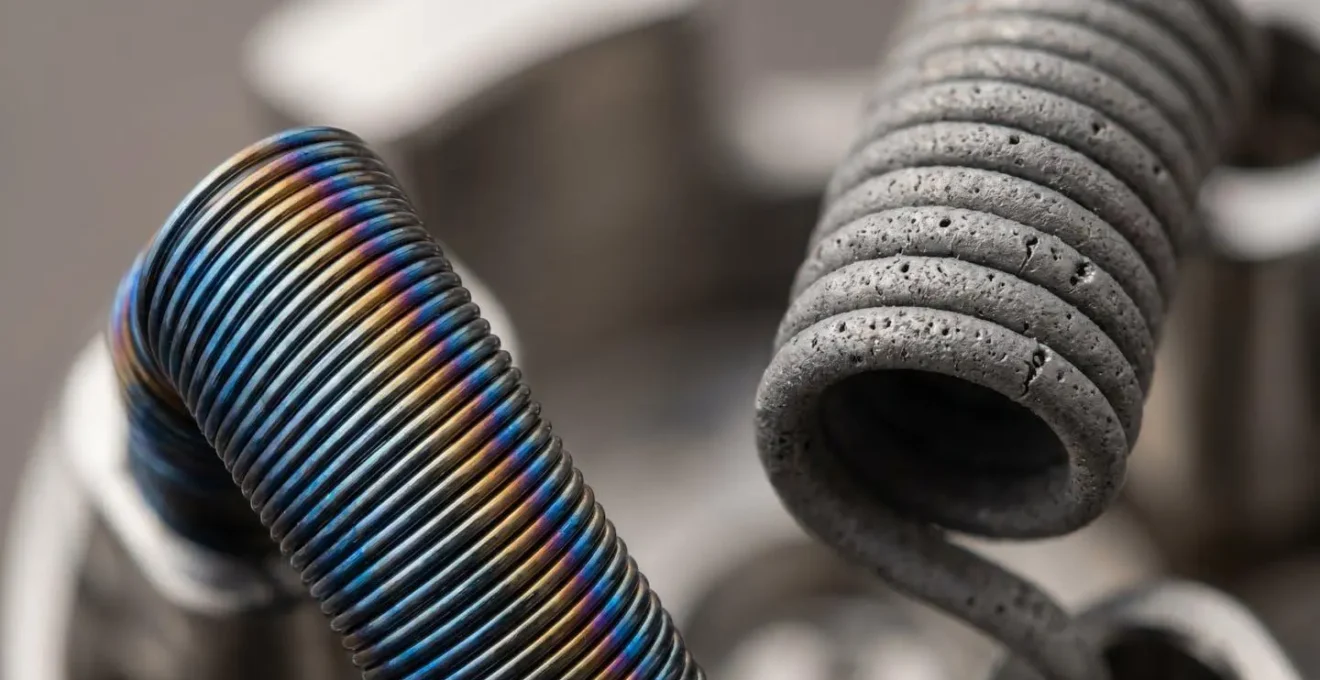
That frustrating metallic taste from your Kanthal coil isn’t a random flaw or a sign of ‘vaper’s tongue’. It is a specific, predictable signal from the material itself, indicating that the coil’s protective, flavour-neutral oxide layer has been compromised. This guide acts as a diagnostic tool, explaining the metallurgy of Kanthal wire so you can understand these signals, control the thermal behaviour of your coil, and eliminate that metallic off-flavour for good.
You’ve spent time meticulously wrapping a new Kanthal coil. It glows perfectly from the centre outwards, the resistance is spot on, and the wicking is flawless. You take the first draw, expecting pure, clean flavour from your favourite e-liquid, but instead, you’re met with a harsh, unmistakable metallic tang. Meanwhile, your friend, using what seems to be the exact same setup, enjoys a perfectly clean vape. It’s a common and deeply frustrating experience for many vapers who build their own coils, often leading to unhelpful advice like “it’s just vaper’s tongue” or “you need to switch to stainless steel.”
The truth is far more precise and rooted in material science. The metallic taste isn’t your fault, nor is it an inherent, unavoidable flaw of Kanthal. It is a diagnostic signal. The key to understanding this lies not in abandoning Kanthal, but in understanding its fundamental nature as a ferritic iron-chromium-aluminium (FeCrAl) alloy. The secret to a clean taste is a stable, protective, and invisible layer of aluminium oxide (alumina) that forms on the wire’s surface.
When that layer is healthy, your vape is clean. When it’s compromised, you taste the iron core. This article will deconstruct the common issues that lead to this failure. We will explore how wire gauge, alloy grade, and your own maintenance habits—specifically how you dry-burn your coils—are the true culprits. By the end, you won’t just know how to avoid the metallic taste; you’ll understand why it happens and be able to diagnose your coil’s health just by looking at it.
To navigate this deep dive into the metallurgy of your vape, this guide breaks down the science into clear, understandable sections. Below is a summary of the topics we will cover to turn you from a frustrated vaper into a confident coil diagnostician.
Summary: A Vaper’s Diagnostic Guide to Kanthal Wire
- Why Kanthal Remains the Most Popular Coil Wire After 15 Years of Alternatives?
- 24-Gauge or 28-Gauge Kanthal: Which Matches Your Low-Wattage MTL Style?
- Kanthal A1 or D: Which Version Handles High Wattages Without Hotspots?
- How Many Times Can You Dry-Burn a Kanthal Coil Before It Needs Replacing?
- When Your Kanthal Coil Changes Colour: The Degradation Signs to Watch
- Which Wire and Gauge Combination Delivers Best Flavour Under 0.5 Ohms?
- Why Stainless Steel Changes Resistance When Heated: The TC Science Explained?
- Why Does Your Hand-Wrapped Coil Taste Better Than the £5 Pre-Built Version?
Why Kanthal Remains the Most Popular Coil Wire After 15 Years of Alternatives?
Despite the emergence of stainless steel, nichrome, and titanium, Kanthal’s dominance is no accident. Its longevity stems from two core metallurgical properties that make it uniquely suited for wattage-mode vaping: high resistivity and the formation of a stable protective layer. Kanthal is the most commonly used wire for vape coils on the market precisely because it is predictable and robust.
Unlike other wires, Kanthal’s resistance barely changes as it heats up. This stability (a low Temperature Coefficient of Resistance or TCR) is why it’s the default choice for variable wattage devices, providing a consistent power output from a cold start to a hot glow. It doesn’t require the complex calculations of a temperature control mod to deliver a reliable vape.
However, the true “magic” of Kanthal lies in its chemical composition. As a “ferritic iron-chromium-aluminium alloy,” its design purpose is to perform at high temperatures. The manufacturer’s own specifications highlight this. According to the official Kanthal datasheet:
Kanthal A-1 is a ferritic iron-chromium-aluminium alloy (FeCrAl alloy) for use at temperatures up to 1400°C (2550°F). The alloy is characterized by high resistivity and very good oxidation resistance.
– Kanthal Official, Kanthal A-1 Wire Technical Datasheet
This “very good oxidation resistance” is the key. When heated for the first time, the aluminium in the alloy rushes to the surface and reacts with oxygen to form a thin, durable, and electrically insulating layer of aluminium oxide (alumina). This layer is incredibly stable and, crucially, flavour-neutral. It is this protective skin that prevents you from tasting the iron and chromium that make up the bulk of the wire. Kanthal’s popularity endures because it was engineered to create its own non-reactive shield, making it a dependable workhorse for vapers worldwide.
24-Gauge or 28-Gauge Kanthal: Which Matches Your Low-Wattage MTL Style?
The choice between wire gauges like 24 AWG (thicker) and 28 AWG (thinner) is more than a matter of hitting a target resistance; it’s a fundamental decision in thermal management. For low-wattage, Mouth-to-Lung (MTL) vaping, the physical properties of the wire dictate the quality of the vape. Thinner gauges, typically 26 to 28-gauge Kanthal wire, are the established workhorses for MTL setups, a preference noted by vaping experts for their quick responsiveness.
From a material science perspective, the difference is mass. A thinner 28-gauge wire has significantly less mass than a 24-gauge wire of the same length. This means it requires less energy (wattage) and less time to reach vaping temperature—a phenomenon known as “ramp-up time.” For a short, sharp MTL draw, you want the coil to heat instantly and cool down quickly to avoid cooking the e-liquid on the wick. The lower mass of a 28-gauge wire is ideal for this, providing a responsive and efficient vape at wattages often below 15W.
The image below illustrates the physical difference in wire diameter and how that translates to thermal response. The thinner wire heats more rapidly and intensely with the same energy input.
Conversely, using a thicker 24-gauge wire for a low-wattage MTL build would be inefficient. Its greater mass requires more power and time to heat up, leading to a sluggish “lag” at the start of your draw. Furthermore, it retains heat for longer after you release the fire button, which can lead to caramelized or burnt-tasting e-liquid. For MTL styles, the snappy, low-mass nature of 28-gauge Kanthal provides the thermal performance that perfectly matches the short, low-power draws it’s designed for.
Kanthal A1 or D: Which Version Handles High Wattages Without Hotspots?
When you start pushing into higher wattages for Direct-Lung (DL) vaping, the specific grade of Kanthal becomes critically important. Not all Kanthal is created equal, and the difference between Kanthal A1 and Kanthal D is a perfect example. This is often where the metallic taste issue originates. While some online tutorials might vaguely suggest the taste is from the iron in the wire, the reality is a material failure. The protective oxide layer is being pushed beyond its operational limits, and the grade of wire determines where that limit is.
Kanthal A1 is the superior grade for vaping, especially at high power. It has a higher concentration of aluminium and is engineered for a higher maximum operating temperature. According to metallurgical specifications, Kanthal A1 handles temperatures up to 1400°C while Kanthal D is limited to 1200°C. This 200°C difference is a massive thermal safety margin. When a coil develops a “hotspot”—a tiny area that glows much brighter than the rest—its temperature can spike dramatically. On Kanthal D, this spike might be enough to breach its thermal limit, causing the protective alumina layer to crack or degrade. Once compromised, the iron core is exposed, and you get that distinct metallic off-flavour.
This explains why one vaper’s coil tastes clean while another’s tastes metallic, even if both are “Kanthal.” The user with Kanthal A1 has a wire that is far more resilient to the thermal stress of hotspots and high wattage, maintaining its protective layer where a lower-grade wire would fail. As one vape tutorial from Misthub notes, the perception of a metallic taste is a subject of debate, but it’s often linked to this very breakdown:
Some people claim that Kanthal wire puts off a slightly metallic taste due to the Iron composition, whereas others claim it does not.
– Misthub Vape Tutorial, Tutorial: NiChrome vs Ni-200 vs Titanium vs Kanthal vs Stainless Steel Vape Wire
The difference isn’t subjective; it’s a matter of material integrity. Those who don’t experience it are likely using a high-quality Kanthal A1 wire and operating it within its thermal limits, preserving the integrity of the flavour-neutral oxide layer. For high-wattage builds, choosing Kanthal A1 is the single most important decision to prevent hotspots and the resulting metallic taste.
How Many Times Can You Dry-Burn a Kanthal Coil Before It Needs Replacing?
Dry-burning a coil is a standard practice for cleaning and re-wicking, but how you do it determines whether you are maintaining your coil or destroying it. The question isn’t how many times you can do it, but *how* you do it each time. Each dry burn is a thermal cycle that stresses the wire. Done correctly, it can clean residue and even help re-passivate the oxide layer. Done incorrectly, it can be the primary cause of a metallic taste.
The goal of a cleaning dry burn is to gently heat the coil until the caked-on residue from e-liquid turns to a fine ash, which can then be brushed or rinsed off. This requires only a dull, cherry-red glow performed in short pulses in a dimly lit room. This gentle heat is well within the operating temperature of Kanthal A1 and helps reinforce the stable alumina surface.
The problem arises when vapers overheat the coil, pushing it to a bright orange or even white-hot glow. This extreme temperature is far beyond what’s needed for cleaning and it actively damages the wire. This intense heat causes rapid expansion and contraction, creating micro-fractures in the protective oxide layer. It can also cause the iron and chromium in the core to migrate, further weakening the material. This is thermal degradation in action. With each aggressive dry burn, the protective layer becomes more compromised until it fails completely, exposing the iron core and producing that familiar metallic off-flavour. While manufacturer guidance suggests about one to two weeks of use from a replaceable coil, the lifespan of a rebuildable coil is entirely dependent on this maintenance routine.
Your 5-Step Kanthal Coil Health Audit
- Visual Inspection (Cold): Before heating, look at the coil. Are there any visible signs of pitting, corrosion, or a dull, lifeless grey colour? If so, the oxide layer is likely compromised.
- Gentle Pulse Test: In a dim room, pulse the fire button gently. Does the coil glow evenly from the inside out? Or are there “hotspots” that glow much brighter and faster than the rest? Hotspots are a sign of imminent failure.
- Colour Check (Post-Glow): After a gentle pulse, as the coil cools, observe the colour. A healthy, passivated coil will often display iridescent blues and purples. A dull grey or black colour that can’t be brushed off indicates severe oxidation.
- The “Sizzle” Test: After cleaning and before re-wicking, place a single drop of e-liquid on the cold coil. Pulse the power. Do you hear a clean, crisp sizzle? Or a sputtering, uneven crackle? The latter can indicate hotspots or poor heat distribution.
- The Taste Test (Baseline): Before adding your flavoured e-liquid, do a quick test with a wick soaked in unflavoured VG/PG base. If you detect any metallic taste here, the coil is the problem and must be replaced.
A Kanthal coil can be dry-burned and re-wicked many times, potentially for weeks, as long as the process is treated as a delicate maintenance procedure, not a brute-force cleaning. Gentle heat preserves the coil; aggressive heat destroys it.
When Your Kanthal Coil Changes Colour: The Degradation Signs to Watch
The colour of your Kanthal coil is not merely decorative; it is a direct visual indicator of the health and status of its surface oxidation. Learning to read these colours is like a mechanic listening to an engine—it allows you to diagnose the coil’s condition at a glance. The transformation from a shiny new wire to a colourful, and eventually degraded, coil tells a story of thermal history.
When you first pulse a new Kanthal coil, you’ll see a beautiful spectrum of colours, from straw-yellow to deep blue and purple. These are not signs of damage. This is a phenomenon called thin-film interference. As the initial, ultra-thin layer of aluminium oxide forms, its thickness is measured in nanometres. Light reflecting off its top and bottom surfaces interferes with itself, cancelling out certain wavelengths and leaving behind these vibrant colours. A colourful, rainbow-hued coil is a sign of a healthy, newly formed, and pristine protective oxide layer.
The visual guide below shows the typical progression. The vibrant colours of a new coil are a good sign. The black, gunked-up coil is dirty but potentially salvageable with a gentle clean. The final, dull grey coil is the one that will taste metallic.
As you use the coil, it will become black and covered in caramelized residue. This is normal and is what you clean off during a dry burn. The diagnostic trouble starts after cleaning. If, after a gentle dry burn, the coil returns to a blue or purple hue, its protective layer is still largely intact. However, if it emerges from the cleaning process a dull, matte grey or shows signs of a chalky white or grey powder, the oxide layer has been compromised. This dull grey is the colour of a heavily oxidized, degraded surface. The alumina layer has become thick, brittle, and likely cracked, exposing the iron-rich core. A coil that looks like this is at the end of its life and will almost certainly impart a metallic taste. As the technical notes from the popular Steam Engine calculator explain, the oxidation of kanthal creates a thin insulating layer of alumina, but it’s not indestructible. The dull grey colour is the sign of its destruction.
Which Wire and Gauge Combination Delivers Best Flavour Under 0.5 Ohms?
When venturing into sub-ohm territory (below 0.5 ohms), the goal shifts from simple heating to maximizing the efficiency of vaporization for better flavour. This requires a significant increase in the coil’s surface area. A simple round wire, even a thick one, has a limited surface to vaporize e-liquid. This is where complex coils, like Claptons or Fused Claptons, become superior for flavour production.
A Fused Clapton, as described by experts at Versed Vaper, is “composed of a thinner gauge wire that is wrapped around two or more thicker gauge wires.” This intricate construction drastically increases the total surface area without proportionally increasing the coil’s mass. More surface area means more e-liquid can be vaporized instantly and efficiently when you fire the device. This creates a denser, more flavourful vapour. The tiny crevices in the outer wrap also act as reservoirs, holding e-liquid against the hot core wires.
The ideal combination for sub-ohm flavour is often a Fused Clapton made with a Kanthal core (e.g., 2 x 26-gauge cores) and a Nichrome or thinner Kanthal outer wrap (e.g., 36 or 38-gauge). This provides a large surface area, structural stability from the Kanthal cores, and a relatively fast ramp-up time. The key is to match the coil’s mass with enough power to heat it quickly and evenly. An underpowered Fused Clapton will feel sluggish and produce weak flavour. An overpowered one can create intense hotspots in the complex structure, leading to the thermal degradation and metallic taste we’ve discussed. The growing demand for such advanced setups is a major driver in the vaping market, with analyses showing the global vaping tank market was valued at $6.8 billion in 2023, reflecting a huge user base seeking better performance.
Why Stainless Steel Changes Resistance When Heated: The TC Science Explained?
Understanding why Kanthal is a “wattage-only” wire is best done by comparing it to its most versatile alternative: stainless steel (SS). The core difference lies in a property called the Temperature Coefficient of Resistance (TCR). This value measures how much a material’s electrical resistance changes as its temperature changes.
Kanthal is engineered to have an extremely low, almost negligible, TCR. Its resistance at room temperature is virtually the same as its resistance at vaping temperature. This stability is a feature, not a bug. It ensures that the power your mod delivers is consistent throughout your draw. However, this also means a device has no way of knowing how hot the Kanthal coil is just by measuring its resistance. It’s “dumb” in the best way possible for wattage mode.
Stainless steel, on the other hand, has a predictable and positive TCR. As you heat an SS coil, its resistance increases in a known, linear fashion. This is the science that makes Temperature Control (TC) vaping possible. A TC mod works by:
- Measuring the coil’s “cold” resistance at room temperature.
- Continuously monitoring the resistance as you fire the device.
- Calculating the coil’s current temperature based on the change in resistance.
- Throttling or cutting power once the coil reaches the temperature limit you have set.
This unique property makes stainless steel a dual-purpose wire. As noted by Vaping360, “It can pull double duty and be used for straight wattage vaping or temp control vaping.” This versatility is its main advantage. However, for pure wattage-mode simplicity and robustness, Kanthal’s stable resistance and superior oxide layer often make it the more reliable choice, especially for beginners who don’t want to delve into the complexities of TCR values and TC settings.
Key takeaways
- The metallic taste is not from Kanthal itself, but from a failure of the protective aluminium oxide (alumina) layer, exposing the iron core.
- Coil colour is a critical diagnostic tool: a rainbow hue is a healthy sign of a new oxide layer, while a dull, matte grey indicates irreversible degradation and end-of-life.
- Dry-burning must be a gentle process using a dull red glow; overheating to a bright orange or white destroys the protective layer and is a primary cause of metallic off-flavours.
Why Does Your Hand-Wrapped Coil Taste Better Than the £5 Pre-Built Version?
It’s a common experience: you spend time and effort on a hand-wrapped coil, and it delivers a cleaner, more satisfying flavour than a pre-built coil head that costs a fiver. The reason is simple and empowering: control. When you build your own coil, you are the quality control manager at every step of the process, from material selection to the final thermal break-in.
First, you control the materials. You can ensure you are using high-quality Kanthal A1 from a reputable source, not an unknown grade of wire that might have a lower thermal tolerance. Second, you control the build. A careful, even wrap on a jig is less likely to have hidden kinks or stress points that can become hotspots later on. In contrast, a mass-produced, machine-wrapped coil head is a black box. You don’t know the exact grade of the wire, its manufacturing tolerances, or whether it was stressed during assembly. The recent market trend, which has seen rechargeable products dominating with a 60% market share, shows a clear user preference for the customisation and control that rebuildable systems offer.
Most importantly, you control the break-in. You perform the initial gentle pulses, ensuring the coil glows evenly and the protective oxide layer forms perfectly. You can spot and correct a hotspot before it becomes a problem. With a pre-built coil head, you just prime it and fire. You have no control over that critical first heating cycle. The superior taste of your hand-wrapped coil is a direct result of the knowledge and care you apply. It’s not magic; it’s the application of the material science principles we’ve discussed. You are ensuring the integrity of the alumina layer, the very thing that stands between you and a metallic taste.
By applying this diagnostic mindset to every coil you build, you can move from being a victim of random metallic tastes to a master of your vaping experience, achieving that clean, perfect flavour every single time.