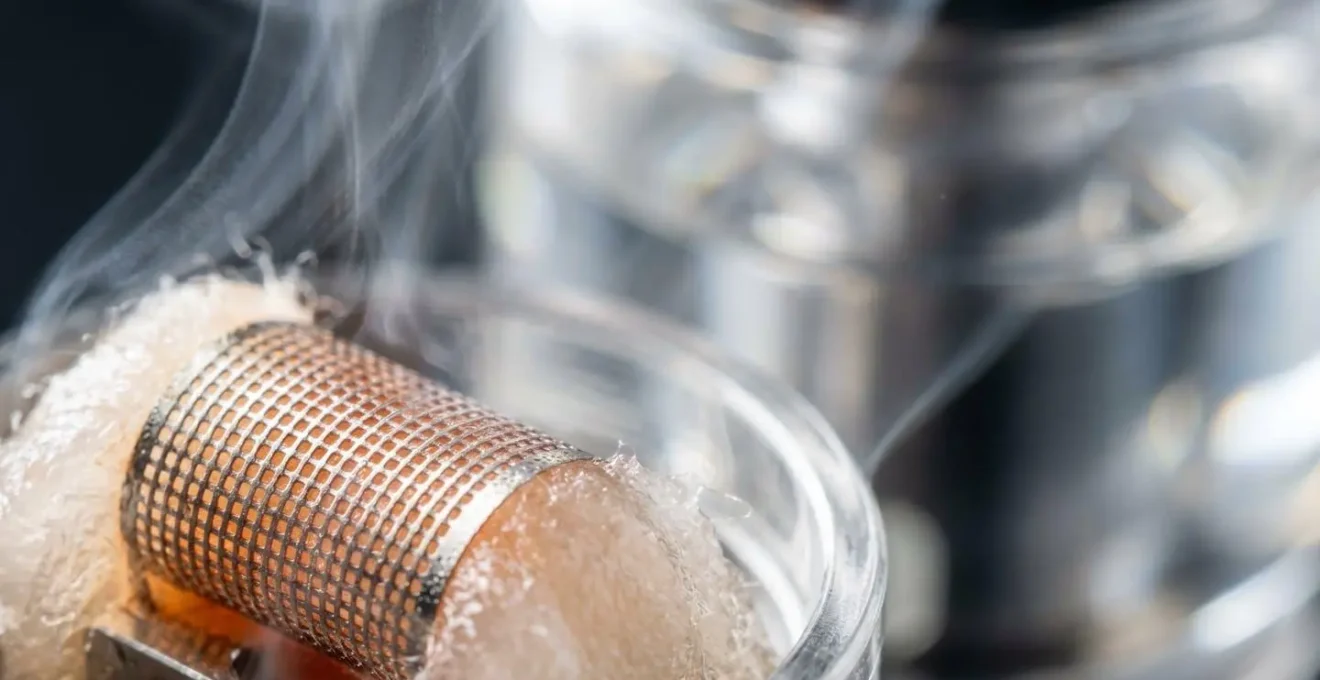
The secret to superior flavour isn’t just that mesh coils are bigger; it’s that they ‘cook’ e-liquid with the precision of a professional chef.
- Traditional wire coils act like an open flame, creating intense hotspots that scorch flavour compounds and mute the taste.
- Mesh coils function like a flat-top griddle, delivering perfectly even heat that vaporizes the entire flavour profile without burning it.
Recommendation: To unlock true flavour fidelity, you must treat your mesh coil like a piece of high-end culinary equipment, focusing on precise heat control and proper preparation.
You’ve spent good money on a complex, premium e-liquid—a carefully crafted blend of Malaysian fruit, delicate pastry, and a hint of cooling. You fill your tank, take a puff, and the taste is… flat. Muted. A shadow of the flavour profile described on the bottle. This frustrating experience is common, and it often leads vapers to question the coil at the heart of their device. The discussion inevitably turns to mesh vs. traditional wire, with many claiming mesh is superior.
The standard explanation you’ll hear is that mesh coils have a “larger surface area.” While true, this statement alone is a lazy oversimplification. It fails to convince the discerning vaper who wants to know if the higher cost of mesh technology genuinely justifies the price. It doesn’t explain *why* that surface area translates to a restaurant-quality flavour experience rather than just a bit more vapour.
But what if the key wasn’t about size, but about culinary technique? The real difference between mesh and wire is the difference between a perfectly seared steak and a charred, unevenly cooked piece of meat. This guide will move beyond the platitudes and dive into the physics and chemistry of flavour vaporization. We will explore how mesh coils act as a precision tool for ‘cooking’ your e-liquid, why traditional coils often fail, and how you can master this technology to finally unlock the full, intended flavour of every drop.
This article breaks down the essential science and practical techniques for mastering mesh coil technology. From understanding heat dynamics to perfecting your priming method, we’ll cover everything you need to know to make an informed decision and elevate your vaping experience.
Summary: The Vaper’s Guide to Flavour Fidelity with Mesh Coil Technology
- Why Mesh Coils Heat 200% More E-Liquid Surface Than Traditional Wire?
- How to Find the Sweet Spot Wattage That Makes Mesh Coils Last 4 Weeks?
- Single or Dual Mesh Coil: Which Produces Better Flavour at Lower Wattage?
- The Mesh Coil Priming Mistake That Burns £5 Coils in One Puff
- Why Mesh Coils Handle 80VG Liquid Better Than Traditional Cotton-Wrapped Wire?
- Mesh Coils or Traditional Coils: Which Delivers Better Flavour for Fruity E-Liquids?
- Why Thick VG Liquids Cause Dry Hits in Small Pod Coil Holes?
- Why Does Your Coil Burn Out in 4 Days When Others Last 3 Weeks?
Why Mesh Coils Heat 200% More E-Liquid Surface Than Traditional Wire?
The core difference in flavour delivery begins with the fundamental geometry of the heating element. A traditional wire coil is a single, spiralled wire. When it heats, it creates intense, concentrated hotspots, much like the individual bars of a grill. This uneven heating leads to some e-liquid being scorched and ‘overcooked’, while other parts are barely warmed, resulting in a muddled and incomplete flavour profile.
A mesh coil, by contrast, is a perforated sheet of metal, akin to a chef’s flat-top griddle. When power is applied, the entire surface heats up instantly and uniformly. This eliminates the hotspots that destroy delicate flavour notes. The result is a ‘flash vaporization’ process that heats the e-liquid precisely and evenly. As Vapor Authority’s analysis notes, “The increased surface area ensures that e-juice is evenly vaporized, preserving the nuances of the flavor profile for a more satisfying vape.” This isn’t just about being bigger; it’s about superior heat control.
This uniform heating dynamic is substantial. Indeed, research demonstrates that mesh coils provide a up to 200% larger surface area for contact with the wick. This massive, evenly heated contact patch ensures that every molecule of e-liquid is brought to the optimal vaporization temperature simultaneously. It’s this culinary precision that allows mesh to render bright, distinct, and complete flavours, while wire coils often produce a muted, ‘caramelized’ version of the same liquid.
How to Find the Sweet Spot Wattage That Makes Mesh Coils Last 4 Weeks?
Owning a mesh coil without knowing its ‘sweet spot’ wattage is like having a performance car and never taking it out of first gear. Pushing too much power results in burnt tastes and a short lifespan, while too little power yields wispy, flavourless vapour. The key to longevity and optimal flavour is finding the precise wattage where the coil vaporizes liquid efficiently without ‘cooking’ the sweeteners into a layer of gunk.
The manufacturer’s recommended wattage range, usually printed on the coil or its packaging, is your starting point—not the final answer. This range is a general guideline. Your specific e-liquid’s viscosity and sweetener content, coupled with your personal draw style, will determine the true sweet spot. Finding it requires a methodical approach often called the ‘Flavor Ladder Technique’.
This process involves starting below the recommended range and making small, incremental adjustments until the flavour pops. It’s a moment of calibration that turns a good vape into a great one. Here is how you can perform this calibration:
- Step 1: Check the coil packaging or side of coil to identify the manufacturer’s recommended wattage range.
- Step 2: Start at 10W below the minimum recommended wattage as your baseline.
- Step 3: Take 2-3 puffs at the current wattage and evaluate flavor clarity and warmth.
- Step 4: Increase wattage by 1-2W increments, pausing to test flavor after each adjustment.
- Step 5: Identify the ‘sweet spot’ as the point where flavor becomes vivid and rich without any toasted or overly warm taste.
- Step 6: Mark this wattage setting and avoid exceeding it to maximize coil longevity and prevent rapid sweetener caramelization.
Once you find this sweet spot and stick to it, you prevent the rapid degradation of both the cotton and the coil element. This disciplined approach is how some vapers achieve a coil life of three to four weeks, while others who constantly chase more heat burn through coils in days.
Single or Dual Mesh Coil: Which Produces Better Flavour at Lower Wattage?
The evolution of mesh technology has introduced a new choice for flavour chasers: single vs. dual mesh coil configurations. The intuitive assumption is that “more is better”—that a dual coil would naturally produce superior flavour. However, when considering performance at lower, more battery-conscious wattages, the opposite is often true.
The critical factor is the power-to-mass ratio. A single mesh coil has less metal to heat, allowing it to reach its optimal vaporization temperature quickly and efficiently, even with modest power input (e.g., 30-50W). This efficiency is perfect for rendering the subtle, delicate notes in complex e-liquids. A dual mesh coil, conversely, has double the mass. It requires significantly more power to overcome this thermal inertia and reach the same temperature. At low wattage, a dual coil can feel anemic, producing wispy, underdeveloped vapour that lacks flavour intensity.
As the following comparison based on recent comparative analyses shows, the choice depends heavily on your preferred vaping style and equipment.
| Characteristic | Single Mesh Coil | Dual Mesh Coil |
|---|---|---|
| Power-to-Mass Ratio | Lower mass, reaches optimal temperature quickly even at low wattage (30-50W) | Double the mass, requires higher wattage (50-80W) to reach optimal temperature |
| Flavor Nuance | Excels at capturing subtle notes; concentrated airflow enhances delicate flavor perception | Produces ‘bigger’ sensation but can dilute delicate notes with increased air volume |
| Airflow Dynamics | Targeted airflow design directs air precisely over coil surface for efficient vapor pickup | Diffuse airflow may feel too spread out at low wattage, reducing vapor density |
| Low Wattage Performance | Optimal: Crisp, nuanced flavor with dense vapor at 30-45W | Suboptimal: Wispy, anemic vapor that lacks flavor intensity at same low wattage |
| Best Use Case | Flavor chasers seeking nuance, battery conservation, MTL-to-restricted DTL vaping | Cloud chasers with high-wattage devices, unrestricted DTL vaping |
For the flavour-focused vaper who values nuance and battery life, a single mesh coil is unequivocally superior at lower wattages. It provides a dense, crisp, and detailed flavour experience precisely because it is engineered for efficiency, not just brute force.
The Mesh Coil Priming Mistake That Burns £5 Coils in One Puff
There is no greater disappointment for a vaper than installing a brand new, expensive mesh coil, taking that first anticipated puff, and being met with the acrid, throat-searing taste of burnt cotton. This catastrophic failure, which destroys a £5 coil in an instant, is almost always due to an improper priming technique that fails to account for the unique physics of a dense mesh coil wick.
The problem lies in a phenomenon that can be called the “Surface Tension Trap.” Mesh coils, with their large heating surface, require a very dense block of cotton to function. Simply dripping liquid onto the visible parts creates a deceptive layer of saturation on the outside, while surface tension prevents the liquid from penetrating the core and displacing hidden air pockets. When you fire the coil, these dry spots instantly combust against the hot mesh, creating an irreversible burnt taste.
Case Study: The “Surface Tension Trap” Phenomenon
The large surface area of mesh coils requires significantly more cotton than traditional wire coils, creating a dense wicking structure. Surface tension can create a deceptive outer saturation layer while leaving hidden dry spots against the mesh itself. Without vacuum-assisted priming, these air pockets remain trapped within the cotton core. When the coil fires for the first time, these dry zones instantly combust, creating irreversible carbon deposits that produce the characteristic burnt taste. This phenomenon explains why mesh coils appear properly saturated externally yet still burn on first use—a £5 mistake that proper Flood and Seal priming prevents.
To defeat this trap, a more robust method is required. The ‘Flood and Seal’ priming technique uses vacuum pressure to force e-liquid into the deepest parts of the wick, ensuring complete saturation and preventing that dreaded first-puff burnout.
Your Action Plan: The Flood and Seal Priming Method
- Step 1 (Internal Saturation): Drip e-liquid directly inside the coil head onto the exposed cotton until it appears fully saturated and glistening.
- Step 2 (External Coating): ‘Paint’ the outer cotton wicking ports with e-liquid using your finger or dropper tip, ensuring complete coverage.
- Step 3 (Tank Assembly): Insert the primed coil into the tank base and fill the tank completely with e-liquid.
- Step 4 (Vacuum Priming – Critical): Close the airflow completely, then take 3-4 gentle ‘primer puffs’ WITHOUT pressing the fire button. This vacuum pressure forces liquid into hidden air pockets within the dense cotton.
- Step 5 (Break-in Period): Set wattage to 50% of your target ‘sweet spot’ wattage for the first 5-10 puffs to gently condition the cotton.
- Step 6 (Full Power): After break-in, gradually increase to your optimal wattage setting identified via the Flavor Ladder technique.
Why Mesh Coils Handle 80VG Liquid Better Than Traditional Cotton-Wrapped Wire?
High-VG (Vegetable Glycerin) e-liquids are prized for their ability to produce dense, thick clouds of vapour. However, their thick, syrupy consistency poses a significant challenge for many coils. The high viscosity makes it difficult for the liquid to flow quickly enough through the small wicking ports of traditional coils, leading to dry hits, especially during chain vaping. Mesh coils, however, are uniquely engineered to overcome this problem.
The science behind this lies in fluid dynamics. Vegetable Glycerin is significantly more viscous than Propylene Glycol (PG). In fact, laboratory measurements confirm that its viscosity can be over 20 times higher. Trying to pull this thick liquid through the tiny, restrictive wicking holes of a standard wire coil is like trying to drink a thick milkshake through a narrow coffee stirrer—the flow rate is simply too slow to keep up with vaporization.
Mesh coils solve this ‘hydraulic resistance’ issue in two ways. Firstly, they are typically designed with much larger wicking ports, creating wider channels for the liquid to flow. Secondly, and more importantly, the vast contact area between the mesh and the cotton creates what experts at ROCKME Vaping Technology call a “‘capillary superhighway.’ This massive interface promotes powerful capillary action, actively and rapidly pulling the thick VG liquid into the coil, ensuring the wick stays fully saturated even under the duress of continuous, high-wattage puffs.
Mesh Coils or Traditional Coils: Which Delivers Better Flavour for Fruity E-Liquids?
Fruity e-liquids present a unique challenge. Their vibrant, bright notes are often derived from highly volatile flavour compounds like esters and aldehydes. These delicate molecules are sensitive to heat; if ‘overcooked’, they degrade and lose their character, and if ‘undercooked’, they fail to vaporize properly, remaining trapped in the wick. This is where the culinary precision of mesh coils provides a distinct advantage.
As the editorial team at Daddy’s Hangout explains, “Fruity notes are often derived from volatile esters and aldehydes that vaporize at lower temperatures. Mesh’s rapid, even heating flashes these compounds into vapor perfectly, creating a ‘bright’ and ‘clean’ taste.” A traditional wire coil, with its uneven hotspots, will inevitably scorch a portion of these delicate compounds, leading to a muted or even slightly caramelized fruit flavour that lacks the intended crispness.
Furthermore, mesh coils excel at preventing a common problem for vapers who enjoy variety: flavour ghosting. This occurs when the remnants of a previous e-liquid linger in the wick, muddling the taste of a new one. Switching from a strawberry to a mango e-liquid in a wire coil often results in a few minutes of an undesirable “strango” flavour.
Case Study: Flavour Ghosting Prevention
Mesh coils vaporize e-liquid with exceptional efficiency due to their large, flat heating surface, leaving minimal residual flavor-soaked liquid on the wick after each puff. In contrast, wire coils with concentrated heat points leave more un-vaporized liquid sitting in cooler zones of the cotton. When switching between different fruity e-liquids (such as moving from strawberry to mango), mesh coils deliver a cleaner transition because the previous flavor profile is ‘flashed off’ more completely during vaporization. This efficiency prevents the common issue of flavor ghosting—where remnants of the prior e-liquid muddle the fresh flavor—making mesh coils ideal for vapers who frequently rotate through multiple fruity profiles without wanting cross-contamination.
For lovers of bright, authentic fruit flavours, the superior, even heating and vaporization efficiency of a mesh coil make it the clear winner, delivering a cleaner, more accurate, and more versatile flavour experience.
Why Thick VG Liquids Cause Dry Hits in Small Pod Coil Holes?
The frustration of a dry, burnt hit from a compact pod system when using a thick, high-VG e-liquid is a direct result of a fundamental mismatch between fluid viscosity and mechanical design. Pod systems, especially those designed for Mouth-to-Lung (MTL) vaping, are engineered for thinner liquids and prioritize compact size over large wicking capacity.
The coils in these devices typically have very small resistance (0.8Ω and higher) and, crucially, feature tiny wicking holes, often only 1-2mm in diameter. These small apertures are perfectly adequate for the low viscosity of 50VG/50PG e-liquids, allowing the thin liquid to be quickly absorbed by the wick through capillary action. However, when a thick 80VG/20PG liquid is introduced, its high viscosity creates a bottleneck. The liquid is too thick to flow through the small holes fast enough to replenish the cotton as it’s being vaporized. After a few puffs, the cotton dries out in spots, and the next time the coil is fired, it burns, resulting in a dry hit.
The relationship between device type, coil design, and e-liquid viscosity is critical for performance. This compatibility matrix, based on data from industry experts like Frugi Liquid, illustrates the ideal pairings.
| Device Type | Coil Resistance | Wicking Port Size | Recommended VG/PG Ratio | Performance Notes |
|---|---|---|---|---|
| Pod Systems (MTL) | 0.8Ω – 1.6Ω | Small holes (1-2mm) | 50VG/50PG | Thin consistency ensures rapid wicking; 80VG causes dry hits and coil burnout |
| Pod Systems (Restricted DTL) | 0.6Ω – 0.8Ω | Medium holes (2-3mm) | 60VG/40PG to 70VG/30PG | Balanced viscosity for moderate cloud production without wicking issues |
| Sub-Ohm Tanks (Standard Coils) | 0.4Ω – 0.6Ω | Large holes (3-4mm) | 70VG/30PG | Adequate wicking for thick liquids; optimal for flavor and vapor balance |
| Sub-Ohm Tanks (Mesh Coils) | 0.15Ω – 0.4Ω | Extra-large ports (4-5mm) | 80VG/20PG to 100VG | Mesh surface area creates ‘capillary superhighway’ enabling chain vaping with high-VG |
| RDAs/RTAs (Wire Coils) | Variable | Manual wicking | 70VG/30PG recommended | User-controlled wick density; 80VG+ may require thinner wicking |
| RDAs/RTAs (Mesh Strips) | Variable | Manual wicking | 80VG/20PG to 100VG optimal | Mesh contact area handles maximum viscosity with proper wicking technique |
Ultimately, using the right tool for the job is paramount. Expecting a small pod system to handle high-VG liquid is setting it up for failure. For those who prefer thick, cloudy liquids, a sub-ohm tank equipped with a mesh coil and its large wicking ports is the appropriate hardware.
Key Takeaways
- Even Heating is Everything: Mesh coils provide superior flavour not because they’re bigger, but because they heat liquid uniformly like a griddle, preventing the scorching that mutes taste.
- Find Your Wattage Sweet Spot: Coil life and flavour peak at a specific wattage. Use the ‘Flavor Ladder’ technique to find it and stick to it, resisting the urge to increase power.
- Priming is Non-Negotiable: A mesh coil’s dense cotton can create a ‘Surface Tension Trap’. Use the Flood and Seal method with vacuum puffs to ensure full saturation and avoid instant burnout.
Why Does Your Coil Burn Out in 4 Days When Others Last 3 Weeks?
Premature coil burnout is one of the most persistent and costly frustrations in vaping. When your coil dies in a few days while others boast weeks of use, it’s rarely due to a faulty product. The culprits are almost always a combination of the e-liquid used, the power applied, and a common user behaviour mistake.
The primary antagonist of coil life is sweetener, particularly sucralose. As the experts at Innokin Vaping Research state, “Some e-liquid ingredients – such as the sugar-free sweetener sucralose – cause residue to build up on your coil’s heating surface over time.” This residue, often called ‘coil gunk’, effectively caramelizes onto the heating element. This baked-on layer acts as an insulator, forcing you to apply more power to get the same level of vapour, which in turn accelerates further caramelization. It’s a vicious cycle.
This leads to a destructive user habit known as ‘Wattage Creep’. It’s the intuitive but incorrect response to fading flavour.
Case Study: The “Wattage Creep” Phenomenon
Many vapers unknowingly engage in ‘Wattage Creep’—the habit of incrementally increasing device wattage when flavor begins to fade from an aging coil. This behavior stems from attempting to revive diminishing taste by applying more heat, but it actually represents a critical mistake that drastically accelerates the coil’s demise. As sweeteners like sucralose caramelize and form an insulating gunk layer on the coil surface, flavor naturally diminishes. Increasing wattage in response forces the coil to work harder against this residue buildup, exponentially accelerating caramelization and burning the cotton from the inside out. Industry experts observe that vapers who resist Wattage Creep and instead replace coils when flavor fades can extend overall coil life by 40-60%. The correct protocol: when flavor deteriorates, replace the coil—never increase power.
While mesh coils do offer a general longevity advantage due to their even heat distribution, they are not immune to the laws of chemistry. The key to long coil life is a three-pronged approach: choosing e-liquids with less sucralose, finding and adhering to your optimal wattage sweet spot, and crucially, resisting the urge to engage in Wattage Creep. When the flavour fades, it’s time for a fresh coil, not more power.
Now that you understand the science behind heat distribution, wicking dynamics, and optimal power settings, you are equipped to move beyond marketing hype. You have the knowledge to treat your vaping hardware like the precision culinary tool it is, enabling you to diagnose issues, optimize performance, and make an informed investment in the technology that will deliver the truest, most satisfying flavour from your favourite e-liquids.