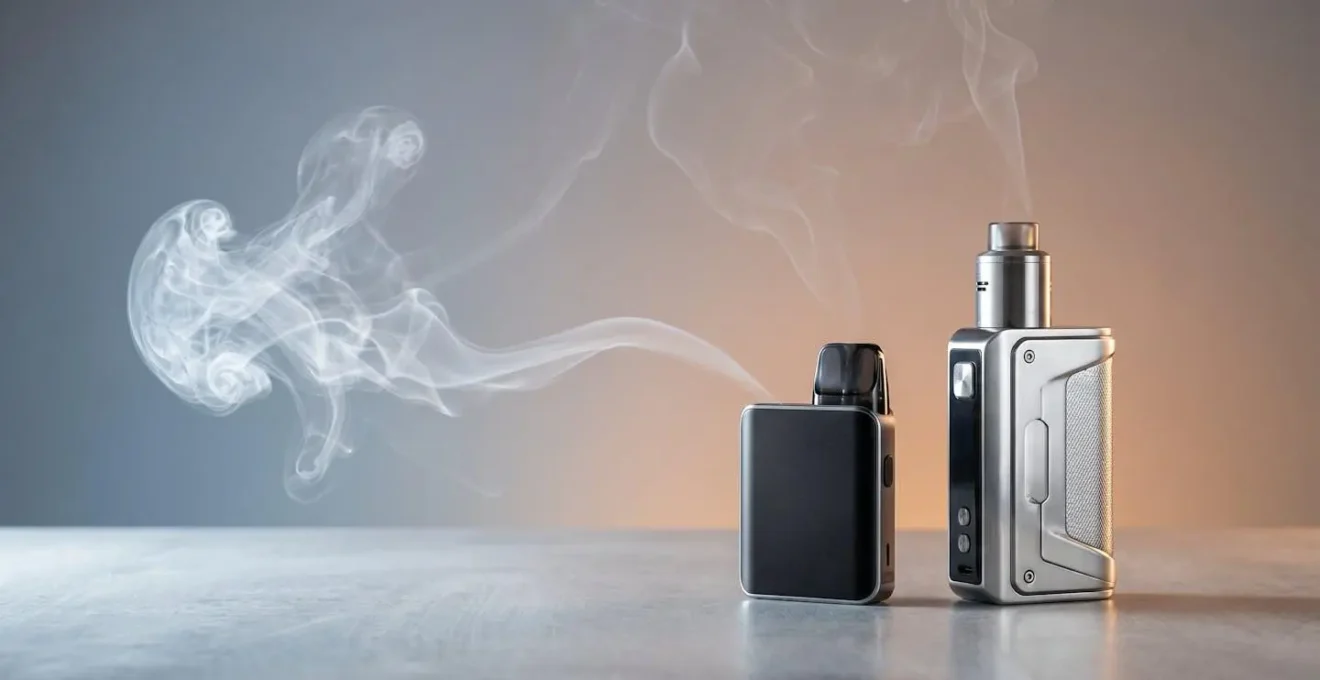
Your 200W mod isn’t underperforming; it’s being bottlenecked. Raw wattage is a blunt instrument that means nothing without total system synergy.
- True vapour production isn’t about maximum power, but about the efficient application of that power through a balanced system of coil, tank, and airflow.
- Mismatches in coil resistance, wicking speed, or airflow dynamics will cripple the performance of even the most powerful device.
Recommendation: Stop pushing wattage and start engineering your vape. Match your coil’s resistance to its mass, your tank’s airflow to the coil’s heat output, and your e-liquid to the wicking capability.
You’ve invested in a 200-watt beast of a mod, a device that promises earth-shattering clouds and intense flavour. You’ve seen the reviews, you know the potential is there. Yet, in a frustrating twist of physics, your friend with their modest 80W setup is blowing clouds that put yours to shame. You’ve cranked the power to its limit, opened the airflow wide, and even switched e-liquids, but the result is a weak, underwhelming, or harsh vape. It’s a common and deeply frustrating experience for intermediate vapers who have rightly assumed that more power equals more vapour.
The community’s default advice—”get a better tank,” “use a different coil,” or “check your batteries”—while not incorrect, misses the fundamental point. These are symptoms, not the root cause. The truth is, chasing higher wattage is often a race in the wrong direction. The secret isn’t in the sheer *amount* of power available, but in its precise and efficient *application*. Performance vaping is a game of technical balance, not a contest of brute force. The problem isn’t your mod’s power; it’s the harmony (or lack thereof) within the entire vaping system.
This guide deconstructs that system. We will move beyond the superficial “more watts” narrative to explore the critical interplay of resistance, heat flux, wicking dynamics, and airflow. You will learn to diagnose the specific bottleneck in your setup and understand why a finely tuned 80W system will always outperform a mismatched 200W configuration. It’s time to stop guessing and start engineering the vape experience you paid for.
This article breaks down the technical reasons behind your high-wattage disappointment and provides the knowledge to unlock your device’s true potential. The table of contents below outlines the key systems we’ll analyse to transform your setup.
Summary: Why a Powerful Mod Can Underperform
- Why Wattage Means Nothing Without the Right Coil Resistance?
- How to Match a 150W Mod With a Tank That Can Handle the Power?
- Why Your Mod Gets Dangerously Hot When Vaping Above 100W?
- The Chain-Vaping Mistake That Burns High-Wattage Coils in 48 Hours
- When to Stop Increasing Wattage: The Flavour Peak Most Vapers Overshoot
- Why Cloud Competitions Require Dual Coils at 0.1 Ohms Minimum?
- Why Sub-Ohm Coils Need 50W When Your Pod Only Needed 12W?
- Why Can’t You Blow Competition-Size Clouds Even With Premium Equipment?
Why Wattage Means Nothing Without the Right Coil Resistance?
Raw wattage is simply potential energy. Its effectiveness is entirely dictated by the coil’s resistance, measured in ohms (Ω). A low-resistance coil (e.g., 0.15Ω) provides a wider, less restrictive path for electricity, allowing it to draw significantly more power at a given voltage. This is why sub-ohm coils are necessary for high-wattage vaping. Trying to push 150W through a 1.2Ω coil is like trying to force a river through a garden hose—the system will fail.
The critical factor is not just heat, but heat flux—the speed and density at which heat is transferred to the e-liquid. According to vaping physics analysis, lower resistance coils, typically made with thicker or more complex wire, have a larger surface area. When massive power is applied, this large surface heats up incredibly quickly, creating a high heat flux that can vaporise a large amount of e-liquid almost instantly. This is the engine of cloud production. Your 200W mod has the power, but without a low-resistance coil designed with a large surface area, that power has nowhere to go efficiently.
As you can see in the detailed structure of a complex coil, the intricate wraps and multiple strands are engineered to maximise the metal’s contact area with the saturated wick. A simple, thin wire coil, regardless of how much power you apply, simply doesn’t have the physical surface area to generate the vapour volume you expect from a high-power device. The wattage is just a number until it’s applied to a resistance low enough and a surface area large enough to use it.
How to Match a 150W Mod With a Tank That Can Handle the Power?
A 150W mod is a high-performance engine, and it requires a chassis—the tank or atomiser—that is built to match. Pairing a powerful mod with an inadequate tank is the most common reason for disappointing performance. A tank not designed for high power will create bottlenecks in e-liquid flow and airflow, leading to dry, burnt hits and weak vapour, no matter how high you set the wattage.
The entire tank system, from its base to the drip tip, must be engineered for high throughput. This means large, adjustable airflow ports to cool the coil and allow for a deep direct-to-lung (DTL) inhale. It requires generous juice channels to allow thick, high-VG liquid to constantly re-saturate the cotton wick. The coil heads themselves must be rated by the manufacturer to handle the power. While higher wattage does tend to burn out coils faster, using a coil outside its specified range guarantees failure. Industry specifications show that while many devices can reach 200W, very few stock coils are designed to be vaped sustainably at that level.
Before you even consider firing a mod at 150W, you must audit your tank’s capabilities. A mismatch in any single area will compromise the entire system and waste the power your mod provides. The following checklist outlines the non-negotiable features of a high-wattage-compatible tank.
Action Plan: High-Wattage Tank Compatibility Checklist
- Verify Coil Wattage Range: Check the manufacturer’s specifications printed on the coil or box. A coil rated for 15-30W will instantly fail and impart a burnt taste above 30W.
- Assess Juice Flow Capacity: Look at the size of the juice intake ports on the coil head. Small ports indicate a tank designed for lower power and thinner liquid; they will cause dry hits at 150W.
- Confirm Airflow Design: A high-power tank must have a wide-bore drip tip and massive, fully adjustable airflow slots at the base to prevent the vapour from being painfully hot.
- Check Heat Dissipation Materials: Look for robust stainless steel construction. A well-designed tank will have features to isolate the chamber and prevent excessive heat from transferring to the mod and drip tip.
- Match Battery Specifications: Ensure your batteries can support the amperage draw. A single 18650 battery with a 20A maximum continuous discharge rate (CDR) should not be used to fire a coil above 84W.
Why Your Mod Gets Dangerously Hot When Vaping Above 100W?
If your mod feels uncomfortably or even dangerously hot when vaping at high wattages, you should stop immediately and diagnose the cause. While some warmth is normal, excessive heat is a critical warning sign that your batteries are under extreme stress. Pushing over 100W demands a tremendous amount of power, which pulls a very high current (amperage) from your batteries. If your batteries are not rated for this level of discharge, they will overheat.
The key specification to understand is the Continuous Discharge Rating (CDR), measured in amps (A). This is the maximum current a battery can safely supply without overheating. As a rule, vapers using high wattages need batteries with a higher CDR, usually 20A or more. Using batteries with an insufficient CDR (or old, damaged batteries) to power a low-resistance coil at high wattage forces them beyond their safety limits. This not only degrades the battery’s lifespan and performance but also creates a significant risk of thermal runaway, a dangerous event where the battery can vent hot gas or even fail catastrophically.
Heat is also generated by the atomiser itself and conducted down to the mod’s 510 connection. However, the most concerning heat is that which originates from the battery bay. As the Vaporesso Safety Team warns, “If you’re cranking up your vape to high wattages for too long, watch out! The battery can overheat… this could also lead to some pretty dangerous situations, like leaks or battery failure.” Always use authentic, high-CDR batteries from reputable brands, ensure their wraps are intact, and never push them beyond their known limits.
The Chain-Vaping Mistake That Burns High-Wattage Coils in 48 Hours
You’ve installed a brand new, expensive high-performance coil, primed it perfectly, and for the first day, the flavour and vapour are incredible. Then, within 48 hours, it tastes burnt and useless. The culprit is almost always a failure in wicking, exacerbated by a common chain-vaping habit at high power. This creates what can be called a wicking bottleneck.
At high wattages (e.g., 120W), your coils become incredibly hot, vaporising e-liquid at an astonishing rate. The cotton wick’s job is to act as a delivery system, constantly drawing new liquid from the tank to the coil via capillary action. The problem is that this process has a physical speed limit. Research on e-liquid vaporization dynamics shows that at high watts, coils vaporize liquid faster than cotton can draw it in. When you chain-vape—taking several long puffs in quick succession—you don’t give the wick enough time to re-saturate the heart of the coil.
This leads to the creation of dry spots on the cotton, even while the rest of the wick is wet. The next time you fire the mod, the intense heat from the coil hits this dry cotton directly, scorching it instantly. This is the dreaded “dry hit” that permanently ruins the coil’s flavour. Even a single, momentary failure to keep the wick saturated is enough to burn it. High-wattage vaping demands a more patient approach: you must allow a few seconds between puffs for the wicking system to catch up with the coil’s ferocious demand.
When to Stop Increasing Wattage: The Flavour Peak Most Vapers Overshoot
In the quest for more vapour, many vapers operate under the assumption that more wattage is always better. They continuously increase the power, pushing past the point of optimal performance and into a zone of diminishing returns where flavour degrades and the vapour becomes harsh. There is a specific “flavour peak” for every coil and e-liquid combination, and learning to identify it is key to a satisfying vape.
While higher power creates more vapour, it also increases the temperature. At a certain point, this temperature becomes too high for the delicate flavour compounds in your e-liquid, causing them to break down or “caramelise” on the coil, leading to a muted or burnt taste. Flavor optimization studies demonstrate that for many popular setups, flavours become more pronounced at mid-range wattages, around 30-60W. While high-performance coils operate far above this, the principle remains the same: there is a sweet spot, and exceeding it is counterproductive.
Finding this peak requires a systematic approach, often called the “Wattage Ladder Method.” This simple process allows you to methodically find the perfect balance of heat, flavour, and vapour for your specific setup.
- Start at the lower end of your coil’s recommended wattage range (check the manufacturer’s guidance printed on the coil).
- Increase the wattage by 2-3W increments, taking a full, normal puff after each adjustment.
- Pay close attention to the flavour. Note when it becomes richer, more complex, and the individual notes become clearer, as opposed to the vapour simply becoming warmer.
- Stop increasing the wattage when the flavour no longer improves or when the vapour starts to feel noticeably harsher or taste even slightly burnt.
- Dial the wattage back down to the last setting where the flavour was at its best. This is your flavour peak—the ideal power setting for that specific coil and e-liquid.
Why Cloud Competitions Require Dual Coils at 0.1 Ohms Minimum?
Cloud chasing competitions are the Formula 1 of vaping, pushing equipment to its absolute limits to achieve maximum vapour density and volume. The reason competitive setups almost universally feature dual (or more) coils with a combined resistance at or near 0.1Ω is rooted in the physics of Ohm’s Law and the pursuit of maximum surface area.
Firstly, installing two 0.2Ω coils in an atomiser doesn’t give you 0.4Ω; it halves the resistance to 0.1Ω. This extremely low resistance allows the mod to discharge a massive amount of power from the batteries. As the Vaping360 Editorial Team notes, “Dual coils are standard for clouds, but many vapers have taken that to the next level with triple and even quadruple coil configurations. This cuts the resistance down and greatly increases surface area.” It’s this combination of extremely low resistance and a vast heating surface that is the cornerstone of competitive cloud production.
Secondly, the massive surface area of two large, complex coils allows for an enormous volume of e-liquid to be vaporised simultaneously. This is what creates the incredibly dense, thick clouds seen in competitions. However, this level of performance operates on the very edge of equipment safety. For this reason, competitive vaping safety standards state that a higher resistance above 0.1 ohms is recommended for general safety. Builds this low are exclusively for experienced users with a deep understanding of battery safety and Ohm’s Law, and are typically used on powerful mechanical mods rather than regulated devices.
Why Sub-Ohm Coils Need 50W When Your Pod Only Needed 12W?
The massive jump in power requirements from a simple pod system (12W) to a sub-ohm setup (50W+) can be confusing, but it’s explained by a fundamental difference in physical mass and design purpose. A pod coil and a sub-ohm coil are engineered for entirely different tasks, much like a bicycle wheel and a lorry tyre are both round but built for vastly different loads.
A typical pod coil is tiny, using a very thin piece of wire and a small amount of cotton. It has minimal mass and a small surface area. It only takes a tiny amount of power—around 12W—to heat this small wire to the temperature needed to vaporise thin, high-PG e-liquid for a mouth-to-lung (MTL) draw. In contrast, a sub-ohm coil is a heavyweight. It’s built with thick, often multi-strand wire (like Clapton or Fused Clapton coils) and a large, dense bed of cotton. This significant mass requires a huge initial burst of power, often 50W or more, just to get the metal up to operating temperature. This is known as “ramp-up” time.
Once hot, this large surface area can vaporise a much greater volume of thick, high-VG e-liquid, which is essential for a direct-to-lung (DTL) hit and large cloud production. E-liquid formulation guidelines even specify that an e-liquid must have at least 70% VG content to be used effectively for sub-ohm vaping, as thinner liquids would wick too quickly and potentially cause leaking. The following table breaks down these critical differences.
| Coil Type | Typical Resistance | Wattage Range | Coil Mass | Surface Area | Vaping Style |
|---|---|---|---|---|---|
| Pod Coil | 1.0Ω – 1.8Ω | 7-25W | Minimal (thin wire, small cotton) | Small | Mouth-to-Lung (MTL) |
| Sub-Ohm Coil | 0.15Ω – 0.8Ω | 50-100W+ | Significant (thick multi-strand wire, dense cotton bed) | Large | Direct-to-Lung (DTL) |
Key Takeaways
- True performance comes from system synergy, not raw wattage. A balanced 80W setup will always outperform a mismatched 200W one.
- The tank is the great bottleneck. Its airflow and wicking capacity must be able to handle the power your mod provides.
- Battery safety is paramount. High-wattage vaping demands high-CDR batteries to prevent dangerous overheating and potential failure.
Why Can’t You Blow Competition-Size Clouds Even With Premium Equipment?
You’ve followed all the rules. You have a 200W+ mod, a top-tier RDA with massive airflow, authentic high-CDR batteries, and you’ve even mastered the wattage ladder. Yet, the clouds you produce, while impressive, are nowhere near the room-filling plumes you see in competition videos. This is the final and most humbling lesson in performance vaping: premium equipment is merely the entry ticket, not a guarantee of victory. The gap between “great” and “competition-level” is closed by technique and deep customisation.
Competitive cloud chasers are artisans of the micro-level. Their builds are highly specific and often tailored to their breathing style. A documented winner of a local cloud competition used a build far from a standard stock coil: dual 24-gauge nano coils on a micro-screwdriver, wicked with a specific brand of Japanese cotton. The vaper emphasised that the wicking method and precise coil positioning within the atomiser were as critical as the build itself. This is a level of detail that goes far beyond simply installing a pre-made coil.
Case Study: The Winning Edge
A competitive vaper documented winning a local cloud competition using dual 24-gauge nano coils wrapped on a micro-screwdriver (slightly smaller than 1/16 inch), wicked with Japanese Shiseido cotton and using 100% VG e-liquid. The build measured 0.17-0.2 ohms. The vaper emphasized that technique was as critical as the build itself, particularly the wicking method and proper coil positioning within the atomizer deck.
Furthermore, the physical technique is a practiced skill. Observation of professional cloud competition technique reveals that competitive cloud chasers bend over to rid their lungs of air before filling their chest with as much vapour as they can handle, maximising lung capacity. Finally, the fuel itself is different. Most competitive chasers use a 100% Vegetable Glycerin (VG) e-liquid with zero nicotine and often zero flavourings, as these can slightly impede maximum vapour production. Your premium all-day-vape liquid is not optimised for this singular purpose.
The journey from a frustratingly weak vape to a satisfyingly powerful one is not about finding the highest number on your mod’s display. It is about understanding that your device is a system of interconnected parts. By balancing coil resistance, tank capability, battery safety, and your own technique, you transform from a user into a true vaping enthusiast. Stop guessing and start engineering. Apply these principles, balance your system, and you will finally unlock the performance you paid for.