That burning or scratching sensation in your throat isn’t random; it’s a diagnostic signal sent by a specific ingredient: Propylene Glycol (PG). While often blamed for irritation, PG is also the primary carrier of flavour and the source of the satisfying “throat hit” many vapers seek. This guide explains the precise chemical properties of PG, helping you understand its role so you can differentiate between a true sensitivity, incorrect device settings, or the wrong nicotine type, and finally choose an e-liquid that is perfectly smooth for you.
You take a drag from a new e-liquid, expecting a smooth, flavourful experience, but instead, you’re met with an unpleasant, harsh scratchiness at the back of your throat. It’s a frustratingly common issue for vapers, especially those in the UK who have recently switched from smoking. The usual advice is a confusing mix of “your nicotine is too high,” “you’re dehydrated,” or simply, “it’s the PG.” While these statements contain a grain of truth, they fail to explain the underlying chemistry and leave you guessing. This superficial understanding often leads to purchasing bottle after bottle, hoping to find one that doesn’t irritate, without a clear strategy.
The problem is that this throat sensation is rarely a single issue. It’s a complex interplay between e-liquid formulation, device physics, and your own physiology. But what if that irritation wasn’t just a side effect to be endured, but a diagnostic signal to be understood? The key isn’t to demonise Propylene Glycol, but to master its properties. By understanding the precise physicochemical reasons PG delivers intense flavour, why it feels harsh at high power, and how its molecular structure interacts with different forms of nicotine, you can move from being a frustrated user to an informed consumer.
This article will guide you through that scientific process. We will deconstruct the role of PG, from its effect on flavour and vapour to its interaction with your device’s coil. We will provide a clear, step-by-step method to diagnose the true cause of your discomfort, explore the importance of ingredient purity, and finally, explain the chemical innovation of nicotine salts that has revolutionised high-nicotine vaping. By the end, you’ll be equipped to control every aspect of your vape for a consistently smooth and satisfying experience.
To navigate this deep dive into e-liquid chemistry, the following summary outlines the key topics we will explore, guiding you from fundamental principles to advanced solutions.
Summary: Decoding the Science Behind a Smooth or Harsh Vaping Experience
- Why High-PG Liquids Taste More Intense but Produce Less Visible Vapour?
- How to Know Whether Your Throat Irritation Is PG Sensitivity or Just Wrong Settings?
- Why MTL Devices Perform Better With 50% PG or Higher?
- Why High-PG Vaping Makes You Dehydrated Without Warning?
- How Long Can You Store a High-PG E-Liquid Before Flavour Degrades?
- High-PG or 50/50 E-Liquid: Which Delivers the Best MTL Throat Hit?
- What Impurities Exist in Non-Pharmaceutical PG and Do They Matter?
- Why Do Nicotine Salts Satisfy Cravings in 30 Seconds When Freebase Takes 5 Minutes?
Why High-PG Liquids Taste More Intense but Produce Less Visible Vapour?
Propylene Glycol (PG) is the workhorse of e-liquid flavour. Its effectiveness comes down to its basic chemical properties: PG is a superior solvent compared to its counterpart, Vegetable Glycerin (VG). As the Vaping360 Technical Review notes, “PG is a more effective solvent than VG for most flavour compounds and carries flavor more effectively, making it the most commonly used suspension fluid for flavor concentrates.” This means that flavour molecules dissolve more readily and remain more stable in a PG-dominant base, resulting in a cleaner, more defined taste profile.
The intensity of the flavour is also linked to the physics of the vapour itself. PG has a lower density and viscosity than VG, which affects how it aerosolises. When heated by the coil, PG vaporises into a finer, less dense aerosol. This physical characteristic is key to its performance. Research confirms that PG creates finer, less dense aerosol particles that dissipate quickly, delivering a concentrated burst of flavour directly to your palate and nasal passages. This is why high-PG liquids are often described as having a “sharper” or more “crisp” taste.
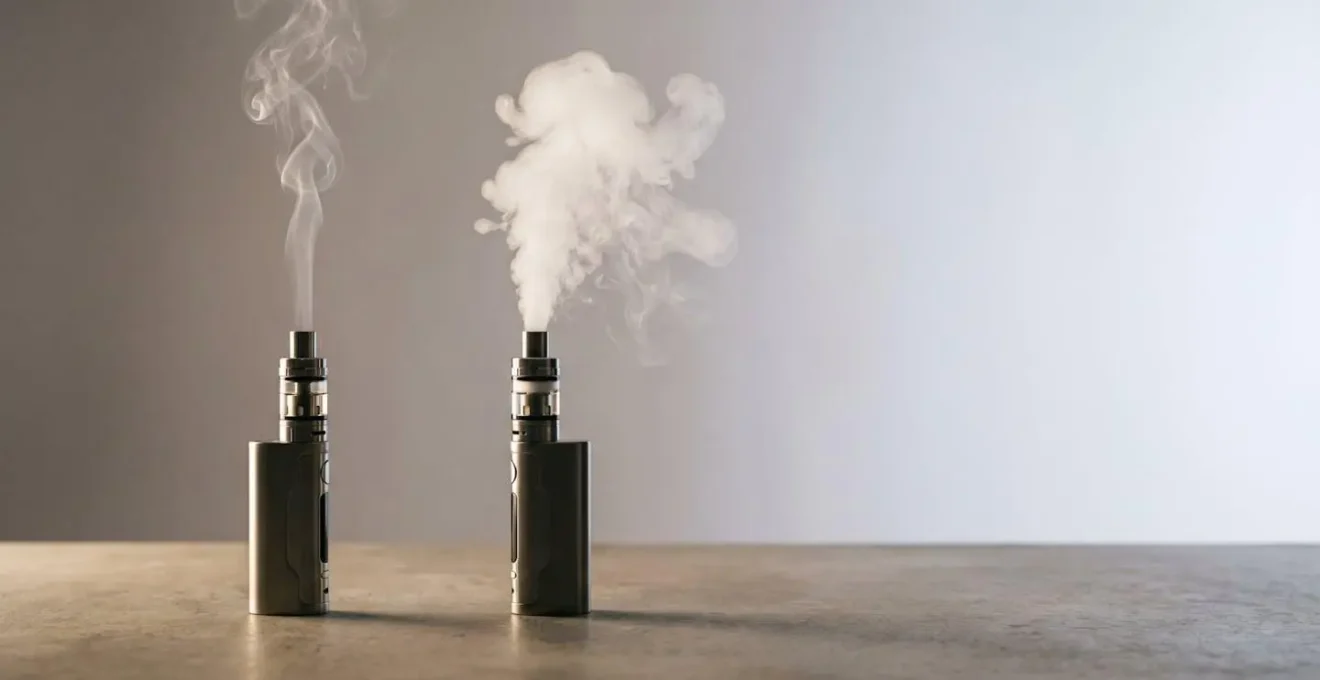
However, this same property is responsible for the less impressive cloud production. The fine aerosol particles that carry flavour so well don’t refract as much light and dissipate into the air much faster than the large, dense particles produced by VG. This creates the characteristic thin, wispy vapour associated with high-PG liquids. The trade-off is clear: you sacrifice visible vapour volume for flavour intensity and a stronger throat hit—a sensation directly linked to PG’s presence.
This dynamic explains why MTL vapers, who prioritise flavour and throat sensation over clouds, naturally gravitate towards liquids with at least a 50% PG ratio. The experience is simply more aligned with their goals.
How to Know Whether Your Throat Irritation Is PG Sensitivity or Just Wrong Settings?
Throat irritation is the most common complaint among new vapers, and PG is often the immediate suspect. However, a true sensitivity is rarer than you might think. While it’s a real condition, epidemiological data suggests that only roughly 3 to 5 percent of vapers experience some degree of PG sensitivity, which can manifest as a persistent sore throat, skin irritation, or sinus issues. For the majority, the harshness is a diagnostic signal pointing towards an imbalance in their setup: either the nicotine strength is too high for the PG ratio, or the device settings are incorrect.
Before concluding you have a sensitivity, it’s crucial to follow a systematic diagnostic process to eliminate other variables. An overly aggressive throat hit is often mistaken for an allergic reaction. This process involves methodically adjusting one variable at a time—power, nicotine, and hydration—to isolate the true culprit. Only after ruling outこれらの common factors should you consider a PG intolerance.
The following checklist provides a structured, four-step approach to determine the source of your throat irritation. By following these steps over a week or two, you can confidently distinguish between a simple settings issue and a genuine sensitivity to Propylene Glycol or specific flavourings. This methodical approach saves you from unnecessarily restricting your e-liquid choices.
Your Diagnostic Checklist: Pinpointing Throat Irritation
- Isolate Device & Hydration: Lower your device wattage by 20-30% and ensure the coil is not burnt. Simultaneously, increase your daily water intake by at least 500ml for 3-5 days. A dry coil or simple dehydration often mimics PG irritation.
- Isolate Nicotine Strength: If irritation persists, reduce your nicotine strength by one level (e.g., from 12mg to 6mg) while using an e-liquid with the same PG/VG ratio. Freebase nicotine is inherently harsh and is amplified by PG.
- Isolate PG Ratio: If the harshness remains, switch to a 50/50 PG/VG blend with your new, lower nicotine strength for one week. A true sensitivity will show marked improvement at this stage as the PG concentration is reduced.
- Final Confirmation Test: For a definitive answer, vape an unflavoured 100% VG base with your usual nicotine strength. If the irritation disappears completely, the issue is confirmed to be either PG or a specific flavouring compound, not the nicotine or your device.
If you complete these steps and still experience discomfort even with a 50/50 blend, you may be part of the small percentage with a genuine sensitivity. At that point, exploring high-VG or even 100% VG liquids is the logical next step.
Why MTL Devices Perform Better With 50% PG or Higher?
The synergy between high-PG e-liquids and Mouth-to-Lung (MTL) devices is not a matter of preference but physics. MTL devices, such as pod systems and starter pens, are specifically engineered to operate at low power, typically between 8 and 18 watts. This is where PG’s chemical properties give it a distinct advantage. As noted by The Vape Cig UK Technical Team, “PG has a lower boiling point and specific heat capacity than VG, which means it vaporizes more efficiently and completely at the lower power levels… typical of MTL devices.” This efficiency ensures that every drop of liquid is properly aerosolised, delivering consistent flavour and nicotine without requiring high temperatures that could burn the wick or degrade the flavour.
The other critical factor is viscosity. High-PG e-liquid is significantly thinner and less viscous than high-VG liquid, which has a thick, syrup-like consistency. This difference is crucial for the wicking process in MTL coils, which have very small juice channels and tightly packed cotton. These designs rely on capillary action—the ability of a liquid to flow in narrow spaces without external forces. PG’s water-like consistency excels at this, rapidly saturating the wick and keeping up with frequent, short puffs.
Case Study: Capillary Wicking Physics in MTL Coils
The physics of wicking clearly demonstrates why high-VG e-liquids fail in typical MTL devices. The high viscosity of VG actively impedes the capillary action required to saturate the small juice channels and dense cotton of an MTL coil. This slow flow cannot keep pace with vaping, especially at the low wattages (8-15W) used, leading to the wick drying out between puffs. The result is a “dry hit”—the unpleasant taste of burnt cotton—and permanent coil damage. In stark contrast, PG’s thin consistency ensures rapid wicking through even the narrowest channels, guaranteeing the coil remains consistently saturated. This prevents coil damage and maintains the integrity of the flavour, making it the ideal partner for low-power MTL hardware.
Attempting to use a thick, high-VG (70% or more) liquid in a standard MTL pod system is a recipe for frustration, leading to poor flavour, frequent dry hits, and a drastically reduced coil lifespan. For these devices, a 50/50 or higher PG blend is a technical requirement, not just a suggestion.
Why High-PG Vaping Makes You Dehydrated Without Warning?
If you’ve ever noticed a persistent dry mouth, a sore throat, or increased thirst after a vaping session, you’ve experienced the most common side effect of Propylene Glycol: dehydration. This isn’t an allergic reaction but a direct consequence of a fundamental chemical property. As the JAC Vapour Medical Advisory clearly states, “Both PG and VG are hygroscopic (they attract water).” This means the molecules of PG in the aerosol you inhale actively bond with water molecules from the saliva in your mouth and throat, drawing moisture away from the surrounding tissues.
This hygroscopic effect is subtle but relentless. Unlike the immediate feedback of a harsh throat hit, the dehydration creeps up on you. You may not notice it during the act of vaping itself, but the cumulative effect throughout the day can lead to a range of symptoms. The most common are a dry, “cotton-mouth” feeling, a slightly sore or scratchy throat that isn’t caused by harshness, and a general increase in thirst. For many, this is the first and only diagnostic signal of their body’s reaction to PG.
The prevalence of this side effect is significant. Comprehensive survey data reveals that approximately 21.7% of vapers reported mild sensitivity to PG, with the primary symptoms being a dry throat or feelings of dehydration. This underscores how widespread the hygroscopic effect is. It’s not a sign of a serious problem but rather an inherent characteristic of the ingredients. The solution is simple and preventative: conscious and consistent hydration. Vapers who use high-PG liquids should make a deliberate effort to drink more water throughout the day than they normally would to counteract this moisture-drawing effect.
Failing to stay adequately hydrated is one of the most common sources of discomfort mistakenly attributed to other causes. Before changing your liquid or device, simply increasing your water intake can often resolve these mild symptoms entirely.
How Long Can You Store a High-PG E-Liquid Before Flavour Degrades?
When it comes to the shelf life of e-liquid, Propylene Glycol is the most stable component in the bottle. Its chemical structure is highly resilient to degradation. In fact, chemical stability analysis demonstrates that pure, unadulterated PG can last for up to 2 to 3 years if stored correctly in a cool, dark place. This inherent stability makes it an excellent base for preserving the other, more volatile ingredients in the mix: flavourings and nicotine.
However, the overall shelf life of your e-liquid is determined by its weakest link, which is almost always the flavouring compounds. These complex organic molecules are susceptible to degradation from heat, light, and oxygen. The type of flavour also plays a significant role in its longevity. Lighter, more volatile notes will fade much faster than heavy, complex ones.
Study: Flavour & Nicotine Stability Over 24 Months
A comprehensive 2024 study published in PMC tracked e-liquid degradation using mass spectrometry. The results showed that volatile top notes like citrus and light fruits began degrading within 6-12 months, even under ideal storage. In contrast, complex bakery and tobacco flavours actually improved for the first 3-6 months—a process known as “steeping”—before degradation started. The most visible sign of aging, however, was nicotine oxidation. When exposed to oxygen, nicotine breaks down, turning the liquid a darker amber or brown and producing a harsh, peppery taste. According to the study, this oxidation occurred regardless of the PG/VG ratio once a bottle was opened and exposed to air. Therefore, while the PG base remains stable, the flavour and nicotine quality will inevitably decline, typically within a year of opening.
For the best experience, store your e-liquids in a cool, dark place like a cupboard or drawer, and aim to use them within 12 months of purchase, especially for fruit-flavoured varieties. The change in colour is the clearest indicator that the nicotine has begun to oxidise and the liquid is past its prime.
High-PG or 50/50 E-Liquid: Which Delivers the Best MTL Throat Hit?
The “throat hit” is the tactile sensation felt at the back of the throat during inhalation, a key part of the experience for many MTL vapers, particularly those transitioning from cigarettes. Both high-PG and 50/50 blends can provide this sensation, but the quality and intensity are markedly different. A high-PG liquid (typically 60% or 70% PG) delivers what the Vaping360 Editorial Team describes as a “sharp, pointed, sometimes ‘scratchy’ hit.” It’s a focused, intense feeling that closely mimics the harshness of a traditional cigarette.
In contrast, a balanced 50/50 blend offers a more “rounded” or “full-bodied” hit. The addition of more Vegetable Glycerin (VG) softens the sharpness of the PG while adding density and volume to the vapour. This creates a sensation that many users find more substantial and satisfying, less like a scratch and more like a gentle, full pressure. The choice between them often comes down to personal preference and, critically, the nicotine strength you are using.
The interaction between the PG/VG ratio and nicotine level is the most important factor in determining the quality of the throat hit. A high-PG liquid might feel perfect with low-strength nicotine but become intolerably harsh at higher concentrations. The following table breaks down these characteristics to help you choose the optimal blend for your needs.
| Nicotine Strength | High-PG (70/30) Throat Hit | 50/50 Blend Throat Hit | Best For |
|---|---|---|---|
| 3-6mg Freebase | Sharp, defined, may feel weak at low nicotine | Balanced, rounded, more satisfying at low nicotine | 50/50 provides fuller experience |
| 12-18mg Freebase | Very harsh, scratchy, often too intense | Strong but smoothed by VG, more tolerable | 50/50 prevents excessive harshness |
| 20mg+ Nic Salts | Intolerable throat irritation even with salts | Smooth high-nicotine delivery, optimal | 50/50 essential for salt formulations |
| Heavy Ex-Smoker (initial transition) | Intense sensation mimics cigarette closely | Slightly less intense but more vapor satisfaction | High-PG for first 2-4 weeks, then 50/50 |
For most users, especially those using nicotine strengths above 6mg or any level of nicotine salts, a 50/50 blend offers the best of both worlds: a satisfying throat hit from the PG, smoothed out by the VG, with good flavour and discreet vapour production.
What Impurities Exist in Non-Pharmaceutical PG and Do They Matter?
The Propylene Glycol used in reputable e-liquids is not just any PG; it is specifically Pharmaceutical Grade (USP/EP). This certification is a guarantee of purity and safety, ensuring the liquid is suitable for human consumption and inhalation. According to Vaping Product Safety Standards, Pharmaceutical Grade PG must be “greater than 99.8% pure.” More importantly, it is rigorously tested to ensure it is free from specific, known toxins. The most critical of these are Diethylene Glycol (DEG) and Ethylene Glycol (EG), both of which are toxic chemicals commonly found in antifreeze and industrial-grade glycols.
The importance of this standard cannot be overstated and is rooted in a pivotal moment in vaping history. Early, unregulated products posed a significant risk, which led to the industry-wide adoption of strict purity standards. Using anything less than pharmaceutical-grade PG introduces an unnecessary and avoidable risk of exposure to harmful contaminants.
Case Study: The 2009 FDA Discovery of DEG Contamination
A 2009 laboratory analysis by the FDA of early e-cigarette cartridges sent shockwaves through the industry. The analysis found detectable levels of the toxic chemical diethylene glycol (DEG) in one cartridge, sparking a major public health scare. This discovery was a stark confirmation that using non-pharmaceutical grade PG could lead to dangerous contamination. The incident served as a catalyst, compelling the nascent vaping industry to self-regulate and adopt USP/EP grade PG as the non-negotiable minimum safety standard. Beyond DEG and EG, low-grade industrial PG can also contain trace amounts of heavy metals like lead and cadmium, as well as residual aldehydes from the manufacturing process. While the acute risk from these trace amounts is low, the long-term effects of inhaling them are unknown and entirely preventable by insisting on verified pharmaceutical-grade sources.
When purchasing e-liquid, always choose reputable brands that are transparent about their ingredients and explicitly state they use USP/EP grade Propylene Glycol and Vegetable Glycerin. This certification is your primary assurance of purity and safety.
Key takeaways
- Propylene Glycol (PG) is a superior flavour carrier due to its low viscosity and ability to form fine aerosol particles, but this results in less visible vapour.
- True PG sensitivity is rare (3-5% of vapers); irritation is more often caused by incorrect wattage, high nicotine, or dehydration from PG’s hygroscopic (water-attracting) nature.
- High-PG liquids (50%+) are physically necessary for low-power MTL devices, as their thin consistency allows for efficient wicking in small coils, preventing dry hits.
Why Do Nicotine Salts Satisfy Cravings in 30 Seconds When Freebase Takes 5 Minutes?
The most significant chemical innovation in vaping is the development of nicotine salts. This formulation solved the fundamental problem of high-strength e-liquids: the intense throat harshness of traditional “freebase” nicotine, which is amplified by PG. The difference lies in the pH level. Freebase nicotine is alkaline, and this high pH is what causes the harsh sensation. Nicotine salts are created by adding a mild acid (like benzoic acid) to freebase nicotine. This reaction lowers the pH, resulting in a much smoother, less irritating form of nicotine that can be inhaled at high concentrations (e.g., 20mg/ml) without causing severe discomfort.
This chemical modification has a profound impact on the user experience, not just in terms of comfort, but in the speed of satisfaction. The primary reason is that the salt form is less volatile. As Dr. Neal L. Benowitz and his team explain, this lower volatility means “a greater fraction of the nicotine in the salt form remains in inhaled aerosol droplets until the aerosol reaches the alveoli for pulmonary absorption.” In simpler terms, more nicotine makes it deep into the lungs where it can be rapidly absorbed into the bloodstream.
This rapid absorption mimics the pharmacokinetic profile of a traditional cigarette far more closely than freebase nicotine. A 2023 pharmacokinetic study confirmed that while freebase nicotine may produce a higher peak plasma concentration, nicotine salts reach their peak concentration significantly faster. This speed is what satisfies cravings almost instantly. Indeed, a clinical study in *Internal and Emergency Medicine* found that the rate of nicotine absorption from nicotine salt e-cigarettes was as rapid as that from a conventional cigarette. This explains why a vaper using a 20mg nic salt pod feels satisfied in under a minute, while someone on 6mg freebase may need to vape for five minutes to achieve the same effect.
Now, armed with this chemical knowledge, you can move beyond guesswork. Evaluate your current e-liquid and device settings to engineer your perfect vaping experience, choosing the right PG/VG ratio and nicotine type to match your specific needs for flavour, throat hit, and satisfaction.